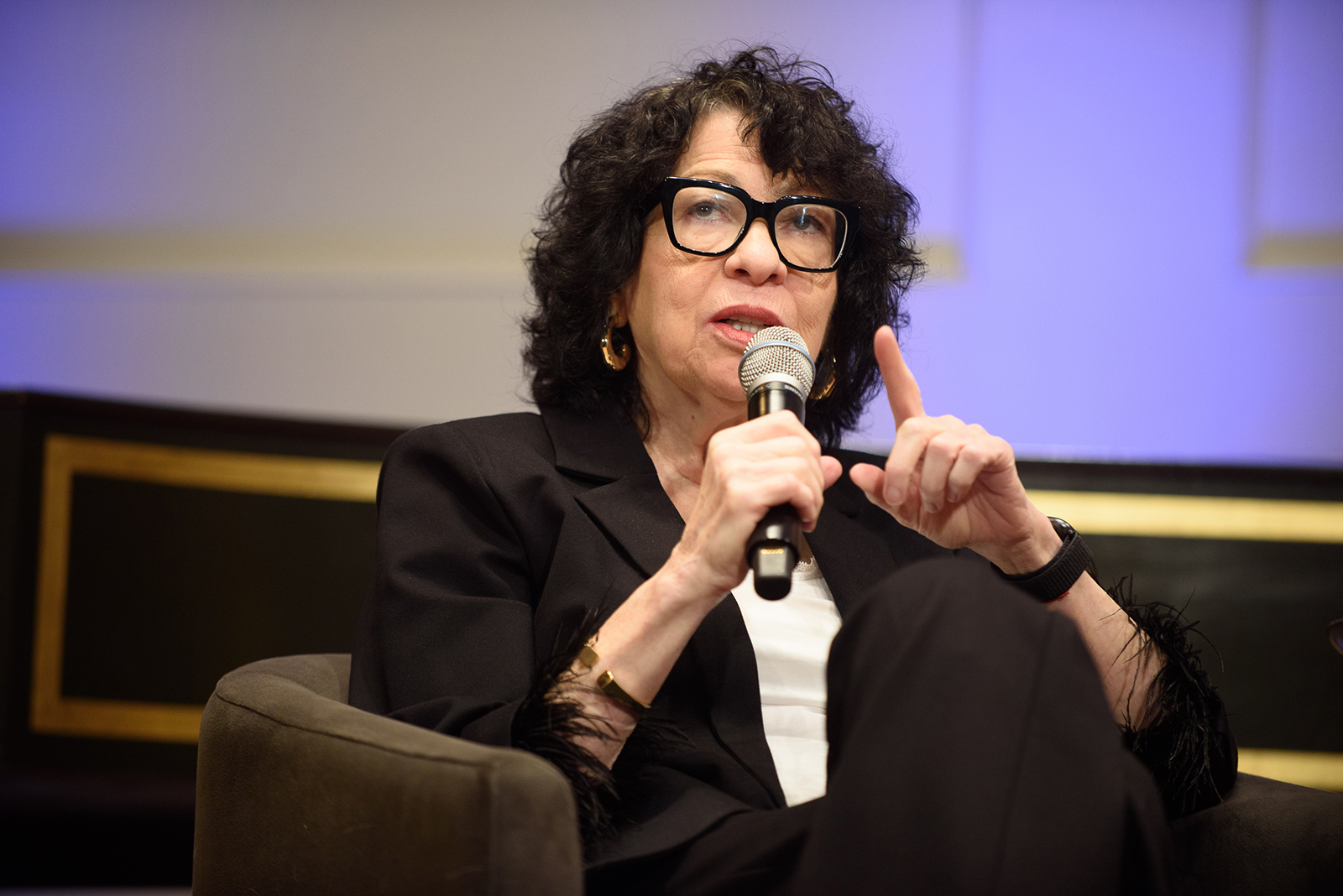
Justice Sotomayor Warns Supreme Court Eroding Legal Norms, Signals Openness to Term Limits
Justice Sonia Sotomayor warned that the Supreme Court is eroding legal norms and signaled openness to term limits during an appearance at the American Philosophical Society in Philadelphia on Friday.
Slaughter, a decision that overturned a 1935 precedent limiting presidential power to remove Federal Trade Commission members, WHYY reported. She called the doctrine a “legal theory on steroids that has just gone off the rails.”
Sotomayor also objected to the court’s expanding use of the emergency docket to issue final rulings without full briefing or lower-court review. “We are making decisions without being assured that all of the relevant legal questions have been actually fully explored,” she told retired Judge David Tatel during the society’s autumn general meeting.
“As with everything else in life, I wouldn’t be unhappy with term limits,” Sotomayor said, adding that many other nations maintain judicial independence without lifetime appointments, CNN reported. The remarks go further than her 2024 comments at the University of Zurich, where she suggested the Constitution might bar Congress from ending life tenure.

Ruling relies on unitary executive theory
The Trump v. Slaughter ruling rested on the unitary executive theory, which posits that the president holds sole authority over the executive branch. The decision discarded Humphrey’s Executor v. United States, the 1935 case that had protected independent agency officials from at-will removal. Sotomayor said the court’s reasoning threatened the structure of independent regulatory agencies.
She acknowledged rulings she viewed as correct, including decisions blocking presidential tariffs and efforts to end birthright citizenship. “There are things to be celebrated, and there’s no question that some rulings were the right rulings,” she said. “Were they all for the right reasons? I don’t know.”
Emergency docket criticism
Sotomayor said the court’s “shadow docket” practice — deciding major cases on emergency applications without oral argument or full records — undermines judicial deliberation. “It is important before the court is making a final decision that we are fully informed, and we’re not being fully informed and we’re making rushed judgments,” she said.
Term limits debate resurfaces
The discussion around structural court reform has intensified after Democrats won control of Congress in the midterm elections, CNN reported. Justice Samuel Alito has stressed the importance of judicial independence since the election without addressing specific proposals.
“Even though poll after poll shows that most liberals and most conservatives support Supreme Court term limits, I don’t believe a majority of the current justices do,” said Gabe Roth, executive director of Fix the Court. “No one in a democracy should serve for 30 or 35 years, as has become the norm, in a position of such power.”
Professional homogeneity on the bench
Tatel, who took senior status on the U.S. Court of Appeals for the D.C. Circuit in 2022, asked whether the court had lost perspective because most justices followed similar career paths. “For sure,” Sotomayor replied. “They’ve forgotten that at the center of every case is people.”
Sotomayor received the society’s Benjamin Franklin Medal for distinguished public service, joining past recipients including Nelson Mandela, Margaret Thatcher, and Bryan Stevenson. The medal was established in 1906 and has honored figures such as Marie Curie, Barbara McClintock, and Francis Crick and James Watson.
Sonia Sotomayor was born in the Bronx in 1954 to Puerto Rican-born parents and graduated from Princeton University in 1976 and Yale Law School in 1979. She served as an assistant district attorney in New York before President George H. W. Bush appointed her to the U.S. District Court for the Southern District of New York in 1991.
President Bill Clinton elevated her to the U.S. Court of Appeals for the Second Circuit in 1998, where she heard more than 3,000 appeals. President Barack Obama nominated her to the Supreme Court in 2009; she became the third woman to serve as an associate justice.
The society, founded by Franklin in 1743, held the session as part of its three-day autumn general meeting featuring research presentations on history, economics, and neuroscience.