
Jupiter’s Size Revised: New Data Reveals Narrower Equator & Flatter Poles
Jupiter, the solar system’s largest planet, is slightly smaller than previously thought, according to novel research published in February 2026. An international team led by scientists at the Weizmann Institute of Science (WIS) in Israel has refined measurements of the gas giant’s dimensions, finding it narrower at the equator and flatter at the poles than earlier estimates suggested.
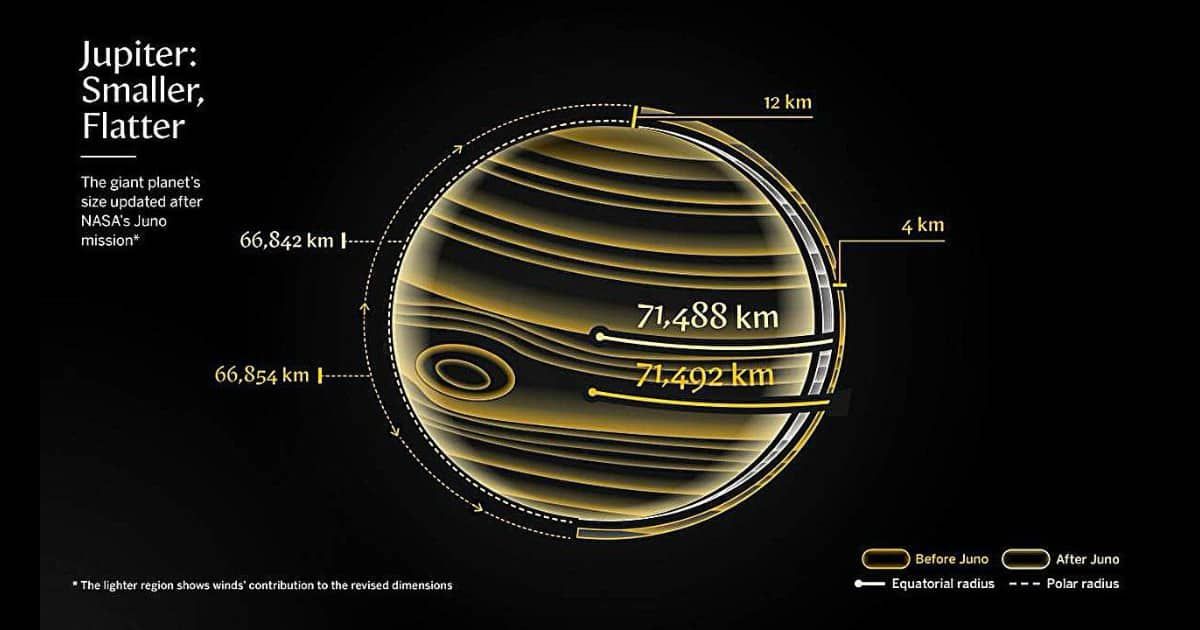
The study, appearing in Nature Astronomy, estimates Jupiter’s polar radius at 66,842 kilometers and its equatorial radius at 71,488 kilometers, both smaller than previous calculations. The mean radius of the planet has also been revised down to 69,886 kilometers. These findings are based on analysis of radio occultation data collected by NASA’s Juno spacecraft, which has been orbiting Jupiter since 2016.
For over 50 years, scientists relied on data from the Voyager and Pioneer missions of the 1970s to understand Jupiter’s size and shape. These earlier measurements, also obtained through radio occultation, indicated an equatorial radius of 71,492 kilometers, a polar radius of 66,854 kilometers, and a mean radius of 69,894 kilometers. However, the WIS-led team, which included researchers from Italy, the US, France, and Switzerland, incorporated more precise data and accounted for factors previously overlooked.
“This work provides the most precise measurement of Jupiter’s size and shape to date, reducing the uncertainty to ~0.4 km using Juno radio-occultation data,” said Yohai Kaspi, lead researcher and co-author of the study at the WIS. He explained that the improved determination of Jupiter’s radius is crucial for modeling the planet’s internal structure and atmospheric dynamics.
Radio occultation involves analyzing how radio signals bend and are delayed as they pass through a planet’s atmosphere. By measuring these changes, scientists can determine the temperature, pressure, and electron density at different depths, and the planet’s shape. The team analyzed 26 radio occultation profiles gathered by Juno over the past 18 months.
A key element of the new analysis was the consideration of zonal winds – powerful east-west winds that encircle Jupiter. These winds penetrate approximately 3,000 kilometers beneath the 1 bar atmospheric pressure level and influence the planet’s shape. “The zonal winds, which blow in the east-west direction, penetrate about 3,000 km beneath the 1bar level and the winds affect the shape throughout this depth,” Kaspi stated. “There are no east-west winds at the poles, and thus there is no effect of the winds on the planetary shape at the pole itself.”
The researchers found that the stronger winds near the equator contribute to a greater bulge, while the absence of such winds at the poles results in a flatter shape. The revised measurements suggest that Jupiter’s outer envelope may be colder and richer in metals than previously thought.
The findings have implications for understanding gas giants both within our solar system and beyond, as Jupiter can serve as a calibration standard for comparative planetology. Future measurements from the European Space Agency’s JUICE mission, scheduled to arrive at Jupiter in 2031, may provide even deeper insights into the planet’s structure, potentially probing down to the 1.5 bar pressure level. However, Kaspi anticipates that these future measurements are unlikely to significantly alter the current understanding of Jupiter’s shape, given the high level of precision already achieved.