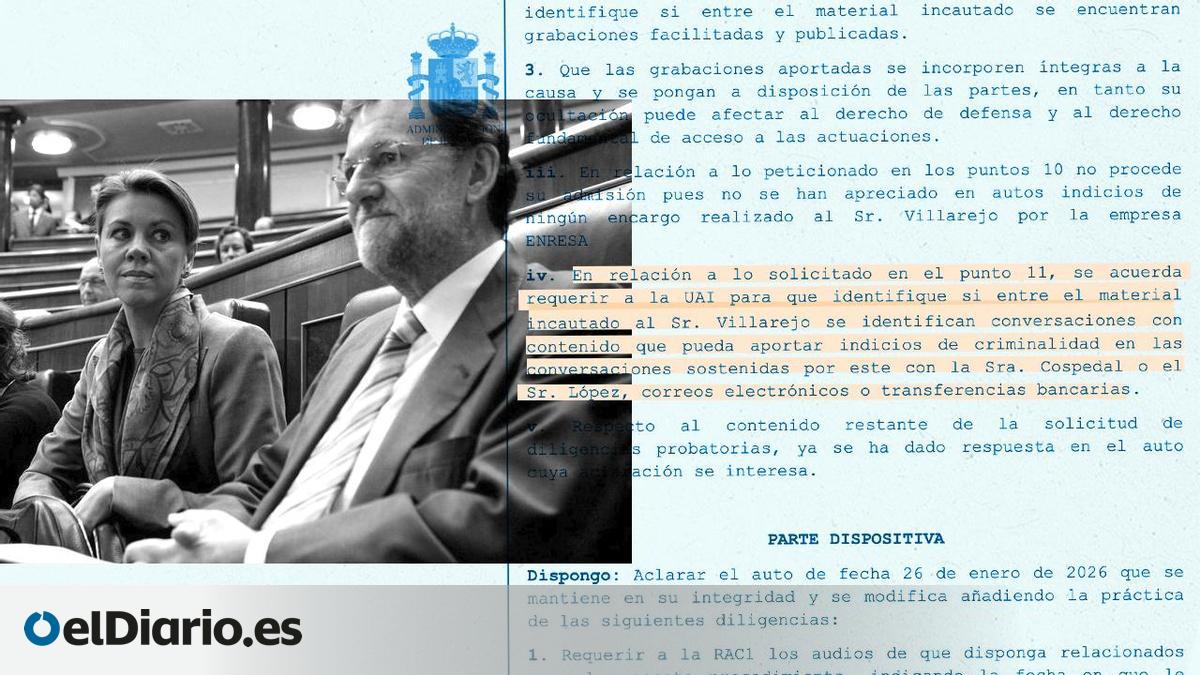
Judge Orders New Investigation Into Rajoy and Cospedal Over Kitchen Case Audios
Judge Antonio Piña has ordered Spain’s Internal Affairs unit to reinvestigate potential criminal links between Mariano Rajoy, former PP Secretary General María Dolores de Cospedal, and Police Commissioner José Manuel Villarejo. The court is specifically seeking to recover and analyze audio recordings from RAC1 and internal police files to determine if illegal payments and evidence tampering occurred during the “Operation Kitchen” espionage scandal.
The move represents a significant legal shift. For years, Rajoy and Cospedal appeared in the Kitchen trial as witnesses. Now, the judiciary is revisiting evidence that suggests the state’s security apparatus was used to “clean” incriminating documents from former PP treasurer Luis Bárcenas to protect the party’s leadership.
The RAC1 Recordings and the “Cleaning” of Bárcenas
Central to this new directive are recordings published by the radio station RAC1 in March 2025. According to court documents accessed by elDiario.es, one specific audio from September 15, 2014, captures a conversation between Villarejo and Cospedal in her office at the People’s Party (PP) headquarters.
In the recording, Villarejo mentions the discovery of “complicated documentation.” Cospedal responds by stating she knows that police had previously found materials and had “more or less cleaned” everything that Bárcenas possessed. When Villarejo questions if the National Intelligence Centre (CNI) was involved, Cospedal explicitly attributes this information to “the president,” stating, “The president told me. No one else told me.”
Because these recordings were not previously valued by the court, Rajoy and Cospedal avoided indictment during the primary Kitchen proceedings. The PSOE’s popular accusation team successfully pushed for this “clarification order,” forcing the judge to admit the audio as evidence.
Tracing the “Under the Table” Payments to Villarejo
Beyond the political cover-up, Judge Piña is targeting the financial relationship between Cospedal and the disgraced commissioner. Internal Affairs must now cross-reference Villarejo’s personal agendas with bank transfers and emails to verify alleged bribes.

Villarejo’s handwritten notes provide a granular timeline of these transactions:
- December 6, 2012: Villarejo noted that Cospedal provided “full support” and sent José Luis Ortiz (Cospedal’s then-chief of staff) with 100 and promised 50 more on the following Monday.
- September 14, 2014: During a meeting at the Hotel Orfila and later at the PP headquarters, Villarejo recorded that Cospedal “promises to pay the debt of 100.”
The head inspector of Internal Affairs testified during the Kitchen trial that Villarejo’s method of work on his agendas was to compare notes with verifiable facts, concluding: “The señor Villarejo does not deceive himself. They were for internal consumption.”
The Mystery of “Piece 34” and Encrypted Evidence
The legal battle is further complicated by the existence of “Piece 34,” a judicial warehouse for audio files. This section of the case contains recordings leaked via Telegram by the ultra Alvise and documents provided by businessman Javier Pérez Dolset.
A critical failure in the previous judicial phase was revealed: an Internal Affairs report had already warned that an annex containing “MDCospedal” audios existed for the court’s valuation. That valuation never happened. Legal sources indicate it is a mystery if all these hours of recording belong to the approximately 50% of Villarejo’s recordings that remain encrypted within the Audiencia Nacional.
The implications extend to other high-ranking officials. Other recordings from 2017 suggest Cospedal ordered Villarejo to stop the publication of Bárcenas’s “B-accounting” ledgers. Another audio reveals that former Interior Minister Jorge Fernández Díaz delivered UDEF reports on the caja B and Gürtel cases to Cospedal just one day before they reached the judge.
Jurisdictional Impact and Legal Precedents
If Judge Piña finds evidence of criminal conduct in the new Internal Affairs report, he can open a separate cause independent of the Kitchen case, allowing for the formal investigation of Cospedal and her former husband, Ignacio López del Hierro.

The State Attorney’s Office has affirmed that Kitchen sought to protect Rajoy and remove “papers that compromised him” from Bárcenas.
The trial’s conclusion, scheduled for July 30, looms as a deadline for these findings. Whether these audios will finally transition Cospedal and Rajoy from witnesses to defendants depends on the Internal Affairs report.