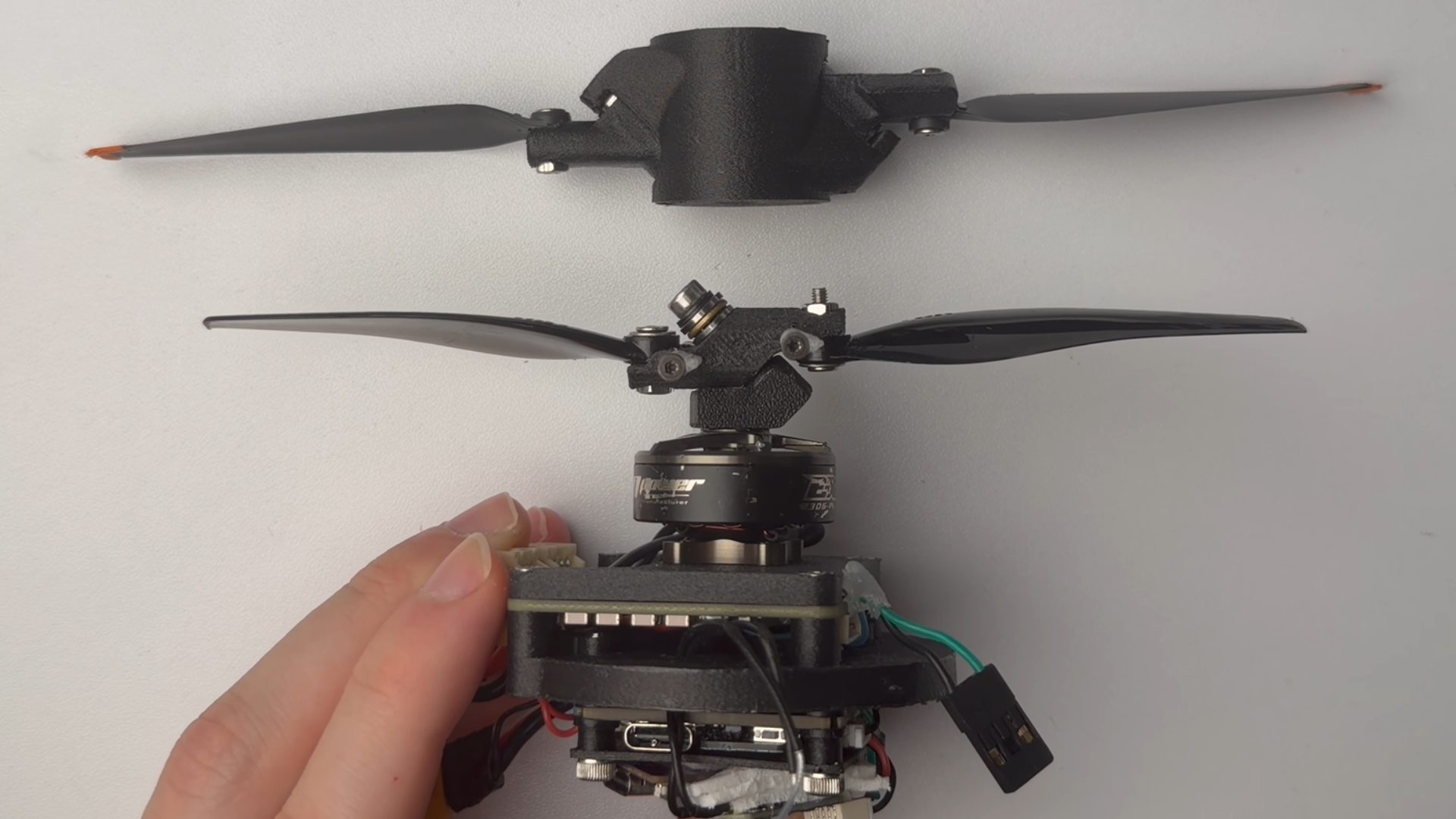
Joshua Bird designs tiny single-motor drone
Software engineer and drone enthusiast Joshua Bird has designed, built, and flown a tiny single-motor drone inside a bedroom, utilizing a hinged propeller and custom firmware to maintain stability without a traditional swashplate or secondary tail rotor. Tom’s Hardware reported on the prototype, which achieves motor speed adjustments in under 0.2 milliseconds.
Engineering a Single-Motor Flight System
Rotary-wing aircraft traditionally rely on complex mechanical assemblies to manage torque and steering. Most helicopters and quadcopters utilize swashplates to alter rotor disk attitudes alongside secondary rotors to counteract engine torque. Bird eliminated these secondary mechanisms by programming rapid changes to a single motor’s rotation speed. Speeding up the motor generates reaction torque in one direction, while slowing it down applies an opposing force. This continuous balancing act manages the overall torque on the drone’s body.

Directional control relies on a mechanical configuration where each rotor blade sits on a 45-degree hinge. As the motor accelerates, one blade pitches upward to increase lift while the other pitches downward to decrease it. By modulating motor acceleration, the system controls roll and pitch. Mezha.net noted that main rotor torque adjustments and 3D-printed stabilizing fins combine to produce effective yaw control.
Custom Camera Setup Leads to Propeller Redesign
The development process required extensive troubleshooting to achieve stable flight. Bird constructed a high-speed camera using a Sony camera and a flash unit controlled by a microcontroller linked to the drone’s motor controller and camera shutter. Footage from this custom setup revealed that the initial propellers were too flexible, prompting a redesign using sturdier 3D-printed filament.
Initial test flights launched from a bed resulted in multiple crashes and some wall damage during programming adjustments. The prototype eventually achieved stable flight, though its navigation remains restricted. The current build relies on a fixed-base infrared beacon navigation system, limiting operation to the bedroom environment. Bird indicated plans to integrate a linear camera to enable outdoor and multi-environment flight.
Project Documentation Available on GitHub Repository
While other engineering teams have developed micro-drones, including a mosquito-sized unit revealed in China, Bird’s project demonstrates an alternative approach to mechanical simplification through software execution. The complete project documentation, including firmware and design files, remains available via the Single Propeller Drone GitHub repository for developers examining single-rotor dynamics.