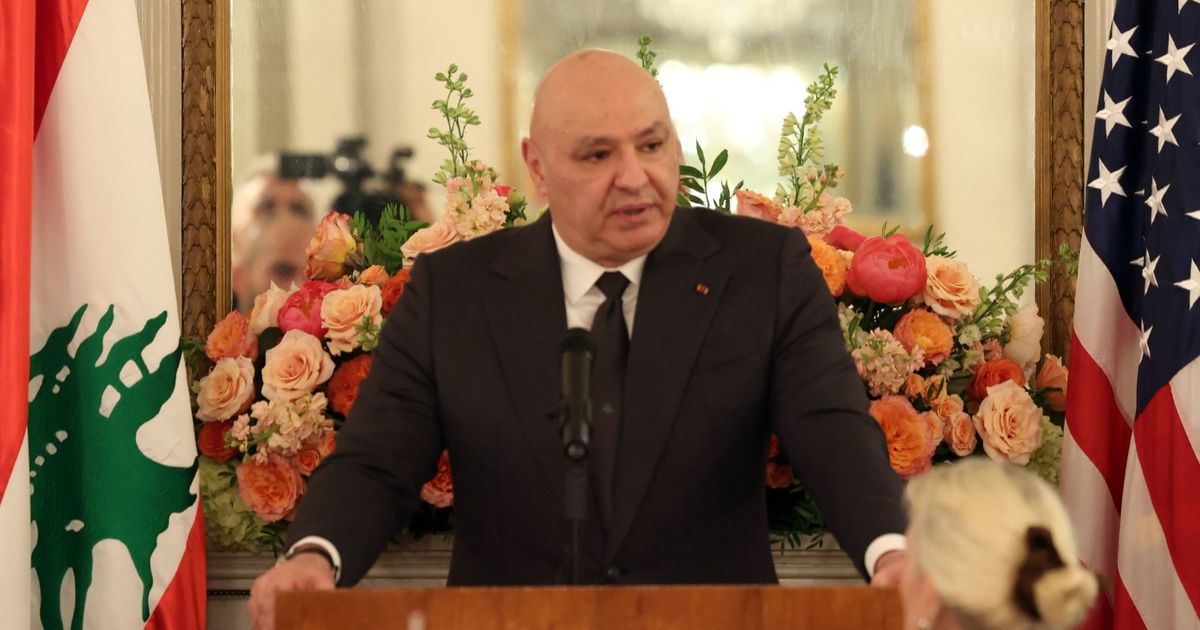
Joseph Aoun dismisses reports on Lebanon’s ambassador to the US
On October 15, 2026, Lebanese President Joseph Aoun stated that circulating media reports regarding Lebanon's ambassador to the United States, Nada Hamadeh Muawad, were entirely disconnected from reality and truth, as reported by ashrq.com.
Presidential Rejection of Allegations at Baabda Palace
The controversy stemmed from an unverified report broadcast by an Israeli news channel claiming that Ambassador Muawad had contacted the Israeli ambassador in Washington to check on the health of his son, a soldier injured in Gaza, according to annahar.com. A lawyer aligned with Hezbollah subsequently filed a complaint with the military judiciary asserting that the ambassador violated Lebanon's law boycotting Israel, annahar.com noted. The complaint relied upon a post published by a media platform affiliated with Hezbollah alleging that the ambassador called the Israeli ambassador in Washington to check on the health of his son, a soldier in the Israeli army who was wounded in the Gaza Strip. However, Elnashra reported that Government Commissioner to the Military Court Judge Claude Ghanem decided to dismiss the complaint filed by lawyer Hassan Adel Bzi against Ambassador Muawad due to the absence of any criminal offense. President Aoun stated: If the goal of whoever is doing this is to target the path we have taken to end the state of war and save Lebanon, then he is a criminal against the country.

Divergent Regional and Institutional Reactions to the Ambassador
The United States State Department issued a strong statement condemning the referral of the complaint to Lebanon’s military judiciary, calling it deeply unsettling that a diplomat executing legitimate state policy and participating in U.S.-led negotiations faced such targeting, alarabiya.net reported. A spokesperson for the U.S. State Department remarked in statements to Al Arabiya that Washington was aware of the complaint submitted by a lawyer loyal to Hezbollah against the Lebanese ambassador to the United States, adding: It is unsettling that a military court would consider a complaint against the Lebanese ambassador in Washington for carrying out her lawful government policy and participating in U.S.-led negotiations.
The U.S. agency argued that military judicial resources should instead target Hezbollah elements conspiring against the Lebanese state, with the spokesperson noting that the Lebanese military judiciary ought to employ its limited resources to pursue Hezbollah elements conspiring against the government and people in Lebanon rather than pursuing those who work on their behalf. Furthermore, the U.S. State Department called for the abolition of laws and practices allowing for the political targeting of civilians and diplomats in Lebanon, stating that laws and practices enabling this type of politicized targeting must be eliminated while providing, according to the statement, systematic protection for Hezbollah elements,
and concluded its stance by emphasizing that Washington no longer has any patience for such obstruction.
Conversely, Change Movement leader Elie Mahfoud defended the diplomat on social media, asking who poses a greater threat to national security: an official state representative in Washington or a militia leader operating outside state institutions, mtv.com.lb reported. Mahfoud further questioned how a formal representative of the state could be questioned while a militia leader threatening the state, its sovereignty, and the security of its people remains untouched, adding that the comparison is not between two individuals but between two situations—a diplomat representing the Lebanese state and the leader of an armed organization imposing his formula on the state—and praised the Ministry of Foreign Affairs for its statement cutting off any attempt to suggest the possibility of prosecuting the ambassador or turning her execution of her official mission into an issue.
President Aoun Says Diplomatic Negotiations Continue Despite Economic Stalls
Addressing broader national concerns during his university meeting, President Aoun maintained that ongoing diplomatic negotiations aimed at halting the war have not stopped, despite regional delays and Israeli electoral schedules, ashrq.com reported. Projected 6% growth for the current year was stalled by the conflict, while rising oil prices were driven by regional Gulf hostilities and commercial profiteering rather than domestic policy, ashrq.com added.
