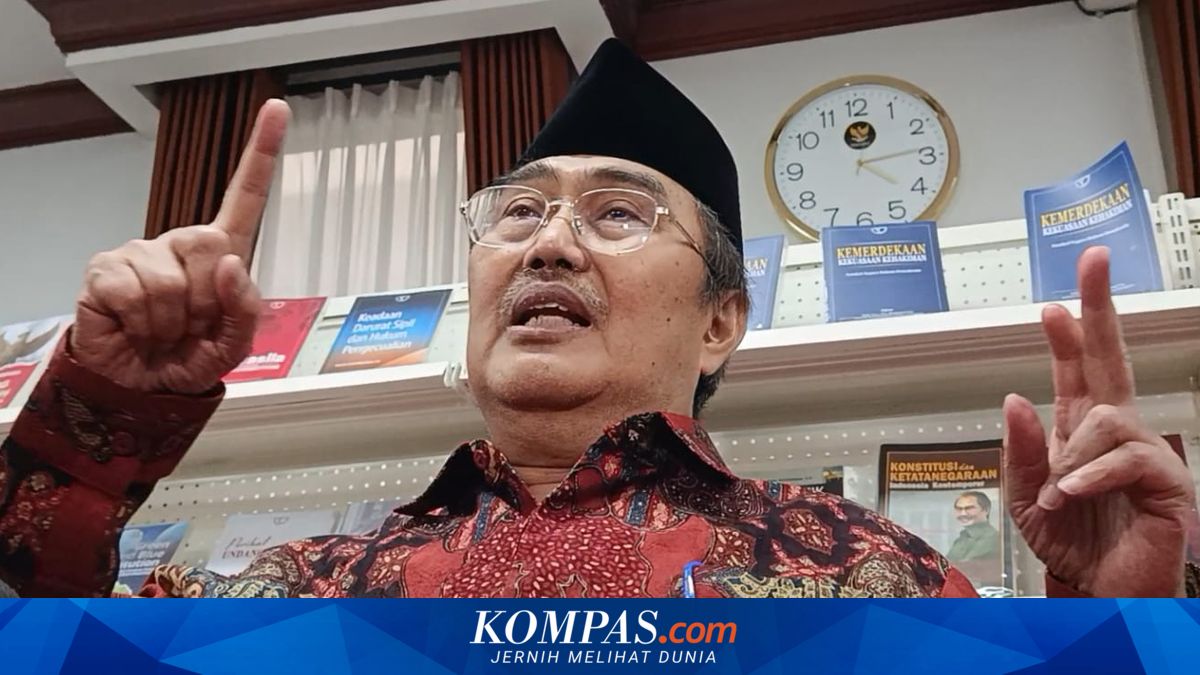
Jimly Asshiddiqie: Gibran Resignation Needs MPR Decree for Accountability
Gibran Rakabuming Raka’s declaration that he was “stopping” his duties as Vice President on November 12, 2026, does not satisfy the requirements of constitutional law, according to expert Jimly Asshiddiqie.
Addressing the People’s Consultative Assembly (MPR) Ad Hoc Committee on Vice Presidential Selection in Jakarta on Wednesday Jimly argued that public office is a mandate that cannot be surrendered through a private statement alone, according to Kompas.
To ensure administrative accountability, Jimly asserted that the MPR must issue a formal decree to finalize the departure, according to detikNews. He suggested that the document should explicitly record the resignation as a voluntary act, distinguishing it from a forced or dishonorable removal.
“Therefore, I agree that this dismissal must later be made through an official MPR decree,” said Jimly, as reported by nasional.kompas.com.
The expert drew a line between the current situation and the 1998 resignation of President Soeharto. He said that today’s democratic framework, where officials are elected directly by the public, demands a more rigorous administrative process. He warned against treating public office as a private right that can be abandoned without explanation, according to kumparan.
“Masa begitu saja ‘mulai hari ini saya berhenti’,” said Jimly, emphasizing the need for clear administrative accountability during his presentation at the parliamentary complex in Senayan.
Establishing Accountability for Public Office
Beyond the procedural requirements for resignation, Jimly told detikNews that Gibran no longer meets the qualifications for the vice presidency following recent rulings by the Constitutional Court and the Supreme Court. He argued that these developments provide a basis for impeachment proceedings, which he framed as a necessary mechanism to demand accountability for the performance of the office.
“Legally speaking, the logic is that it is finished. But there must be an accountability mechanism, at the very least administrative accountability,” Jimly told Antara News.

Jimly also identified the “Fufufafa” social media account as evidence of “perbuatan tercela” or disgraceful conduct, suggesting that this provides an easier path for proving grounds for impeachment beyond the constitutional qualifications. He said that the current legislative body should not hesitate to utilize the “Hak Menyatakan Pendapat” (HMP) process to address these concerns.
As the MPR works to establish a formal protocol for the transition, legal experts within the committee have pointed out that existing constitutional provisions do not specifically outline the mechanics for such a resignation, reported pantaucom.
“Kami buka-buka konstitusi dan undang-undang tidak mengatur soal ini,” said committee member Benny, noting that the status of a vice president is distinct from that of a civil servant. “Ini kan bukan PNS, ini adalah wakil presiden,” he added.
The committee continues to gather input to bridge these procedural gaps, particularly as the administration of President Prabowo Subianto faces this vacancy only two years into its term. The current uncertainty regarding the resignation process leaves the question of whether an official, voluntary withdrawal can be legally finalized without a formal MPR decree still unresolved by the legislative body.
Formalizing the Resignation Through MPR Decree
Jimly contrasted this requirement with Western liberal philosophies, arguing that Indonesia’s democracy mandates that public office be treated as a public trust rather than a personal right.
He warned that allowing an official to simply announce their resignation without formal accountability would undermine the nature of the vice presidency. By issuing a Tap MPR, the assembly would provide the necessary legal closure to the vacancy while maintaining the integrity of the office’s administrative history.
Jimly Asshiddiqie is a distinguished professor of constitutional law whose authority on the vice presidential resignation process stems from his extensive history shaping Indonesia’s legal framework.
His expertise is grounded in his tenure as the first chief justice of Indonesia’s Constitutional Court from 2003 to 2008, where he presided over the nation’s highest judicial body. Furthermore, his deep involvement in the transition to democracy provides him with unique insight into the mechanics of governance.
During 1998–1999, Jimly served as the person in charge of the Constitutional Reform Panel, playing a critical role in drafting the amendments to the 1945 Constitution that established the modern democratic system.
Meanwhile, the legislative body is moving toward a replacement. President Prabowo Subianto has submitted Agriculture Minister Andi Amran Sulaiman and Coordinating Minister for Human Development and Culture Sugiono as candidates for the vacancy, according to nasional.kompas.com. The assembly has scheduled a plenary session to elect and inaugurate the new vice president on December 11, 2026.
- Paris Basketball Beats Besiktas for 7th Straight Win; ASVEL Loses 7th Overall to Milan
- New ‘Fandemonium’ Episode Spotlights Six Foo Fighters Fans Reshaped by Band
- SpaceX Share for Every Kid Needs a Charity and Treasury's Approval (daybreakwire.com)
- Anwar Has Not Accepted Loke’s Resignation, Instructs Leave (archyde.com)