Japan Scrambles Jets After Russian Aircraft Violate Airspace
Two suspected Russian aircraft violated Japanese airspace northwest of Okinoshima Island early Tuesday morning, prompting Japan to scramble fighter jets and lodge a formal protest with Moscow, the country’s Defense Ministry said.
The intrusions lasted roughly three minutes each, between 4:07 a.m. and 4:12 a.m. local time, according to Japan’s Defense Ministry. Defense Minister Shinjiro Koizumi confirmed the breaches at his press conference on Tuesday. Sourced accounts differ on the day of the incursion: USNI News places the violations on Thursday, while Kyodo, Jiji Press and Deutsche Welle all report Tuesday, matching the ministry’s announcement.
It matters because it is the first confirmed Russian airspace violation since September 2024, when an IL-38 maritime patrol aircraft entered Japanese territory three times north of Rebun Island in Hokkaido. It also lands at a moment when Tokyo-Moscow relations are deteriorating on several fronts at once.
“The violation of our national airspace by Russian aircraft is not only a serious infringement of our country’s sovereignty, but also a threat to our security and is completely unacceptable,” said Minoru Kihara, Japan’s chief cabinet secretary, at a press conference.
Five minutes over the East China Sea
The first suspected Russian aircraft entered Japanese airspace northwest of Okinoshima between 4:07 and 4:10 a.m., Koizumi said, according to a transcript of his conference published by USNI News. A second aircraft crossed into the same zone between 4:09 and 4:12 a.m.
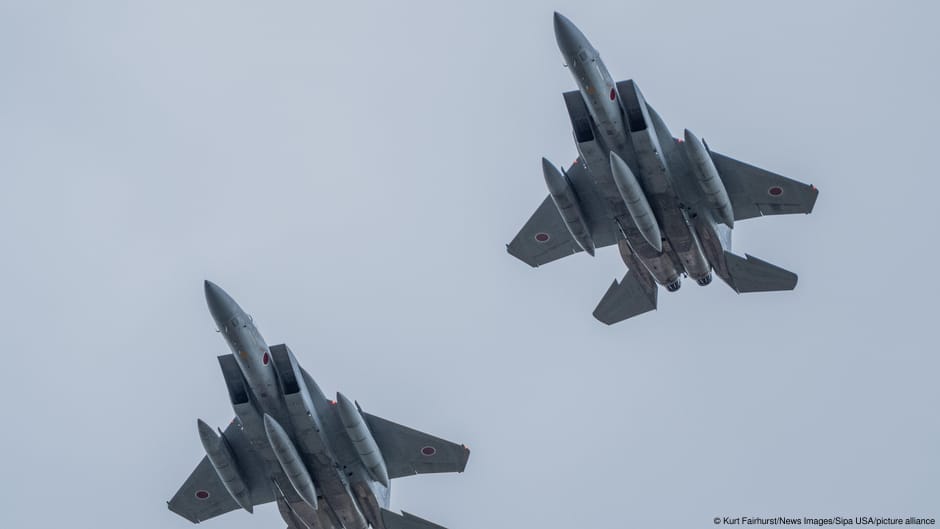
Japan Air Self-Defense Force fighters from the Western Air Defense Command scrambled in response and issued radio warnings. Japanese crews could not visually identify the aircraft type, USNI News reported. The ministry did not say how many fighters launched.

After leaving Japanese airspace, the aircraft flew through the Tsushima Strait between Kyushu and the Korean Peninsula, passed between Yonaguni Island and Taiwan, and continued into the Philippine Sea. South Korea separately said several Russian military aircraft entered its air defense zone in the early hours of Tuesday, prompting Seoul to deploy fighters and conduct tactical maneuvers.
A route across three defense zones
An ADIZ is not sovereign airspace. It begins where territorial airspace ends — 12 nautical miles from a coastline under international law — and marks a buffer in which countries track approaching aircraft for security reasons. Fighters routinely scramble to shadow foreign aircraft until they exit. The zones are not recognized under international law, but Japan, South Korea and Taiwan all maintain them.
“Whilst it is difficult to state with certainty the intent or purpose behind the Russian aircraft’s actions on this occasion, the Ministry of Defense and the Self-Defense Forces will, in any case, continue to monitor Russia’s military movements with the utmost attention,” Koizumi said, according to the transcript carried by USNI News.
Where the trail points: Vietnam
USNI News adds a detail the other accounts leave out: later that same day, two Tu-95MS bombers and two IL-76 transports landed at Da Nang International Airport in Vietnam, according to local aviation spotters. A Da Nang-based community social media page posted photos and video of the four aircraft parked at the airport. Neither Moscow nor Hanoi had issued an official statement as of publication.

There is precedent for such deployments. In 2015, Reuters reported that the United States had asked Vietnam to stop allowing Russian tanker aircraft to use Cam Ranh Bay, where they refueled bombers flying provocative routes near Guam.
The last known Russian bomber deployment to Southeast Asia came on Dec. 5, 2017, when two Tu-95MS bombers and two IL-76 transports landed on Biak Island, Indonesia. Indonesia’s air force called it a navigation exercise; Russia’s Defense Ministry said the bombers refueled in the air over the Pacific.
Why ties with Moscow are souring now
The incursion did not happen in a vacuum. Kyodo reports that Russia has been stepping up pressure on Japan as it opposes the sanctions Tokyo imposed over the war in Ukraine.
In August, President Vladimir Putin made his first visit to a Russian-held, Japanese-claimed island off Hokkaido. In October, Russian authorities detained a Japanese journalist in the Far East on spying allegations. And this month, presidential decrees placed Russian assets of Japan Tobacco Inc. under state control.
Russia has simultaneously left open the possibility of talks between Japanese Prime Minister Sanae Takaichi and Putin on the sidelines of an international conference in China this week, Jiji Press reported. Jiji’s assessment: the incursion may have been intended to increase pressure on Japan ahead of any such meeting.
Tokyo lodged what Kihara called a “very stern protest” through diplomatic channels and demanded measures to prevent any recurrence, per Deutsche Welle. The two governments also carry a decades-old dispute over the ownership of several Pacific islands, a friction point that has deepened since Japan joined sanctions in 2022.
What Japan is watching, and what comes next
Koizumi framed the violation as both a sovereignty breach and a security threat, and pledged continued vigilance and “appropriate responses to airspace violations,” USNI News reported. The 2024 Rebun Island incident shows how Tokyo’s responses have hardened: on that occasion, F-15J and F-35 fighters scrambled and discharged flares after the Russian aircraft appeared to ignore warnings — the first time Japan had released flares at a foreign aircraft.
This week’s episode drew no flare discharge, and no aircraft type has been confirmed. For businesses, shippers and residents in southwestern Japan — Fukuoka Prefecture, the Tsushima Strait corridor and islands such as Okinoshima and Yonaguni — the practical takeaway is that the routes Russian military aviation uses pass directly over fishing grounds, commercial flight paths and island communities, and local authorities track each scramble.
The next dated marker on record is the possible Takaichi-Putin encounter at the conference in China this week. Whether the two leaders meet at all, days after Japanese fighters scrambled over Okinoshima, will say much about where this relationship is heading.