James Webb Telescope Detects Water Near Milky Way’s Supermassive Black Hole
Water Detected Surprisingly Close to Our Galaxy’s Supermassive Black Hole
Using the James Webb Space Telescope (JWST), astronomers have detected water and cosmic dust around an aging star located 0.55 light-years from Sagittarius A* (Sgr A*), the Milky Way’s supermassive black hole. This discovery suggests that water and dust can form and survive surprisingly close to a supermassive black hole, according to a study published Aug. 11 in the journal Astronomy & Astrophysics.
The Tech TL;DR:
- JWST’s Mid-Infrared Instrument (MIRI) observed water in the environment surrounding Sgr A*.
- The detection of silicate dust and water around IRS 3, an asymptotic giant branch star, suggests dust production remains resilient near supermassive black holes.
- The results could aid astronomers in comprehending the recycling of material within galactic centers and the contribution of evolved stars to supplying these areas with new dust and molecules.
Architectural Breakdown: JWST’s MIRI and Extreme Environment Observations
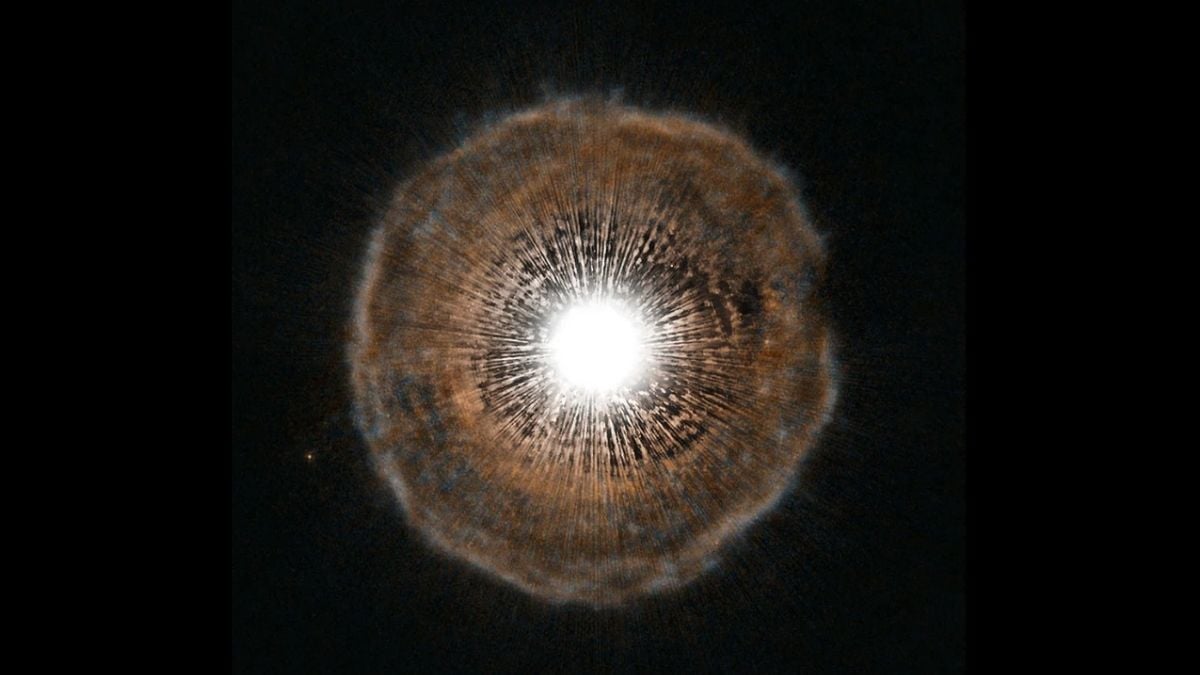
The James Webb Space Telescope’s Mid-Infrared Instrument (MIRI) enabled the detection of water and dust around IRS 3, an aging star located 0.55 light-years from Sgr A*. Researchers reconstructed the structure of the star’s envelope, finding a layered, shell-like distribution of silicate dust extending roughly 10,000 astronomical units from the star. The temperature in the envelope decreases from approximately 1,700°F (927°C) close to the star to roughly -280°F (-173°C) in the outer parts.
“Galactic centres are among the most extreme environments, so understanding whether stars can continue enriching their surroundings there is an important question,” said Florian Peißker, lead author of the study from the University of Cologne in Germany. “With Webb, we can directly observe how stars behave under these conditions and see that dust production remains remarkably resilient.”
Technical Implementation: Analyzing Dust Envelopes with Spectral Data
The research team combined MIRI spectroscopy with simulations of how the star’s light travels through different models of the surrounding material to reconstruct the structure of the star’s envelope. The observations revealed clear evidence of water within the envelope.

Implications for Galactic Evolution and Interstellar Chemistry
The discovery has implications for models of galactic evolution, particularly the role of asymptotic giant branch stars in enriching the interstellar medium. The location of IRS 3 near Sgr A* indicates that aging stars can still enrich their environment despite the extreme conditions near a supermassive black hole.
“The detection of water is especially exciting because it shows that molecular material can survive in an environment dominated by intense radiation,” said Macarena Garcia Marin, co-author of the study and an ESA astronomer.
Comparative Analysis: JWST vs. Hubble in High-Radiation Zones
The observations indicate that water and dust can form and endure remarkably near a supermassive black hole, an environment where intense radiation and other harsh conditions would typically eliminate them.

Future Work: Mitigating Radiation Effects in Deep-Space Observations
These findings may assist astronomers in understanding the recycling of material in galactic centers and the role of evolved stars in providing these areas with new dust and molecules.
FAQPage