Jackie Chan Makes Rare Public Appearance With Son Jaycee Chan in China
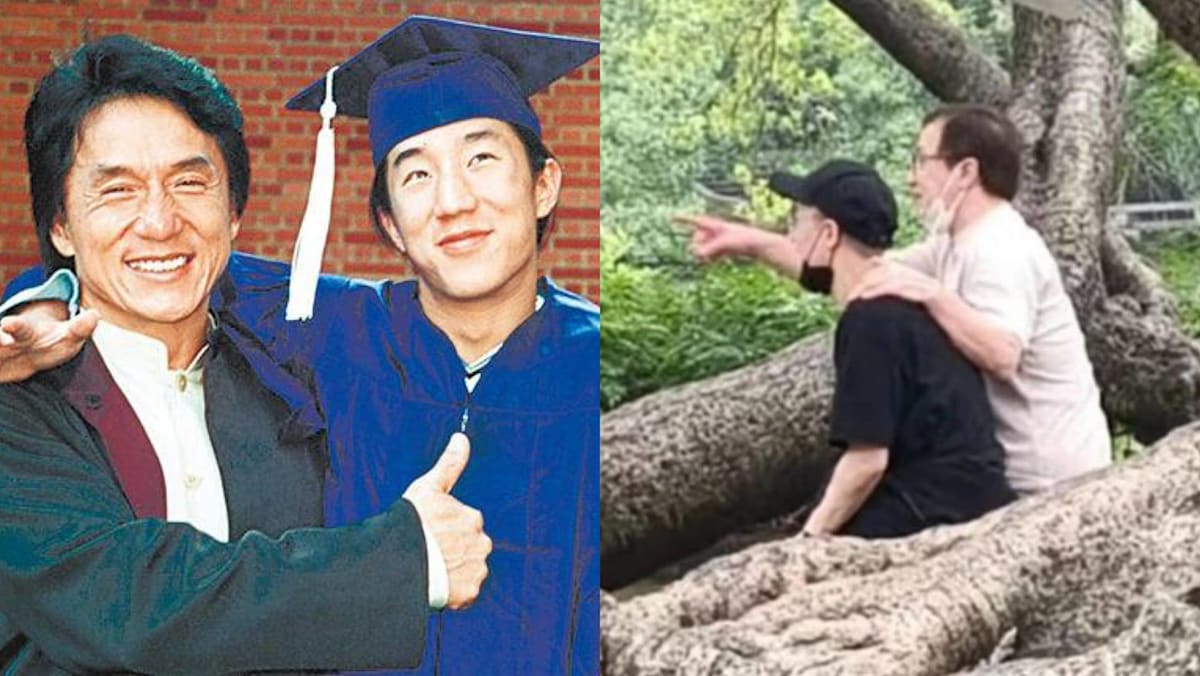
Jackie Chan, 72, was recently spotted in Huizhou, China, with his 43-year-old son Jaycee Chan. The pair, previously estranged, were seen in an affectionate moment at the Su Dongpo Memorial Site, signaling a public reconciliation just days after Jackie’s birthday on April 7, 2026.
In the high-stakes world of global celebrity, a photograph is rarely just a photograph; it is a strategic asset. For a figure like Jackie Chan, whose brand equity is built on a foundation of discipline, family values, and an almost superhuman public persona, the narrative of a fractured relationship with his son has been a lingering smudge on an otherwise pristine legacy. The recent sightings in Guangdong are more than a heartwarming family reunion—they represent a critical pivot in the management of the Chan family’s public image.
The optics of the encounter, captured by netizens and reported across outlets like 8days and The Star, are meticulously poignant. The father and son were seen resting under a tree at the Su Dongpo Memorial Site, with Jackie’s arm draped around Jaycee’s shoulder, pointing toward the horizon while Jaycee listened attentively. This specific imagery—the mentor and the protégé, the patriarch and the heir—serves to rewrite the history of their estrangement in real-time. When a global icon seeks to mend a public rift, the transition from “estranged” to “affectionate” is often managed with the precision of a studio rollout. Such shifts in narrative typically require the intervention of crisis communication firms and reputation managers to ensure the reconciliation feels organic rather than orchestrated.
The Strategic Weight of the Su Dongpo Memorial Site
The choice of location is not incidental. By appearing at the Su Dongpo Memorial Site in Huizhou, the Chans have anchored their reconciliation in a place of cultural and intellectual significance. Su Dongpo is a symbol of resilience and poetic reflection in Chinese history. For Jackie Chan, who has spent decades navigating the complex intersection of Hong Kong’s cinematic output and mainland China’s cultural expectations, this setting adds a layer of gravitas to the reunion. It elevates the story from a tabloid “spotted” piece to a narrative of cultural continuity and filial piety.
“The public’s reaction to these sightings—described by bystanders as ‘touched’—indicates that the ‘redemption arc’ is playing out exactly as intended. By moving the reunion away from the flashing lights of a press conference and into a serene, cultural landmark, the brand moves from ‘celebrity gossip’ to ‘human interest.'”
This move effectively shields the family from the cynicism of the entertainment press. It is a masterclass in soft-power branding. While the world sees a father and son patching things up, the industry sees a stabilization of the family’s intellectual property. The “Jackie Chan” brand is not just about stunts and slapstick; it is a multi-generational legacy. Any perceived instability within the family unit is a liability that can affect endorsement deals and the perceived longevity of the Chan cinematic empire.
Navigating the Shadow of a Global Icon
For Jaycee Chan, now 43, the challenge has always been the sheer scale of his father’s shadow. Being the son of a martial arts legend is a double-edged sword: it provides an immediate platform but creates an impossible benchmark for success. The reports from KbizoOm highlight this perpetual struggle—life in the shadow of a global icon. For Jaycee, this public reconciliation is as much about professional viability as it is about personal healing. In the Asian entertainment market, the endorsement of the patriarch is often the most valuable currency a younger actor can possess.
The rare public appearance of the duo in China suggests a realignment of their professional and personal trajectories. In an era where SVOD platforms and global streaming are hungry for “legacy” content and family-driven narratives, a unified Chan front is far more marketable than a divided one. The industry observes these movements closely, as they often precede joint ventures, documentary projects, or a strategic hand-off of brand leadership.
Managing the logistics of such a high-profile reconciliation in a public space like Huizhou is a daunting task. The presence of “onlookers” and “netizens” suggests a level of accessibility that is risky for stars of this magnitude. Ensuring the safety of the principals while allowing just enough “organic” leakage of photos to the public requires a sophisticated layer of regional event security and logistics experts. The goal is to create the illusion of a private moment that just happens to be witnessed, rather than a staged photo-op.
The Business of the 72nd Birthday
The timing of this reunion—occurring just before Jackie Chan’s 72nd birthday on April 7—is the final piece of the puzzle. Birthdays for icons of this stature are not merely personal milestones; they are brand anniversaries. They are moments when the media reflects on the artist’s contributions to cinema and their standing in the global zeitgeist. Entering his 72nd year with his son by his side is a powerful statement of closure and wholeness.

From a business perspective, this reconciliation secures the “backend” of the family legacy. Whether it is the management of future royalties, the curation of archives, or the potential for a joint production house, the legal and financial structures governing the Chan estate are significantly more stable when the heirs are in alignment. This is where the intersection of family law and entertainment law becomes critical, often involving specialized IP lawyers and estate planners to ensure that the family’s creative assets are protected across borders.
As the dust settles on the Huizhou sightings, the industry will be watching for the next move. Will this lead to a collaborative project, or is it a private peace intended to safeguard the family’s peace of mind in the twilight of Jackie’s career? Regardless of the intent, the result is a strengthened brand. The image of Jackie Chan pointing toward the distance with his arm around his son is a potent symbol of a future reclaimed.
In the volatile ecosystem of celebrity, where reputations can be dismantled by a single leaked email or a bad tweet, the Chans have opted for a return to tradition. By leveraging cultural landmarks and the timeless narrative of fatherly love, they have turned a private struggle into a public victory. For those navigating the complexities of high-net-worth reputation management or seeking the discretion of luxury hospitality sectors for their own private transitions, the Chan reconciliation serves as a blueprint for the sophisticated merger of personal healing and professional branding.
Disclaimer: The views and cultural analyses presented in this article are for informational and entertainment purposes only. Information regarding legal disputes or financial data is based on available public records.