
Jack Hughes: From Golden Goal to Sports Icon – How Olympic Glory Changed a Star
NEWARK, NJ — Jack Hughes estimates he has rewatched his overtime goal against Canada approximately 50 times, the shot that secured Olympic gold for the U.S. Men’s hockey team – their first since 1980. The goal, scored February 22, 2026, continues to reverberate through the hockey world, transforming Hughes from a star player into a national icon.
The goal itself, captured from every angle by NBC Sports and widely circulated online, ended a 46-year gold medal drought for Team USA. Hughes, seated in a suite at Prudential Center last week, told ESPN he experiences a growing anxiety with each viewing. “I just get nervous watching it. Like, what if it doesn’t go in this time?”
The immediate aftermath of the goal saw Hughes mobbed by teammates, including a jubilant Dylan Larkin. The victory, as Hughes emphasized, was a collective achievement. “It changed all of our lives. We’re champions. We’re Olympic gold medalists. To break that streak and win a gold medal, it bonds us forever,” Hughes said after returning from Milan. “It’ll never be about one person. It’s all about the USA Hockey brotherhood. We’re just such a team.”
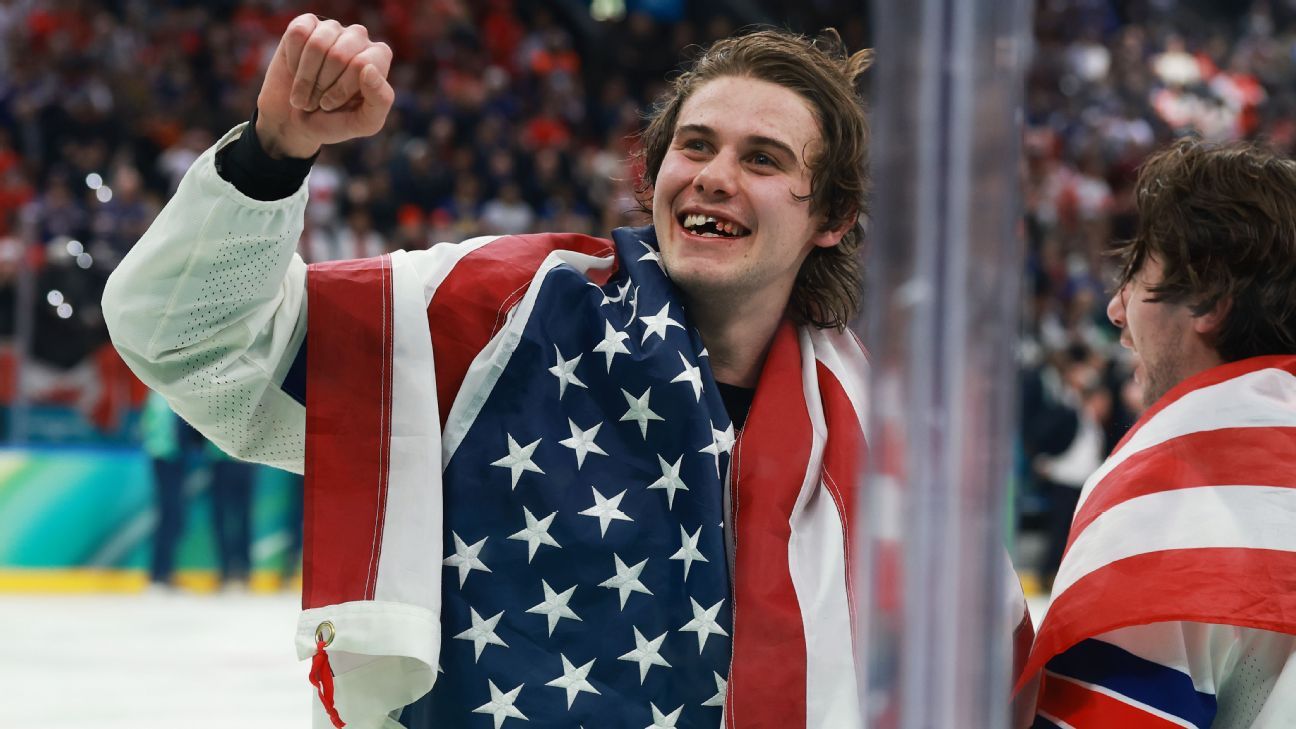
Despite Hughes’ attempts to deflect individual praise, the “golden goal” has become synonymous with his name. He has since appeared on morning and late-night talk shows, and his presence at NHL games has been met with cheers even from rival fans. A photograph taken by Elsa Garrison at the Olympics – Hughes draped in an American flag, fist raised, and teeth bloodied – has become an instant classic, even appearing on ESPN’s Pat McAfee while interviewing Hughes. New York Yankees star Aaron Judge reportedly circulated the image within the World Baseball Classic group chat as a symbol of American athletic excellence.
Hughes, however, expressed his discomfort with the image. “I don’t even like that photo. I just look like an idiot with no teeth,” he said, acknowledging its popularity.
Agent Pat Brisson believes Hughes was uniquely prepared for the sudden surge in fame. “It couldn’t have been a better person, in that sense. He’s not just a hockey player. He’s very smart, well-read. Hockey is his passion, but he also has a lot of interest about the world, understanding different cultures and understanding his generation,” Brisson said. “So, when this moment happened — I called it ‘the tsunami’ — Jack is equipped to handle it.”
The whirlwind following the gold medal included a celebratory event in Miami hosted by Pat McAfee, who reportedly covered a $150,000 champagne tab for the team. Hughes participated in a shooting challenge on McAfee’s show, successfully sinking a shot to earn $100,000 for the Gaudreau Family Foundation. He then made a last-minute appearance on “Saturday Night Live,” arriving via a private jet and helicopter from a Devils game in St. Louis, accompanied by Devils owners David and Allison Blitzer.
Hughes also appeared on “The Tonight Show with Jimmy Fallon” alongside Quinn Hughes and Hilary Knight. During a pre-show meeting, Hughes encountered actress Nicole Kidman, a noted Nashville Predators supporter. Fallon, a known New York Rangers fan, also engaged with Hughes, prompting a lighthearted exchange about the Devils-Rangers rivalry.
The gold medal win also led to a White House invitation from President Donald Trump, which the team accepted, with the exception of five players citing scheduling conflicts. The decision drew criticism, with some accusing the team of being “pawns” and failing to capitalize on a cultural moment. Hughes responded by emphasizing the team’s pride in representing the United States.
A separate controversy arose when Hughes expressed his desire to personally own the “golden goal” puck, only to learn that it had been donated to the Hockey Hall of Fame by the International Ice Hockey Federation. The Hall of Fame confirmed that the puck was never Hughes’ to own, citing a pre-existing agreement regarding Olympic artifacts. Hughes later acknowledged the Hall of Fame’s position and expressed his honor that the puck was preserved in the institution.
Despite the team’s playoff prospects remaining slim as of Sunday, with a 0.1% chance of qualification according to Money Puck, Hughes’ performance since the Olympics has been strong, with 19 points in his first 12 games. His teammates have noted a shift in his demeanor, describing him as more assertive and confident.
“I think he’s definitely sure of himself and maybe a bit more assertive in the way he feels that we should play,” said Connor Brown, Hughes’ linemate. “He’s a leader in this room. I think when you have a guy like that, it can be inspiring down the lineup.”
Hughes himself reflected on the impact of the gold medal. “A gold medal, in general, just establishes you as a winner. So, for every guy on our team to win, it just changes USA Hockey. And then, on a personal note, I’m on the fourth line. I have to play through things — different role, different minutes. I’m only playing 10 minutes a night and still having to find a way to produce and do my thing. So, looking back at that whole experience, if I just look at what I’m most proud of for myself, what I did with what I was given. The amount I accomplished is something I’m proud of.”