
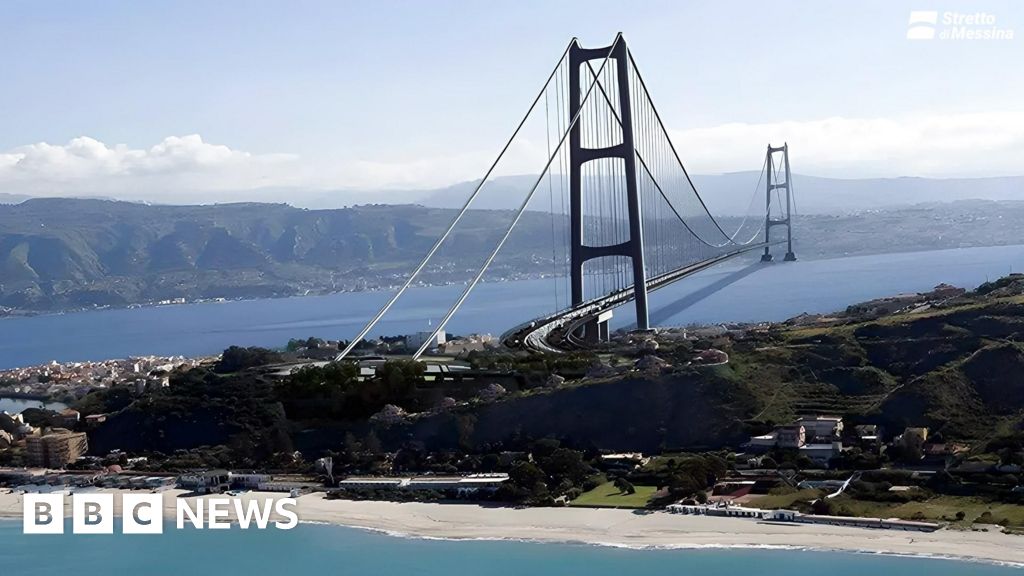
Italy Greenlights World’s Longest Suspension Bridge to Sicily
Massive €13.5 Billion Project Aims to Connect Mainland to Island Despite Historical Hurdles
Rome has given its final authorization for a monumental €13.5 billion ($15.6 billion) undertaking to construct the planet’s longest suspension bridge. This ambitious project intends to link the island of Sicily with Calabria, situated at the southern tip of Italy’s boot.
Seismic Resilience and Historical Setbacks
Designers assert that the proposed bridge, slated for construction in one of the Mediterranean’s most seismically active zones, will be engineered to withstand significant earthquakes. This endeavor marks the latest effort by Italian authorities to realize the Messina Bridge concept, a plan that has faced numerous abortive attempts over decades due to concerns ranging from prohibitive costs and environmental impacts to safety assurances and potential organized crime interference.
“We enjoy difficult challenges when they make sense.”
—Giorgia Meloni, Prime Minister
Prime Minister Giorgia Meloni acknowledged the recent project’s challenging path, characterizing it as an “investment in Italy’s present and future.” The bridge will span 3.3 kilometers (2.05 miles) across the Messina Strait, supported by two colossal 400-meter (1,300 feet) high towers. It is designed to accommodate two railway lines in its center, flanked by three traffic lanes on each side.
The Italian government is reportedly seeking to classify the bridge as a military expenditure, aiming to count it towards NATO’s defense spending target of 5% of GDP. Transport Minister Matteo Salvini, leader of the Lega party, celebrated the advancement, projecting completion between 2032 and 2033. He also forecast that the bridge could generate 120,000 jobs annually, boosting the economies of Sicily and Calabria, two of Europe’s economically disadvantaged regions.
Lingering Doubts and Local Opposition
However, the project still requires final approval from the Italian Court of Auditors and national and EU environmental agencies. Furthermore, local residents facing potential property expropriation must be consulted, with the possibility of legal challenges that could delay or halt construction. This project has faced formidable opposition and numerous shelved plans for over fifty years, with persistent concerns about the potential for mafia groups to siphon off taxpayer funds.
Italy has finally approved a 13.5 billion euro project to build the world’s longest suspension bridge, connecting the island of Sicily to the mainland.
Construction is due to begin in 2024, with the bridge expected to open in 2032.
The bridge will span 3.3km and will be 60 metres wide.
It is expected to boost tourism and trade in the region.
Local political figures have voiced their discontent. Senator Nicola Irto of the Democratic Party described the project as “controversial and divisive,” arguing it would divert vital resources from essential local services like transportation, schools, and healthcare. The mayor of Villa San Giovanni, Giusy Caminiti, expressed concerns about her town’s impact and called for more consultation time.
The grassroots committee “No to the Bridge” condemned the announcement as a political maneuver rather than a result of thorough technical assessment. Opponents also highlight the project’s water consumption, noting that both Sicily and Calabria frequently experience drought conditions. Currently, rail transport across the Strait involves ferrying train carriages, a journey taking 30 minutes.
In comparison, the proposed Gotthard Base Tunnel in Switzerland, the world’s longest railway tunnel, facilitates rapid transit through the Alps, demonstrating the potential for large-scale infrastructure projects to revolutionize connectivity. For example, the Gotthard tunnel, completed in 2016, reduced travel times significantly for freight and passengers across the Swiss Alps (Swiss Federal Statistical Office, 2024).
