
Italian Students Shun Law & Architecture: Rise of Humanities & Lawyer Concerns
Italian traditional professional sectors face a structural labor contraction as law and engineering enrollments plummet 38% since 2012. AlmaLaurea and Cassa Forense data reveal collapsing ROI on legal careers, driving young talent toward humanities. This supply shock forces enterprise clients to seek alternative B2B solutions for talent acquisition and operational efficiency.
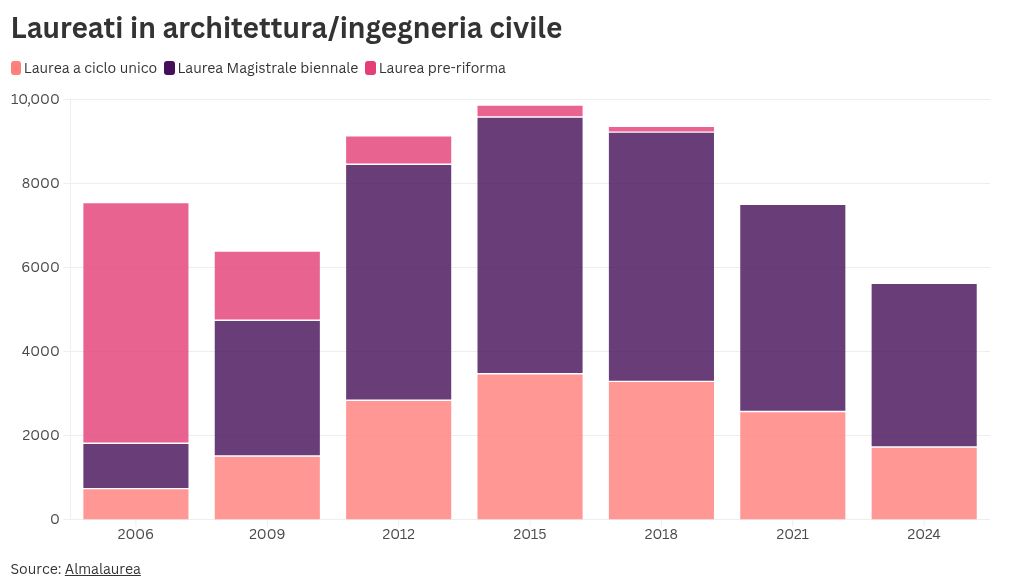
The prestige economy is crumbling. For decades, the Italian market operated on a simple arbitrage: invest in a law or engineering degree, secure a golden plaque on the office door, and reap stable returns. That model is now insolvent. Modern data from the Interuniversity Consortium AlmaLaurea indicates a severe correction in human capital allocation. Law graduations have fallen from a peak of 14,344 in 2015 to just 9,499 in 2024. Architecture and civil engineering saw an even starker decline, dropping 38.5% over twelve years. This is not merely a cultural shift; it is a supply chain failure in the professional services sector.
Financial officers across Europe must recognize this as a leading indicator for service pricing and availability. When the pipeline of qualified associates dries up, billable hour models become unsustainable. The 2025 Report from the Italian Lawyers’ Welfare Fund (Cassa Forense) exposes the underlying economics driving this exodus. Active practitioners decreased by 15,000 between 2019 and 2024. Meanwhile, the average age of practicing attorneys climbed from 42.3 to 48.9 years. An aging workforce without replacement creates immediate succession risks for corporate clients relying on external counsel for M&A or compliance operate.
Income compression validates the downturn. Over 40% of lawyers under 35 report annual gross incomes below €15,000. In a high-inflation environment, this wage stagnation renders the profession economically unviable compared to tech or finance sectors. Young talent is voting with their feet, migrating toward humanities or sectors with clearer liquidity events. The market is correcting the overproduction of lawyers seen in the early 2000s, but the speed of the contraction threatens service continuity.
Three Structural Shifts for Enterprise Buyers
Corporate procurement teams cannot ignore this demographic cliff. The traditional model of outsourcing complex work to junior-heavy law firms is breaking. Buyers must adapt their vendor management strategies to account for scarcity. We identify three critical adjustments required for the upcoming fiscal quarters:
- Pricing Power Inversion: As senior talent becomes scarce, hourly rates for experienced partners will decouple from junior associate rates. Firms can no longer leverage pyramids of low-cost associates. Enterprises should renegotiate fee structures to focus on value-based pricing rather than time-and-materials, mitigating the risk of paying premium rates for inexperienced labor.
- Technology Substitution: With fewer juniors entering the pipeline, legal and engineering firms must accelerate automation. Demand for legal tech and workflow automation providers will surge as firms attempt to maintain margins with reduced headcount. Corporate clients should vet their vendors’ tech stacks to ensure efficiency gains are passed down.
- Talent Acquisition Overhaul: The passive candidate market in these sectors is shrinking. Companies relying on traditional recruitment pipelines will face delays. Engaging specialized executive search and talent acquisition firms with deep niche networks is no longer optional; it is a risk mitigation strategy.
The work-life balance metric further complicates retention. The Cassa Forense data shows 63.4% of lawyers struggle to reconcile career demands with personal life. Among professionals under 40, that figure jumps to 73.7%. This burnout rate suggests high turnover risk even among existing staff. For corporate clients, this translates to disrupted continuity on long-term projects and increased knowledge loss.
“The labor market is signaling a fundamental repricing of professional services. Firms that do not adapt their operational leverage will see EBITDA margins compress as recruitment costs spike.” — Senior Managing Director, Global Human Capital Practice
Global context reinforces the local data. According to the European Central Bank’s recent monetary policy statement regarding labor market tightness, service sector inflation remains sticky due to wage pressures in specialized fields. Italy’s situation is an extreme version of a broader European trend where productivity growth fails to match wage demands. The shift toward humanities degrees among Italian youth suggests a preference for flexibility over traditional status, a sentiment echoing across Gen Z workforces in London and New York.
Gender dynamics within the profession highlight additional liability. Female attorneys report significantly higher difficulty balancing work and life (70.6%) compared to males (57%). This asymmetry limits the total addressable market for talent retention. Firms ignoring these demographic specifics risk losing half their potential workforce. Corporate diversity mandates may clash with reality if the pipeline itself is damaged by structural inefficiencies.
The B2B Solution Landscape
Market volatility creates opportunity for service providers who can solve the efficiency gap. As traditional firms struggle to staff engagements, corporate legal departments and engineering procurement units will look inward. We expect a rise in interim management solutions and specialized consulting to bridge the knowledge gap left by retiring seniors. Organizations should consider partnering with corporate restructuring and advisory firms to optimize their internal workflows before the talent shortage bites harder.
The myth of the guaranteed professional income is dead. The data confirms that status no longer guarantees yield. For business leaders, the implication is clear: reliance on traditional external service providers carries new execution risk. Due diligence must now extend beyond price and reputation to include vendor workforce stability. The firms that survive this contraction will be those that leverage technology to do more with less, not those waiting for the enrollment numbers to rebound.
Investors and operators alike should monitor the next AlmaLaurea release for signs of stabilization. Until then, the strategy is defense. Secure your supply chain of talent, automate where possible, and diversify your vendor base. The golden plaque on the door no longer protects against market forces. Only operational resilience does.