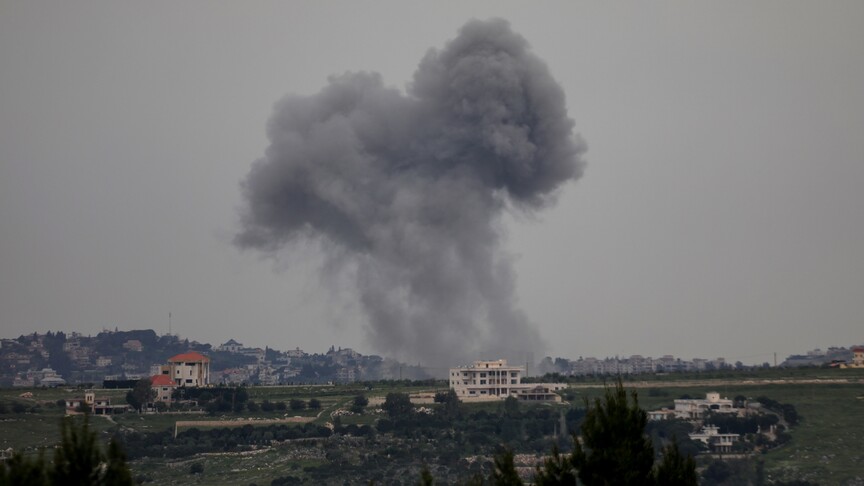
Israeli Airstrikes Target Southern Lebanon Towns of Kfar Remman and Nabatieh Al-Fawqa
Intense Israeli airstrikes and artillery shelling targeted the towns of Kafr Rumman and Nabatieh al-Fawqa in southern Lebanon, according to regional reporting.
Escalating Strikes Across Southern Towns
The military escalation intensified as warplanes and artillery pounded multiple population centers across southern Lebanon. According to regional reports from Anadolu Ajansı, the eastern outskirts of Douhet Kafr Rumman faced heavy artillery fire alongside drone activity. An Israeli drone initially dropped explosive materials over the town before a warplane launched a strike on the eastern periphery of the town.

Concurrent strikes struck Nabatieh al-Fawqa. Fighter jets targeted the Al-Dair neighborhood in two separate waves separated by less than fifteen minutes. Additional strikes hit the vicinity of the orphanage situated between Nabatieh al-Fawqa and Mivdoun, while artillery shells landed near the outskirts of Haris in the Bint Jbeil district.
Further operations involved heavy demolitions and clearance work. The Israeli military carried out a large explosion in Kfar Tibnit and conducted similar detonations and bulldozing operations in villages including Houla and Bani Hayyan.
Broader Regional Impact and Airspace Violations
The operational footprint of the current offensive extends far beyond the immediate border strip. Reports documented low-altitude drone flights over the capital city of Beirut, its southern suburbs, and the Zahrani region further south. Villages such as Mansouri and Sarbine, and the Wadi Zebqin area experienced repeated bombardments and heavy engineering operations aimed at razing local structures.

In the Tyre district, military engineering units carried out a massive explosion near the outskirts of Bayut al-Siyad opposite Mansouri. Meanwhile, heavy artillery targeted the Litani River basin near the Khardali road.
Diplomatic Maneuvers and the Future of UNIFIL
Amid the ongoing field operations, high-level military diplomacy is addressing the administrative future of the border zone. Lebanese Army Commander Rudolph Haikel traveled to Italy to meet with his counterpart, Luciano Bortulano, to discuss the post-mandate framework for the United Nations Interim Force in Lebanon (UNIFIL).
During the discussions, Bortulano stated that Lebanon’s stability remains a strategic priority and emphasized the importance of supporting the Lebanese Armed Forces in maintaining security. The mandate for UNIFIL is scheduled to conclude at the end of 2026, sparking international debate over future peacekeeping architectures. Beirut continues to insist on the vital presence of international observers as an essential anchor for regional security.
These diplomatic talks unfold alongside ongoing efforts to solidify security arrangements tied to the Framework Agreement signed between Lebanon and Israel on June 26. That accord envisions a phased Israeli withdrawal from Lebanese territories, matched by the deployment of the Lebanese army and the dismantling of armed groups.
As diplomatic channels debate the future of peacekeeping mandates and structural recovery frameworks, communities across southern Lebanon face recovery challenges.