
Israel-Iran War 2026: Are Israel’s Shelters Enough to Protect Its Citizens?
The question facing residents of southern Israel, many of whom spent 23 days navigating a cycle of fear between apartments, stairwells, and shelters under a barrage of Iranian rockets, is stark: how can Prime Minister Benjamin Netanyahu convince them of the security he promises today? The sustained conflict with Iran, entering its 28th day as of February 28th, has exposed critical questions about the strength of Israel’s defensive infrastructure, long touted as impenetrable against heavy ballistic and cluster missiles.
Netanyahu attempted to address these concerns during a visit to the city of Arad following recent Iranian missile strikes. Standing amidst the damage, he stated he “relies on fortifications, not miracles,” even as urging residents to strictly adhere to Home Front Command guidelines. However, his message rang hollow for many after a single strike on Arad and Dimona injured over 180 people – dozens in a single neighborhood – prompting accusations that the government was attempting to deflect blame.
The criticism quickly faltered in the face of documented evidence suggesting the problem extended far beyond individual non-compliance. A January report by Israel’s State Comptroller, Matanyahu Englman, revealed a crisis impacting over 3 million Israelis – roughly a third of the population – living in areas lacking “standard protection,” whether through safe rooms within homes or usable public shelters. Englman’s report specifically warned of an “urgent danger” posed by the lack of shelters in the north, compounded by structural and logistical deficiencies rendering many existing shelters unsafe.
Reports indicate the situation is particularly acute in the Tel Aviv metropolitan area, where approximately 40% of residents live in buildings without compliant safe rooms or shelters, forcing them to rely on stairwells or parking garages as makeshift safety zones. A Jerusalem Post investigation described public shelters as dangerously overcrowded during rocket attacks, with some residents reportedly closing shelter doors to prevent further entry due to fears of being crushed.
The disparity in protection extends along ethnic lines. The State Comptroller’s report highlighted a severe lack of shelter access within Arab communities in Israel. Of the 11,775 public shelters nationwide, only 37 are located in Arab local councils, with eight of those deemed unusable. This means less than 1% of Israel’s public shelter network serves Arab communities, who face the same missile threat as the rest of the population. Data from “Shomrim – Center for Media and Democracy in Israel” reveals entire Arab and Bedouin towns in the Negev and Galilee lack any protective infrastructure, or possess only a symbolic number of shelters insufficient for their populations.
The city of Rahat, with a population of approximately 96,000, has only five public shelters. The town of Shqib al-Salam, home to around 13,000 residents, has none approved by the state. In the northern city of Tamra, roughly 40% of residents have safe rooms in their homes, with a near-total absence of adequate public shelters. A previous rocket strike on Tamra resulted in the deaths of four civilians and injuries to others, a tragedy cited by local media as evidence that the lack of shelters is not merely an administrative oversight, but a life-or-death issue.
The New York Times reported that Jewish cities, even those of moderate size, benefit from a more extensive network of safe rooms and public shelters, providing residents with faster access to protection during the critical seconds before sirens sound.
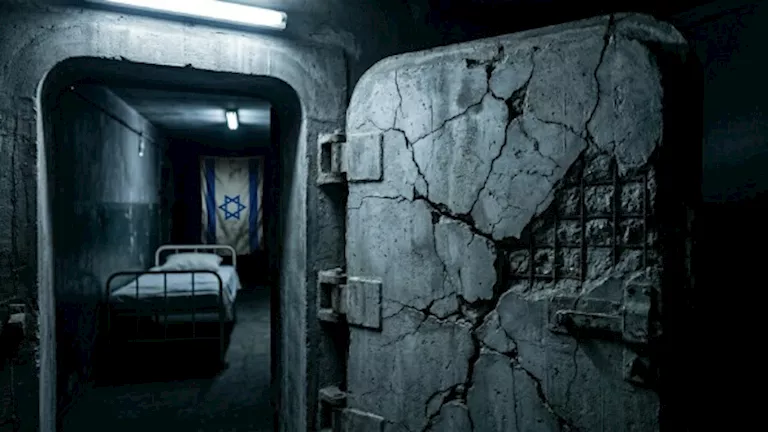
Beyond the political rhetoric, the Israeli shelter system is undergoing a rigorous engineering assessment in light of the 2026 conflict. Professor Nir Moalem of the Technion – Israel Institute of Technology, in a research paper titled “Shelters and Safe Rooms: Policies and Regulations,” traces the evolution of the system from communal public shelters in the 1960s to the inclusion of “mamad” (safe room) apartments beginning in the 1990s. These structures, featuring 20-30cm thick concrete walls and steel doors, were originally designed to withstand shrapnel and rockets with shorter ranges, assuming explosions would occur in the periphery. This defensive philosophy is now challenged by the evolving capabilities of the Iranian arsenal.
Defense analyst Uzi Rubin, writing in the Jerusalem Post, explains that ballistic missiles with cluster warheads present a new equation. These weapons release numerous smaller explosives over a wide area, increasing the likelihood of multiple buildings being hit simultaneously, rendering the “civilian fortification” scenario ineffective and placing the burden squarely on air defense systems.
Reports from the International Institute for Strategic Studies (IISS) on “The Military Balance in the Middle East” corroborate these concerns. Iran possesses heavy missiles like the “Khorramshahr” with a one-ton warhead, and the “Sejjil” with high speeds that amplify destructive impact. The June 2025 conflict saw the launch of over 600 Iranian ballistic missiles, with approximately 500 entering Israeli airspace, partially breaching interception systems and reaching their targets. These figures lead Israeli research centers like INSS to conclude that the current fortification system was developed for shorter, limited conflicts, and is now facing a potential “war of attrition” scenario.
Research indicates a significant psychological toll accompanying prolonged shelter confinement. A study published in Scientific Reports this year, tracking individuals evacuated or living under rocket threat, found that 38-46% met the criteria for post-traumatic stress disorder, with higher rates among those spending extended periods in crowded shelters. Other research links continuous siren exposure and limited access to shelters to increased rates of chronic anxiety, depression, autoimmune diseases, and even higher mortality rates in areas closest to conflict zones.
Amos Yadlin, former head of the Israel Defense Intelligence and researcher at the Institute for National Security Studies (INSS), frames Netanyahu’s actions within a broader strategic context, suggesting the ongoing conflict with Iran is being used as a tool to reshape regional power dynamics. Within this framework, the vulnerabilities of the home front – and the uneven distribution of protection – are seen as a cost of this strategy, a political and strategic price Netanyahu seeks to extract in the long term. Recent INSS polls reflect this internal tension, showing support for strong action against Iran alongside growing existential anxiety about the home front’s ability to withstand a prolonged war.