
Reza Khaleghian, 70, erupted into Naab Cafe in Westwood on Saturday morning, shouting the news in Farsi – “Khamenei is dead!” – a claim soon confirmed by former President Trump, who announced the death of Iran’s supreme leader following a joint U.S.-Israeli operation. The announcement sparked immediate celebrations within the large Iranian American community of Los Angeles, particularly in the area known as “Tehrangeles.”
Within hours, the intersection of Wilshire Boulevard and Veteran Avenue became a focal point for jubilant gatherings. Beha Pangrazio, 35, a recent emigrant from Tehran, celebrated with her family. “This is a fantastic day we could not even imagine in our dreams,” she said, expressing hope for a regime change and the potential return of the monarchy. Los Angeles County is home to nearly 140,000 people of Iranian descent, representing the largest concentration of Iranians outside of Iran, according to the Migration Policy Institute.
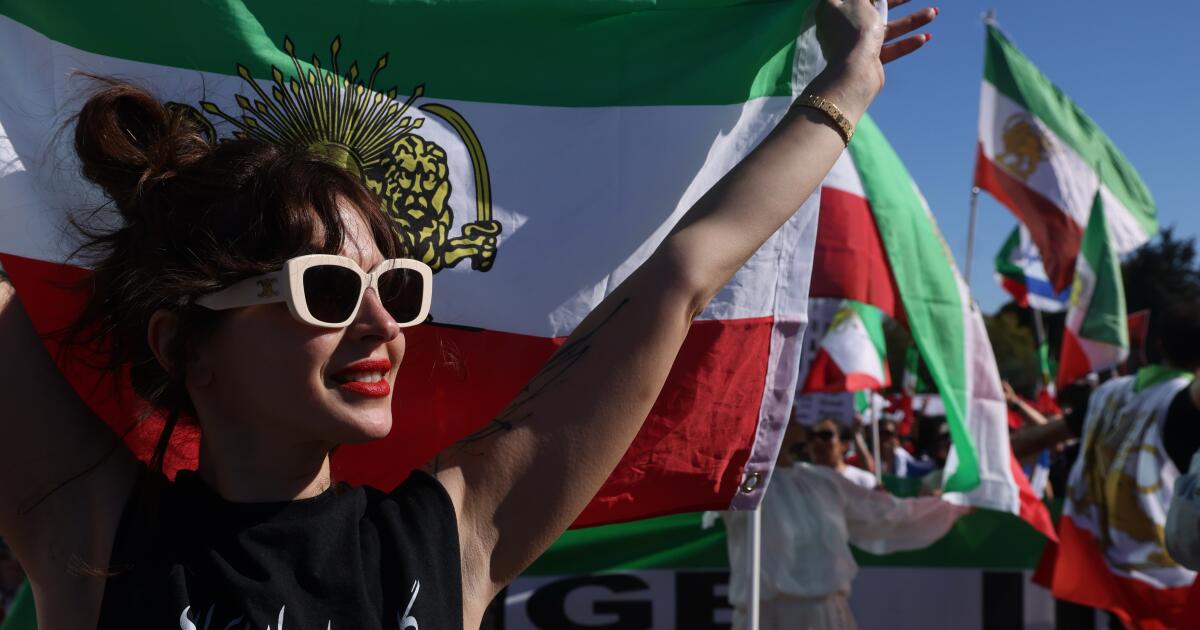
The atmosphere in Westwood was electric. Car horns blared, Persian music filled the air, and flags of the Imperial State of Iran – the monarchy overthrown in the 1979 revolution – were prominently displayed. A Tesla Cybertruck and a Mercedes-Benz, both adorned with the imperial flag, drove in opposite directions along Veteran Avenue. Social media amplified the news, drawing more people to the neighborhood’s cafes and shops.
Ryan Abrams, 34, and his wife, Ashley Abrams, 32, walked through the neighborhood, each wearing a flag representing their heritage – Abrams, the lion-and-sun flag of the shah’s Iran, and his wife, an Israeli flag. Both families had immigrated to Los Angeles in 1979. “Our whole lives we’ve had to navigate our different identities,” Abrams said. “Today we see one step forward.”
Back at Naab Cafe, a gathering point for exiles, Khaleghian and others embraced and chanted “javid Shah” – long live the shah. “I’m 70 years old. This is the best time, ever, in my life. Freedom for my country. Best day of my life,” Khaleghian declared, adding his support for Trump. The cafe’s waiter, Amir, a native of Tehran who participated in the 2009 Green Revolution, expressed cautious optimism. “On one hand, you hate all of them so bad you want them all to die,” he said, referring to the Iranian regime. “On the other hand — war. Things can go wrong in war. But me and a lot of people suppose war is better than what’s going on.”
A man identified only as Bob revealed he had profited from a prediction market bet on Khamenei’s death, made through the Kalshi app. The mood was largely celebratory, with many expressing plans to return to Iran as soon as possible. “Next summer, I’m not going to Italy. I’m going to Iran,” Khaleghian stated.
However, a note of caution was sounded by Paul Daneshrad, 59, who questioned whether the event would lead to meaningful change. “The people aren’t armed, so unless the army, or part of the army, decides to support the people, there’s going to be 50 people taking” the place of each leader killed, he said. Sepehr, 58, echoed this sentiment, acknowledging the regime’s resilience over nearly half a century. “It’s a bad dream,” he said, but added that Persian culture had endured for over 3,000 years, putting the current moment into historical perspective.
