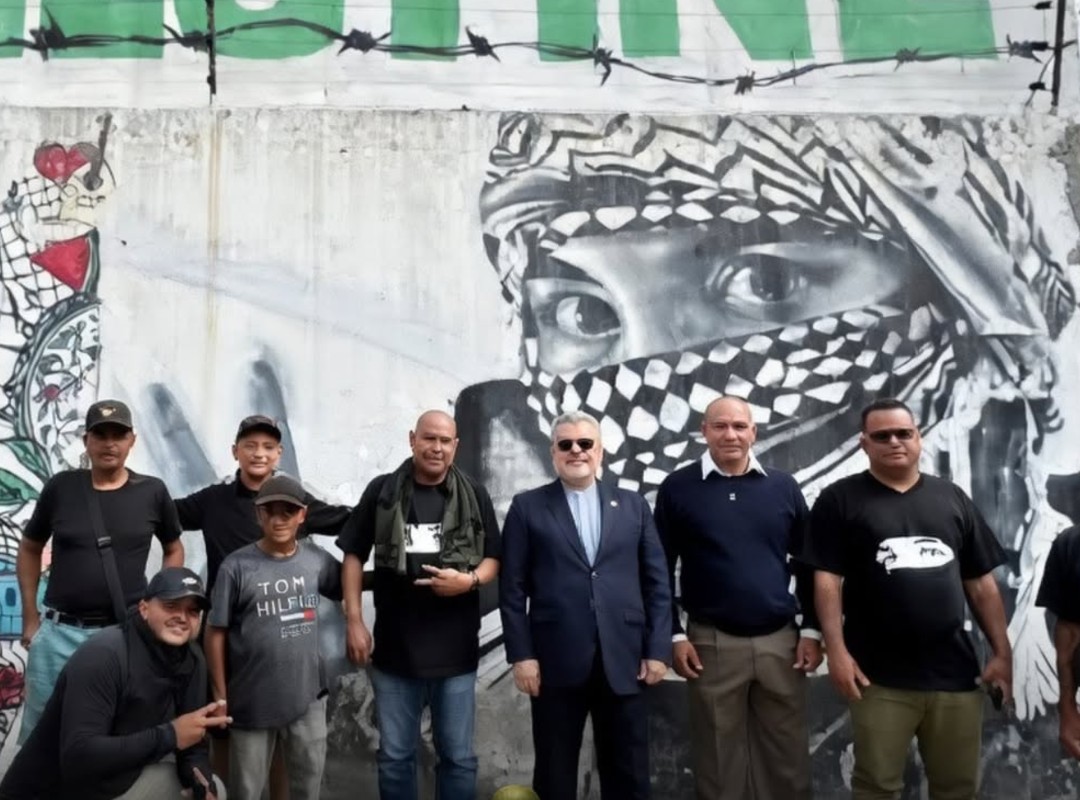
Iranian Ambassador Meets 23 de Enero Collectives Amid Trump Assassination Incitement Claims
The Iranian Ambassador to Venezuela recently met with “23 de Enero” paramilitary groups in Caracas, participating in a radio broadcast where rhetoric escalated to incite the assassination of U.S. President Donald Trump. This diplomatic breach signals a deepening alignment between Tehran and Caracas’s most volatile grassroots militias.
This isn’t just a diplomatic gaffe; it is a calculated provocation. When a high-ranking diplomat engages with “colectivos”—the armed civilian groups that act as the regime’s street-level enforcers—the line between formal diplomacy and state-sponsored insurgency vanishes. The 23 de Enero sector of Caracas has long been a flashpoint for political violence, and by anchoring themselves here, Iranian officials are signaling a shift toward asymmetric warfare strategies on Latin American soil.
The immediate problem is the destabilization of regional security. When foreign powers legitimize paramilitary violence, they erode the rule of law and create a vacuum where only the strongest—or most violent—survive. For businesses and residents in Caracas, this increases the risk of sudden civil unrest and state-sanctioned intimidation.
The Geopolitical Calculus of the Caracas-Tehran Axis
To understand why Iran is courting the 23 de Enero collectives, one must look at the macro-economic strangulation both nations face. Both Venezuela and Iran are under heavy U.S. Department of the Treasury sanctions. This shared isolation has forged a “partnership of the sanctioned,” where the exchange of oil technology and ideological warfare becomes a survival mechanism.
The Iranian presence in Venezuela has evolved from simple trade to strategic embedding. By associating with the colectivos, Iran gains a low-cost, high-impact tool for psychological warfare against the United States. It allows Tehran to project power in the Western Hemisphere without deploying a formal military presence, utilizing existing local proxies to amplify anti-American sentiment.
“The intersection of foreign diplomatic missions and local paramilitary groups creates a ‘grey zone’ of legality. When an ambassador encourages violence, they are no longer representing a state; they are coordinating a militia.”
This environment creates a precarious legal landscape. Local enterprises operating in these zones are often caught in the crossfire of geopolitical posturing. To navigate these volatile waters, many firms are now relying on international law firms specializing in sanctions compliance and diplomatic immunity to protect their assets from sudden seizures or political reprisals.
Anatomy of the “23 de Enero” Influence
The 23 de Enero community is not merely a neighborhood; it is a political fortress. Named after the date of a 1989 uprising, the area is the heart of the “Bolivarian” grassroots movement. The colectivos here operate as a shadow government, providing social services while maintaining an armed grip on the territory.
- Tactical Integration: The use of community radio stations to broadcast incitement allows the regime to maintain plausible deniability while ensuring the message reaches the most militant sectors of the population.
- Foreign Sponsorship: Iranian involvement provides these groups with perceived international legitimacy and potentially advanced communication tools.
- Targeted Rhetoric: The specific call for the “magnicide” of a U.S. President is designed to trigger a response from Washington, potentially justifying further domestic crackdowns under the guise of “national defense.”
The ripple effect extends beyond the radio waves. As these groups become more emboldened by foreign support, the risk of localized violence increases. This necessitates a heightened reliance on private security consultants who understand the specific dynamics of Venezuelan paramilitary movements and can provide real-time risk assessments for expatriates and diplomats.
The Disinformation War and the “Fake News” Layer
The fallout from this meeting has been complicated by a secondary war of narratives. Organizations like “Cazadores de Fake News” (Fake News Hunters) have reported the unauthorized use of their imagery to fabricate “debunking” statements. This is a classic hallmark of hybrid warfare: not only is the event provocative, but the subsequent information cycle is designed to confuse the public about what actually happened.
When the truth is obscured by layers of synthetic media and false denials, the only reliable currency is verified documentation. This trend is forcing a shift in how news is consumed in the region, moving away from social media feeds and toward vetted, primary-source journalism.
For those attempting to verify the legitimacy of political claims or business contracts in this chaotic environment, the require for certified forensic auditors and investigative researchers has surged. Verifying the “who” and “how” is no longer a luxury; it is a prerequisite for survival in the Venezuelan market.
Long-term Implications for Hemispheric Security
If this pattern of diplomatic-paramilitary collaboration continues, we are looking at a permanent shift in how foreign influence is exerted in Latin America. We are moving away from the era of “soft power” (cultural and economic influence) and into an era of “hard proxying.”
The risk is that Venezuela becomes a laboratory for Iranian destabilization tactics. If the 23 de Enero model—where a foreign embassy directly fuels local militants—is scaled, other neighboring countries could witness similar “friendships” between their own fringe groups and adversarial foreign powers.
“We are seeing the normalization of the ‘militia-diplomat’ relationship. This effectively kills the Vienna Convention on Diplomatic Relations, replacing diplomacy with insurgency coordination.”
The long-term impact will be felt in the municipal laws of Caracas and surrounding regions. As these collectives gain more “official” recognition through foreign ties, the city’s administrative infrastructure may further erode, leaving the population dependent on non-state actors for basic security and governance.
The meeting in 23 de Enero is a warning shot. It reveals a world where the boundaries between a sovereign embassy and a street gang are intentionally blurred to serve a larger geopolitical game. As the rhetoric moves from political disagreement to calls for assassination, the window for traditional diplomacy closes.
In an era of systemic instability, the only defense is preparation. Whether you are a business owner protecting an investment or a citizen seeking clarity in a sea of disinformation, the ability to connect with verified, expert professionals is your only safeguard. The World Today News Directory remains the definitive bridge to the verified legal, security, and investigative experts capable of navigating the complexities of this evolving crisis.
Keep reading
- Japan Ex-Defense Chief Urges PM to Challenge US Sanctions on ICC President
- Mistrial Declared in Lindsay Clancy Child Murders Trial After Jury Deadlocks
- Why Trump Can't Just Fire a Federal Reserve Governor (daybreakwire.com)
- Trump Envoys Witkoff and Kushner to Visit Moscow and Kyiv for Peace Talks (time.news)