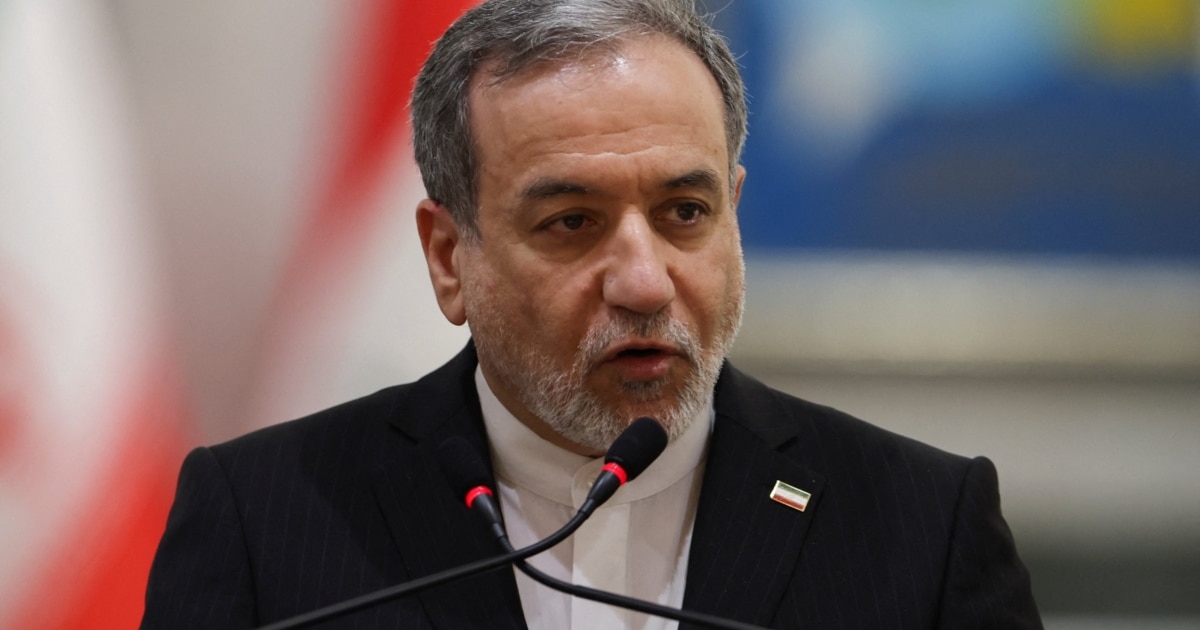
Iran Foreign Minister Says Nuclear Doctrine Change Arguments ‘Serious and Strategic
Iran’s top diplomat acknowledged that arguments for revising the country’s nuclear doctrine carry serious strategic weight because membership in the Non-Proliferation Treaty failed to shield nuclear sites from attack, Radio Free Europe/Radio Liberty reported Friday.
Foreign Minister Abbas Araghchi told the state daily Iran in an interview published November 21 that the debate unfolding among the Iranian elite is “serious and strategic,” with both sides holding convincing arguments, according to Mezha. He said proponents of change argue that NPT membership, IAEA safeguards and other monitoring mechanisms did not prevent strikes on Iranian nuclear facilities.
Despite acknowledging the logic behind a doctrinal shift, Araghchi emphasized that Tehran’s official stance remains the same. “At this moment our doctrine has not changed, and our official positions remain the same,” he said.
Hardline lawmakers and security officials have publicly urged Iran not only to withdraw from the NPT but to build a nuclear deterrent over the last several months. The 1970 treaty obligates non-nuclear-weapon states not to manufacture or acquire nuclear weapons while preserving the right to develop peaceful nuclear energy under International Atomic Energy Agency verification.

The International Atomic Energy Agency estimates Iran holds 440.9 kilograms of uranium enriched to 60 percent purity — a short technical step from the roughly 90 percent needed for weapons-grade material, according to Радіо Свобода. In March, IAEA Director General Rafael Grossi said more than 200 kilograms of that material was believed stored in tunnels at the Isfahan nuclear facility, with additional quantities at Natanz.
Both sites were struck by the United States in June 2025. The IAEA reported in September that it had lost the ability to track those stockpiles more than a year earlier.
Araghchi suggested a formula could be found to keep enriched material inside the country rather than shipping it out, echoing remarks earlier this month by Mohsen Rezaei, secretary of the Supreme National Security Council. The disposition of Iran’s uranium stockpiles remains one of the largest uncertainties in any prospective agreement with the United States, which has been in a state of war with Iran since late February.
Asked whether Russia and China would support a change in Iran’s nuclear doctrine, Araghchi said they “have opposite views.” It remains unclear whether he meant the two powers oppose a shift in Iranian policy or that their views differ from each other, Mezha.net reported.
“We can find a certain formula, but the material will not leave Iran,” Araghchi said in the interview.
Founded in 1957 after U.S. President Dwight D. Eisenhower’s “Atoms for Peace” speech, the International Atomic Energy Agency was created to monitor nuclear technology worldwide. Its statute entered into force on 29 July 1957 upon U.S. ratification. The agency and its then-director general, Mohamed ElBaradei, received the Nobel Peace Prize in 2005 for efforts to prevent military use of nuclear energy.
The United States and Iran have been in a state of war since the end of February. Negotiators face a narrowing window to address a stockpile that the IAEA can no longer fully monitor and a Tehran leadership openly debating whether the legal framework constraining its program has proven worthless.