Iowa Lead Azide Blast: Air Monitoring Clear, But Ground Testing Crucial for Contamination Risk
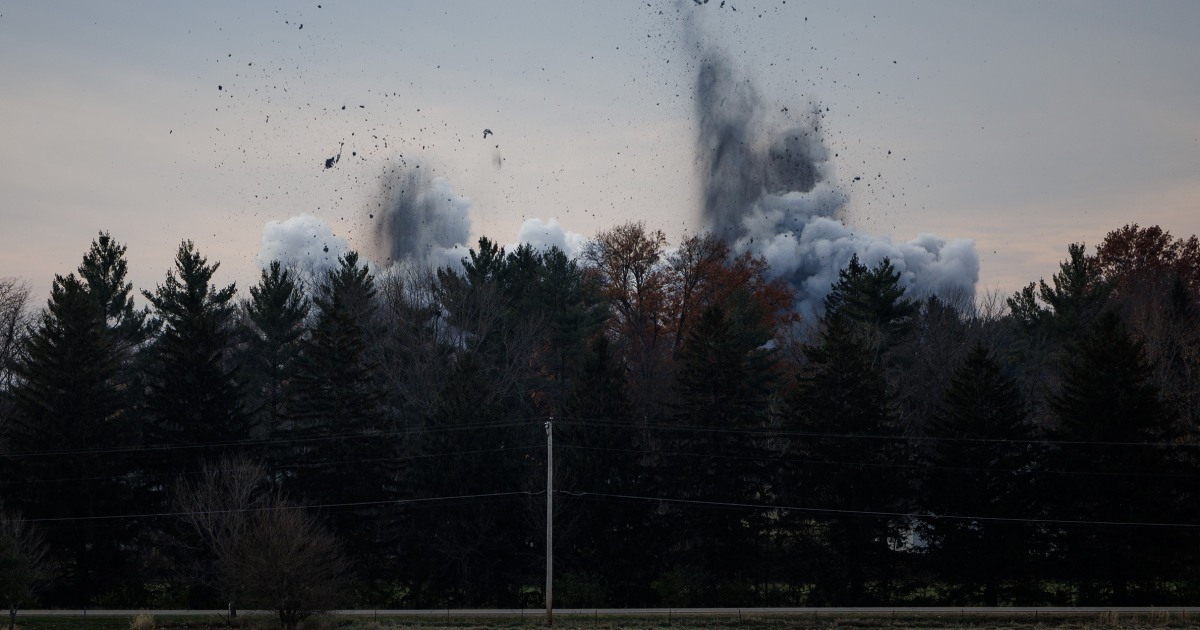
The Army detonated 9,500 pounds of lead azide Wednesday at the Iowa Army Ammunition Plant near Middletown after the chemical became too unstable to store safely.
Initial real-time air monitoring from four EPA sites detected no lead in the atmosphere, and the Federal Emergency Management Agency issued an “all clear” around 5:30 p.m. local time, the Army said on X. But independent scientists and residents said the ground testing now underway will determine whether lead dust settled in hotspots that require cleanup.
Scientists call ground sampling essential
Dr. Joel Kaufman, a professor of medicine, epidemiology and environmental health sciences at the University of Washington, said the EPA’s real-time monitoring was a promising start but must be backed by lab analysis of dust collected on the ground.
“This is a reasonable way to test for real-time lead in the environment,” Kaufman told NBC News.
“Is it possible that they are right that the amount of lead that’s being put into the environment is virtually zero? Yes. Is there reason to be suspicious about it? Yes.”
Andrew Whelton, a professor of civil, environmental and ecological engineering at Purdue University, agreed that physical samples are essential.
“You have to collect particles that deposit and send them to a lab for chemical analysis,” Whelton told NBC News.
Residents wait for clearance to return
Garrett Anthony, a Burlington resident about seven miles from the blast site, said he stored soil in advance to use as a baseline for his own tests.
“I’m really thrilled to see that the live monitoring by the EPA is showing zero lead in the air, but the ground testing is still very, very important to me, and I want to see what happens next,” Anthony told NBC News. “I definitely care about the lasting effects.”
The Iowa Army Ammunition Plant, a 19,011-acre government-owned, contractor-operated facility in Middletown, has produced medium- and large-caliber ammunition for the Department of Defense since starting operations in 1941 as the Iowa Ordnance Plant, later resuming manufacturing in 1949 and increasing output dramatically for the Korean conflict in 1950.
The installation encompasses 767 buildings, 271 igloos, and 1,100,775 square feet of storage capacity, operated under the US Army Joint Munitions Command with American Ordnance LLC as the primary contractor.
In August 1989, the plant was placed on the National Priorities List after explosives caused surface water contamination beyond the installation boundary, prompting ongoing clean-up activities overseen by a Restoration Advisory Board.
UPDATE: @FEMA has issued an All Clear around Iowa Army Ammunition Plant. DTRA maps indicate ZERO airborne lead detection following this morning's controlled detonation. Post-detonation surface sampling is underway, and results will be released once complete. pic.twitter.com/qgxitd6l28
Agencies detail sampling effort and next steps
The EPA said it had 300 employees and contractors on the ground in Iowa and had taken 1,200 air, land and water samples before the detonation. Post-detonation surface sampling is underway, and results will be released once complete, the Army said.
Jim Macy, an EPA administrator for the region, wrote to Iowa’s governor Friday that the Army’s permit required a plume estimate within six hours of the detonation. The Army published deposition and air dispersal maps at 3 p.m. local time showing no plume, but the maps contained few immediate details and noted “Post detonation sampling underway.”
Macy said the EPA expected initial results from dust wipe samples “in the days following the detonation,” though a full data review would take longer. The Army and EPA are also required to identify affected water bodies and reach out to public water systems to offer lead sampling resources, drinking water evaluations and filter equipment for homes.
Whelton had criticized the EPA and Army before the blast for not publicly sharing more details about their lead testing plan, saying the permit documents contained “no plan for applying an evidence-based approach to determine if people’s homes, schools and businesses are safe.”
More on Iowa Army Ammunition Plant
All EPA air monitors continue to report a ZERO DETECT of airborne lead, which has remained consistent before, during, and after this morning’s controlled detonation at the Iowa Army Ammunition Plant. 300 EPA personnel are now sampling air, land, and water across the region. We… pic.twitter.com/VjzYpwbjlh