
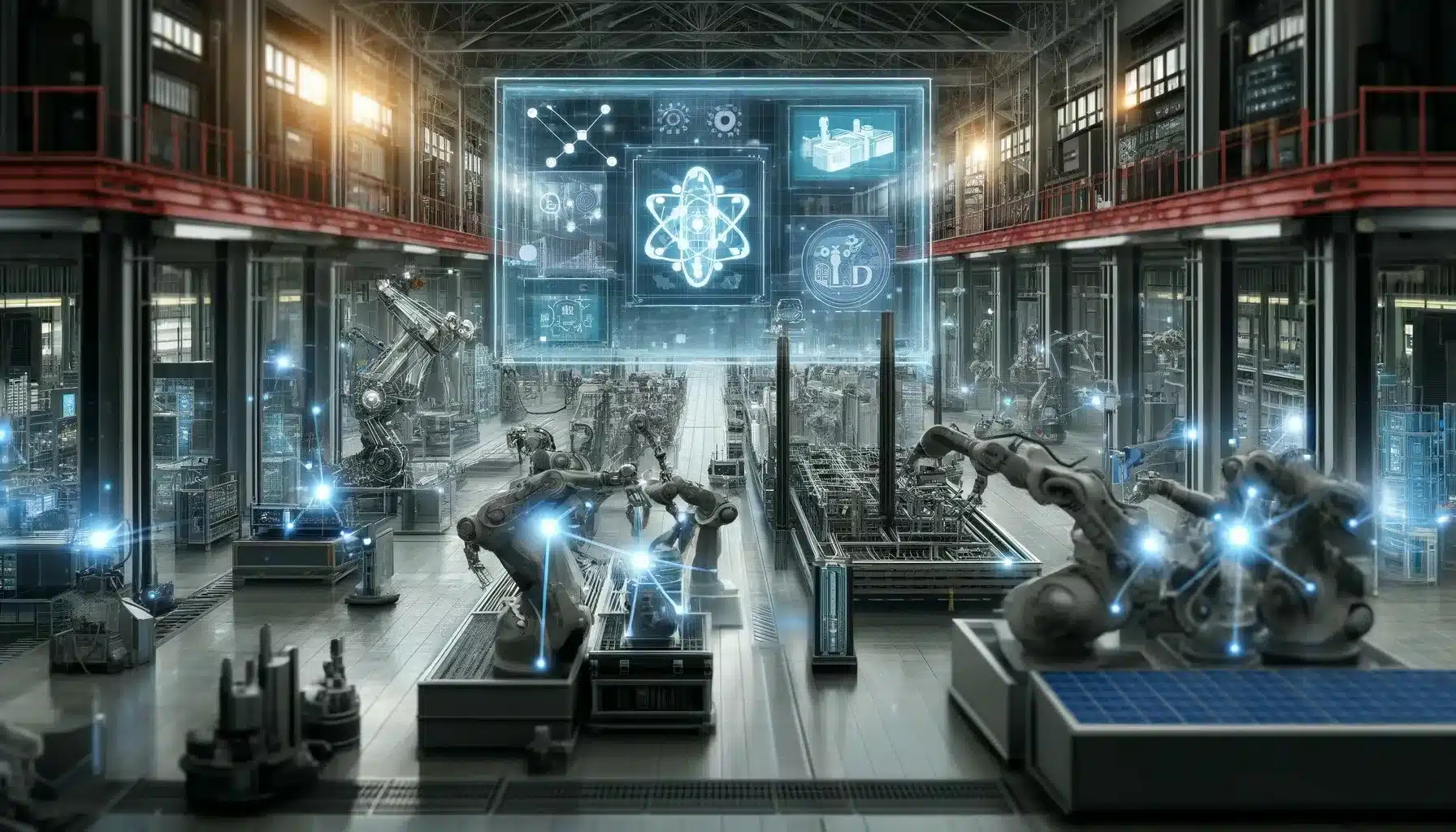
Investing in the Next Era of Robotics and Manufacturing
Eclipse is deploying $1.3 billion into the physical industry, specifically targeting the intersection of robotics and manufacturing. While the capital injection is significant, the real architectural challenge lies in whether this funding can actually solve the integration friction between legacy machining and the convergence of AI and robotics.
The Tech TL;DR:
- Eclipse is mobilizing $1.3 billion to fund companies shaping the next era of robotics and manufacturing.
- Industry focus is shifting toward “smart manufacturing” through the convergence of AI and robotic systems.
- Deployment models are bifurcating between high-mix, turnkey robotic solutions and capital-free technology renewal for the machining industry.
The industrial sector has long suffered from a fragmentation problem. Most factory floors are a patchwork of legacy PLC (Programmable Logic Controller) systems and isolated robotic cells that cannot communicate without brittle, custom-coded middleware. The “smart manufacturing” vision cited by PwC suggests that the convergence of AI and robotics is the primary lever for unlocking efficiency. However, from a systems engineering perspective, this convergence introduces significant latency and synchronization hurdles. When you move from static, repetitive motion to AI-driven, adaptive robotics, the requirement for real-time deterministic networking becomes absolute.
Eclipse’s $1.3 billion mobilization arrives as enterprise adoption of these systems scales. The goal is to move beyond simple automation into “physical industries” that can adapt in real-time. This shift requires a complete overhaul of the traditional manufacturing stack, moving away from rigid assembly lines toward the “high-mix production” models seen in the work of firms like Caracol. For CTOs, this isn’t just a hardware upgrade; it’s a transition to a software-defined factory floor where the hardware is essentially an API endpoint.
The Infrastructure Gap: Turnkey vs. Capital-Free Renewal
The current market is splitting into two distinct implementation paths. On one side, we have the turnkey approach. Caracol, for instance, focuses on digitalized, turnkey robotic manufacturing solutions specifically designed for large-scale, high-mix production. This model minimizes the integration burden on the end-user by providing a pre-validated stack, backed by venture capital from entities like Omnes Capital, Move Capital, and CDP Venture Capital. The advantage here is reduced deployment risk and faster time-to-production.
Conversely, the machining industry faces a different bottleneck: the capital expenditure (CapEx) barrier. Tezmaksan Robot Technologies is addressing this by offering digital solutions that allow the industry to renew technology “without the need for capital.” This “as-a-service” or financing-led model is designed to increase competitiveness without forcing small-to-medium enterprises (SMEs) into crippling debt. From a strategic standpoint, This represents an attempt to lower the barrier to entry for digital transformation in sectors that are traditionally slow to iterate.
The Tech Stack & Alternatives Matrix
When evaluating the deployment of robotic systems, the choice between a bespoke integrated stack and a turnkey solution depends entirely on the production volume and variety (the “mix”).
| Metric | Turnkey Solutions (e.g., Caracol) | Digital Renewal (e.g., Tezmaksan) | Legacy Automation |
|---|---|---|---|
| Deployment Speed | High (Pre-integrated) | Moderate (Iterative) | Low (Custom build) |
| Production Flexibility | High-Mix / Large-Scale | Machining Optimized | Single-Task / Low-Mix |
| Financial Model | CapEx / Venture Backed | Low/No Capital Entry | Heavy CapEx |
| AI Integration | Deep (Native) | Modular (Add-on) | None/Minimal |
The “advantages and disadvantages” of these systems, as outlined by the BARA guide via Automate UK, generally center on the trade-off between precision and flexibility. While traditional robots excel at high-precision repetition, AI-converged systems are designed for adaptability. This adaptability, however, requires a robust software layer to handle the continuous integration of new task parameters without halting the entire production line.
The Implementation Mandate: Managing Robotic Nodes
For developers tasked with managing these converged systems, the abstraction layer is everything. Most modern robotic deployments rely on frameworks like ROS 2 (Robot Operating System) to handle communication between sensors and actuators. To verify that a robotic cell is responding to AI-driven commands without excessive latency, engineers often use CLI tools to monitor node health and topic frequency.
# Check active nodes in the robotic manufacturing cell ros2 node list # Monitor the frequency of the AI-driven trajectory planner to detect latency spikes ros2 topic hz /robot/trajectory_planner # Call a service to reset the robotic arm to home position after a fault ros2 service call /robot/reset_position std_srvs/srv/Empty {}Integrating these commands into a CI/CD pipeline allows for “continuous deployment” of robot behaviors, treating the physical arm as a piece of deployable code. However, this opens a massive attack surface. A compromised node in a ROS 2 network can lead to physical damage or safety breaches. Corporations are now urgently deploying vetted [cybersecurity auditors and penetration testers] to secure these exposed industrial endpoints and ensure SOC 2 compliance across their OT (Operational Technology) networks.
The bottleneck is rarely the robot itself; it is the data pipeline. Moving high-resolution sensor data from the edge to an AI inference engine and back to the actuator in milliseconds requires optimized edge computing. This is where the “smart manufacturing” convergence mentioned by PwC becomes a networking problem. Companies failing to optimize their internal latency are finding that their expensive robotic investments are idling while waiting for a cloud-based AI to decide the next move. To solve this, many are hiring [industrial automation consultants] to implement on-premise edge clusters that keep the inference loop local.
As Eclipse pours $1.3 billion into this space, the focus will inevitably shift from “can we build the robot” to “can we manage the fleet.” The transition to high-mix production means robots must be reconfigured on the fly. This requires a level of software orchestration—similar to Kubernetes for containers—but for physical hardware. We are moving toward a world where the factory floor is a dynamic cluster of robotic nodes, and the “Principal Engineer” of the future will be as concerned with torque and kinematics as they are with API latency and packet loss.
For those looking to bridge the gap between legacy hardware and these new AI-driven stacks, the priority should be on interoperability. Whether utilizing a turnkey solution or a capital-free renewal model, the goal is to eliminate the silos. The firms that will survive this transition are those that treat their manufacturing floor as a programmable environment, utilizing [robotic systems integrators] to ensure that the physical layer is as agile as the software layer.
Disclaimer: The technical analyses and security protocols detailed in this article are for informational purposes only. Always consult with certified IT and cybersecurity professionals before altering enterprise networks or handling sensitive data.