
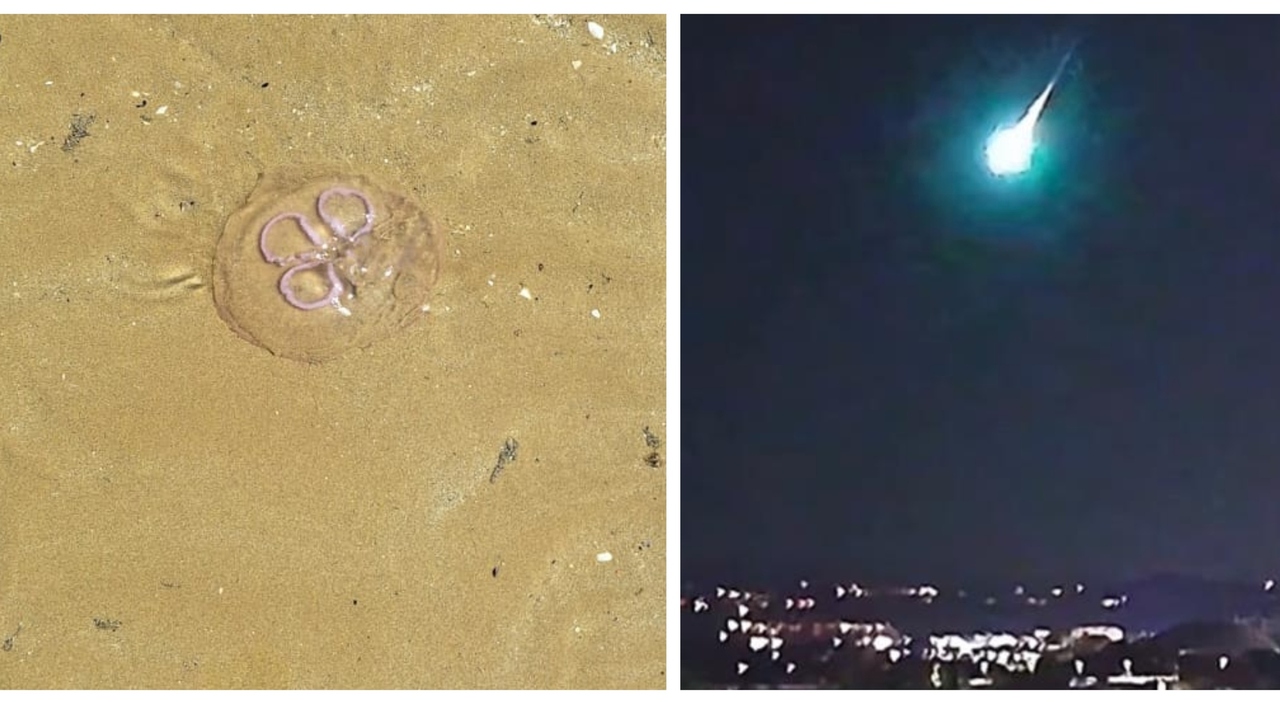
Invasion of Jellyfish, Sea Snow, Three Earthquakes, and a Fireball Lighting Up the Night: Marche’s 48-Hour Natural Spectacle — Video Highlights
In the Marche region of central Italy, a rare convergence of natural phenomena—jellyfish blooms, marine snow, three seismic tremors, and a bright fireball lighting the night sky—has drawn both scientific curiosity and public concern over the past 48 hours, prompting residents and authorities to assess environmental shifts and potential risks to coastal ecosystems and infrastructure.
The events, reported across multiple coastal towns including Senigallia, Ancona, and Porto Recanati between April 24 and 26, 2026, began with an unusual influx of Pelagia noctiluca, commonly known as the mauve stinger jellyfish, whose sudden proliferation disrupted fishing operations and led to temporary swimming bans along several Adriatic beaches. Simultaneously, marine biologists observed increased “marine snow”—organic particulate matter drifting from surface waters to the seafloor—which, while a natural process, spiked in volume, raising questions about changing plankton dynamics and carbon cycling in the basin.
“We’ve seen jellyfish spikes before, but not this early in the season and not combined with such anomalous seismic and atmospheric events. It suggests a possible disruption in the Adriatic’s thermal stratification, possibly linked to broader Mediterranean warming trends.”
— Dr. Elisa Moretti, marine ecologist at the Polytechnic University of Marche, speaking to regional environmental monitors on April 25, 2026.
Adding to the unusual sequence, three low-magnitude tremors—measuring 2.1, 1.8, and 2.3 on the Richter scale—were recorded by the Italian National Institute of Geophysics and Volcanology (INGV) off the coast of Monte Conero between 03:14 and 04:02 local time on April 25. Though too weak to cause structural damage, the quakes were felt lightly in inland towns like Osimo and Castelfidardo, prompting the Marche Civil Protection Agency to issue a precautionary advisory for residents in vulnerable hillside zones.
Shortly after the final tremor, at approximately 04:18 AM, a bolide—an exceptionally bright meteor—streaked across the night sky over the Adriatic, visible from as far away as Bologna and San Marino. The event, captured on dashcams and security footage, lasted over five seconds and ended with a silent disintegration at high altitude, leaving no debris trail. While such fireballs are not uncommon globally, their occurrence over densely populated coastal zones often prompts public inquiry into near-Earth object monitoring.
Scientists emphasize that no causal link has been established between these phenomena. Still, the clustering has reignited discussions about the Adriatic Sea’s sensitivity to climate variability. Historical data from the CMCC Foundation shows that sea surface temperatures in the central Adriatic have risen by 1.4°C since 1980, altering habitats and potentially contributing to earlier jellyfish blooms. Meanwhile, the region’s seismic activity, while generally low, sits atop the Adriatic microplate—a tectonic zone experiencing slow northward compression, which can trigger diffuse, low-energy quakes.
Environmental Monitoring and Public Safety Response
In response, the Marche Regional Agency for Environmental Protection (ARPA Marche) deployed additional sampling units along the coast to monitor water temperature, salinity, and plankton concentrations. Local municipalities, including Senigallia and Fano, activated their coastal vigilance protocols, deploying lifeguard units with vinegar-based sting kits and increasing public signage about jellyfish safety.

Meanwhile, the Italian Civil Protection Department coordinated with INGV to review seismic data, confirming no escalation in tectonic stress but recommending continued monitoring of subsurface shifts, particularly in areas with aging infrastructure or recent construction near fault-adjacent zones.
For residents and businesses affected by beach closures or fishing disruptions, access to verified environmental consultants and coastal resilience planners has develop into critical. Municipalities are now advising local fisheries to consult marine environmental assessors to evaluate long-term impacts on catch viability, while tourism operators are turning to crisis communication specialists to manage public perception and maintain visitor confidence during seasonal peaks.
“When nature sends multiple signals at once, it’s not about panic—it’s about preparedness. Our job is to connect ecological anomalies with actionable civic response, especially in regions where the economy leans heavily on the sea.”
— Luca Ferretti, Director of Coastal Risk Management, Marche Regional Government, in a press briefing on April 26, 2026.
Long-Term Implications for Adriatic Resilience
Beyond immediate safety, the convergence of events underscores the need for integrated environmental monitoring systems. Experts point to the lack of real-time, multi-parameter buoys in the southern Adriatic as a gap in early warning capacity. Unlike the Tyrrhenian Sea, which hosts several Euro-Mediterranean Seafloor Observatory (EMSO) nodes, the central Adriatic remains under-instrumented for combined bio-physical-seismic tracking.
This has prompted calls from academic institutions and environmental NGOs for expanded investment in oceanographic monitoring services, particularly platforms capable of correlating biological anomalies with geophysical data. Such systems could improve forecasting for harmful algal blooms, jellyfish swarms, and even tsunami risk assessment in the Mediterranean.
Economically, the Marche region’s reliance on coastal tourism—accounting for roughly 18% of regional GDP according to ISTAT 2025 data—means that repeated disruptions, even if brief, can have outsized impacts on small businesses. Hoteliers in Numana and Marcelli have reported a 12% drop in same-day bookings following the jellyfish alerts, though most recovered within 48 hours as conditions normalized.
Legal experts note that while no liability currently attaches to natural phenomena, municipalities may face scrutiny if emergency responses are deemed inadequate. Coastal towns are increasingly reviewing their municipal liability attorneys to ensure compliance with regional civil protection codes and EU directives on coastal zone management.
The Bigger Picture: A Sea in Transition
What unfolded over those two nights in Marche is not an isolated curiosity but a potential indicator of broader marine destabilization. The Adriatic, though small, is one of the most densely monitored seas in Europe due to its ecological and economic significance. Yet, as climate oscillations intensify and human pressures mount, its systems are showing signs of nonlinear response—where multiple stressors converge to produce atypical outcomes.
Scientists warn that without adaptive governance and sustained investment in observation infrastructure, such events may become less surprising and more symptomatic. For now, the region’s response—swift, coordinated, and grounded in scientific liaison—offers a model of resilience. But the real test lies ahead: whether communities can translate moments of awe and alarm into lasting preparedness.
As the Adriatic continues to shift beneath our feet and within its depths, the need for trusted, verified expertise—from marine scientists to emergency planners—has never been greater. For those seeking to understand, adapt, or protect, the World Today News Directory remains a vital resource for connecting with professionals who operate at the intersection of environment, safety, and public trust.