Introducing Vero: Can AI Agents Build Formally Verified Software?
Can AI Agents Build Formally Verified Software Repositories? Introducing Vero
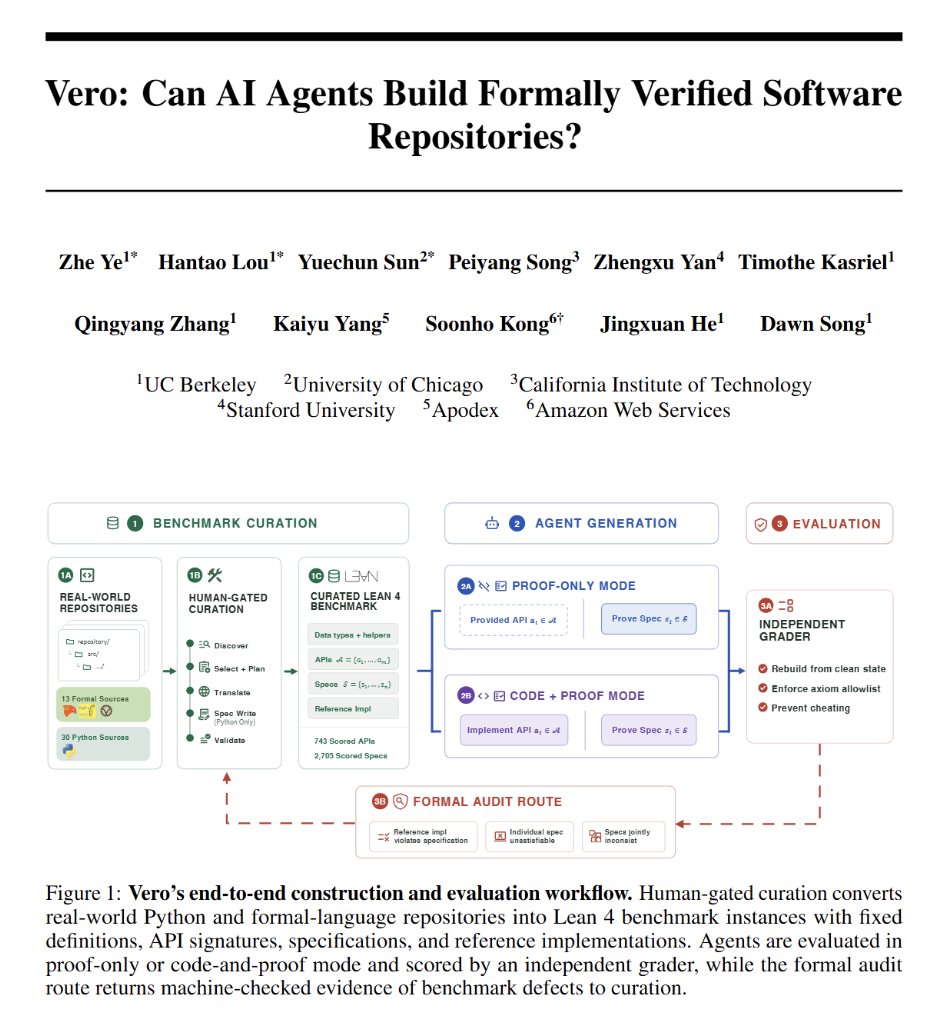
As enterprise engineering teams rush to adopt autonomous coding assistants, a major engineering bottleneck remains unaddressed: probabilistic language models write probabilistic code, but production infrastructure demands mathematical certainty. Addressing this gap, Dawn Song highlighted the release of Vero, a framework asking a critical architectural question: Can AI agents build formally verified software repositories? Detailed on arXiv under identifier 2608.13522v1, Vero shifts the developer paradigm from writing tests to specifying theorem-backed proofs that AI agents must satisfy before deployment.
The Tech TL;DR:
- The Core Innovation: Vero introduces a structure-based repository implementation model combining API signatures, canonical references, and explicit theorem proofs.
- The Verification Standard: Rather than relying on standard unit tests or integration suites, agent outputs are evaluated against formal specifications using proof assistants.
Deconstructing the Vero Architecture and API Signatures
At the center of the Vero framework is a formalization approach designed to bind agent-generated code to strict mathematical specifications. According to the published arXiv documentation, the repository structure defines explicit API signatures before any implementation logic is written. For instance, banking or ledger primitives are instantiated as explicit state transformations:
https://x.com/dawnsongtweets/status/2091215979334533597
-- API signatures
abbrev CreateAccountSig := AccountId -> Ledger -> Ledger
abbrev AccountExistsSig := AccountId -> Ledger -> Bool
abbrev GetBalanceSig := AccountId -> Ledger -> Option Balance

-- Interface structure: one field per API signature
structure RepoImpl where
  createAccount : CreateAccountSig
  accountExists : AccountExistsSig
  getBalance : GetBalanceSig
This structural rigidity forces autonomous coding agents to operate within strict type and state boundaries. By establishing a canonical implementation—instantiated to a reference implementation in proof-only mode and the agent solution in code-and-proof mode—the system prevents common logic errors that typically slip past standard continuous integration pipelines.
Specifications, Proof Obligations, and Agent Execution
The true challenge of autonomous software engineering is not generating syntax, but guaranteeing correctness under edge cases. Vero handles this by turning requirements into predicates over implementations. As detailed in the technical specifications, a property like zero-balance creation requires an explicit theorem proof obligation:
-- Specification: a predicate over implementations
def spec_create_zero_balance (impl : RepoImpl) : Prop :=
  ∀ (id : AccountId) (ledger : Ledger),
  impl.accountExists id ledger = false ->
  impl.getBalance id (impl.createAccount id ledger) = some 0

-- Theorem: Proof obligation on the canonical implementation
theorem proof_create_zero_balance : spec_create_zero_balance canonical := by sorry
When an AI agent interacts with the Vero framework, its primary objective is replacing that placeholder
Deployment Realities and Enterprise Integration
Transitioning from probabilistic code generation to formally verified repositories requires a major shift in enterprise tooling. Development teams cannot simply plug standard LLM APIs into legacy codebases and expect theorem compliance. Instead, infrastructure architects must configure development environments to support proof assistants alongside standard containerization tools.
https://x.com/dawnsongtweets/status/2091215981037469963
As autonomous software generation matures, frameworks like Vero point toward a future where code correctness is mathematically guaranteed rather than empirically inferred. By bridging the gap between large language models and formal verification systems, engineering teams gain a path toward truly reliable automated software repositories.
Disclaimer: The technical analyses and security protocols detailed in this article are for informational purposes only. Always consult with certified IT and cybersecurity professionals before altering enterprise networks or handling sensitive data.