
Carbon Markets Surge in Net-Zero Transition
Financial incentives drive global decarbonization efforts.
The carbon market is rapidly expanding, driven by investors and governments aiming to curb climate change effects. Emission credits are bought, sold, and traded like commodities, making the market a crucial tool for global economic decarbonization by pricing carbon and pushing polluters to cut emissions.
Market Dynamics
Carbon markets are split into two main types: voluntary carbon markets (VCMs) and compliance carbon markets (CCMs). VCMs are unregulated, allowing voluntary carbon offset purchases, while CCMs, also known as emissions-trading systems (ETS), are regulated by governments.
CCMs, which include ETS, are marketplace mechanisms. Regulators auction or freely distribute a limited number of carbon allowances to specific companies. Owning an allowance permits emitting one ton of a pollutant such as CO2. Companies with emissions reductions can sell unused allowances to those needing more. The goal is to efficiently price carbon, enabling markets to optimize resource use via buying credits or curbing emissions. Currently, about 30 ETS operate worldwide, encompassing 38 national jurisdictions.
EU ETS Dominance
The EU ETS is the largest, most developed system, representing approximately 90% of worldwide carbon credits turnover in 2021. The total value of global compliance carbon credits traded in 2021 reached about EUR 760 billion (USD 851 billion), a 164% rise from 2020. This growth reflects higher carbon prices and increased trading volumes.
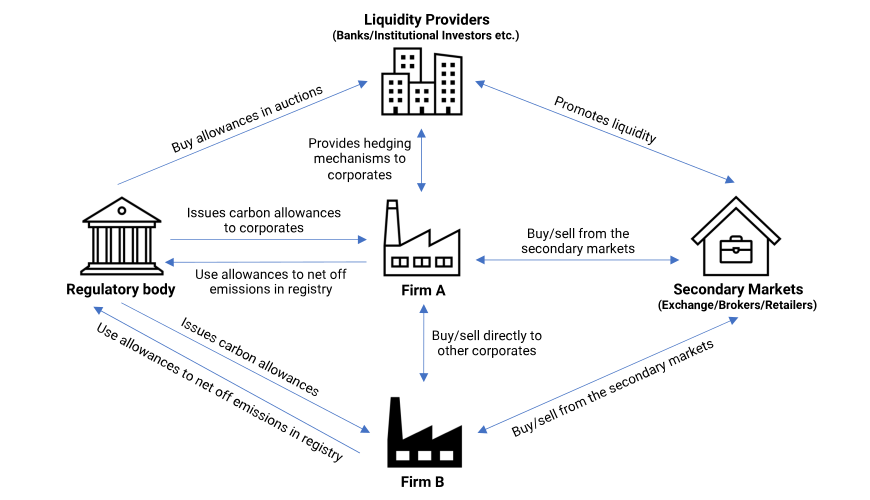
Carbon allowances are traded on both primary and secondary markets. Regulators provide allowances via primary markets. These allow companies to meet emissions goals. Companies then trade allowances on secondary markets using spot or derivatives, such as futures, options, and swaps. Several actors are involved in CCMs.
Recent Price Volatility
Recent market volatility has been driven by global macroeconomic uncertainty. The war in Ukraine and subsequent sanctions led to a ~40% drop in EU ETS carbon prices in the first quarter, before a partial recovery. The correlation between carbon and oil prices, typically positive, turned negative.
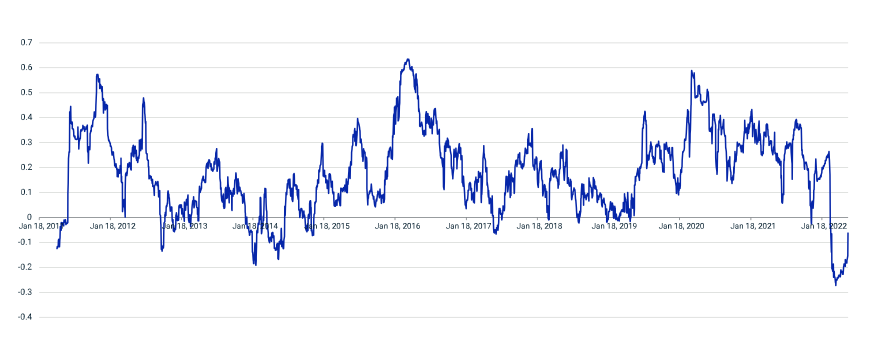
Europe’s reliance on Russian fossil fuels has caused carbon market shocks due to energy price volatility. Some nations shifted back to coal, increasing demand for carbon allowances. The fall in EU carbon prices in March 2022 was potentially due to market sell-offs, economic concerns, and the allocation of 2022 free allowances. Despite volatility, regulators are committed to the “Fit for 55” plan, aiming for a 55% reduction in net greenhouse-gas emissions by 2030 compared to 1990 levels.
The carbon market’s potential hinges on its link to achieving net-zero emissions. As of December 2023, global carbon credit prices are expected to reach a record high of $100 per ton, a significant increase from previous years, fueled by demand and policy changes (Reuters).
