
Interstellar Object 3I/Atlas Zips Through Solar System, Offers Rare Research Opportunity
Table of Contents
- Interstellar Object 3I/Atlas Zips Through Solar System, Offers Rare Research Opportunity
- Discovery and Trajectory of 3I/Atlas
- The Meaning of Interstellar Visitors
- A Unique Research Opportunity
- Time is of the Essence
- Future Discoveries
- Evergreen Insights: Understanding Interstellar Objects
- frequently Asked Questions About Interstellar Objects
- What are the key characteristics of interstellar objects?
- How do astronomers detect interstellar objects?
- What are the challenges in studying interstellar objects?
- What future missions are planned to study interstellar objects?
- How do interstellar objects contribute to our understanding of the universe?
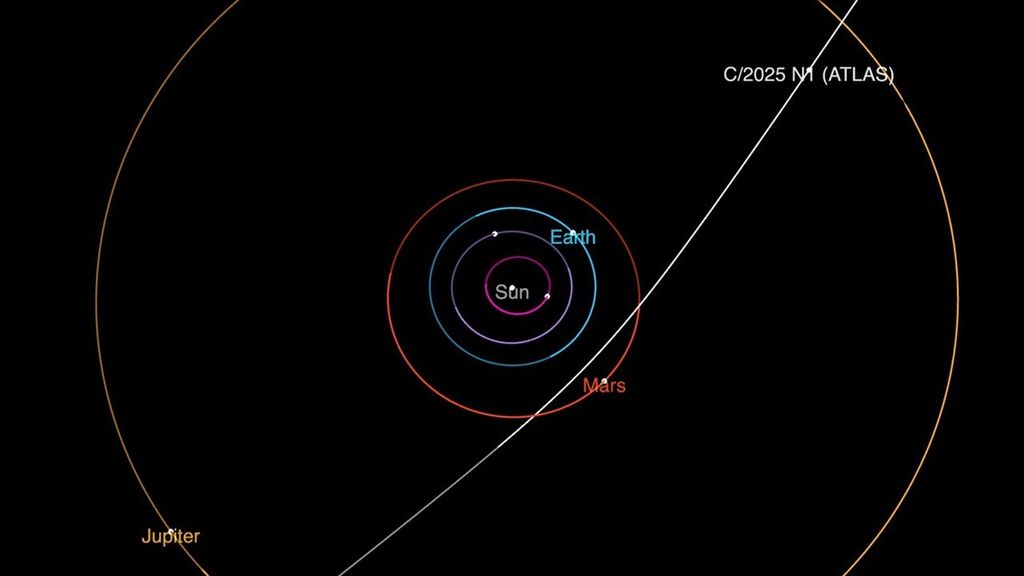
Racing towards the sun at over 124,000 miles per hour, an interstellar object, designated 3I/Atlas, is currently traversing our solar system, presenting a rare opportunity for astronomers. This celestial wanderer, originating from beyond our solar system, marks only the third time such an object has been observed, following ‘Oumuamua in 2017 and 2I/Borisov in 2019.
Discovery and Trajectory of 3I/Atlas
Astronomers using telescopes in Chile first spotted 3I/Atlas on Tuesday. Over one hundred observations have since confirmed its trajectory, solidifying its interstellar nature. As 3I/Atlas approaches the sun, its speed will increase, offering a fleeting but invaluable chance for study.
Did You Know? The Vera Rubin Observatory in Chile,which recently opened,is expected to substantially increase the discovery rate of interstellar objects in the coming years.
The Meaning of Interstellar Visitors
Lucas ellerbroek, an astronomer, emphasizes the rarity of these interstellar objects. These objects likely formed around distant stars and were ejected into interstellar space long ago. Unlike typical solar system bodies that orbit a star, these objects travel at immense speeds, perhaps propelled by gravitational interactions with other celestial bodies, a process akin to “cosmic billiards.”
A Unique Research Opportunity
For planet researchers, 3I/Atlas represents a golden opportunity to examine an object from another star system. Its shape, structure, and brightness can reveal clues about its history and composition. Scientists speculate that 3I/atlas might be a “lingered comet,” an icy body capable of developing a tail as it nears the sun.
Pro Tip: Comparing data from interstellar objects with those of our solar system can provide insights into the formation of planetary systems.
By comparing data from 3I/Atlas with objects within our own solar system,scientists hope to understand the object’s journey and composition. Determining if it’s an asymmetrical rock,like many asteroids and comets in our system,and analyzing its composition could contribute to understanding how planetary systems form.
Time is of the Essence
A key challenge in studying interstellar objects is their rapid transit through the solar system. They typically exit within months and never return. The relatively early detection of 3I/Atlas provides a significant advantage, allowing for more comprehensive study before it disappears from view.
| Object Name | Year of Passage | Notable Feature |
|---|---|---|
| ‘Oumuamua | 2017 | First observed interstellar object |
| 2I/Borisov | 2019 | Cometary nucleus and tail |
| 3I/Atlas | 2025 | Opportunity for early and detailed study |
Future Discoveries
The Vera Rubin Observatory,with its advanced capabilities,is expected to detect an increasing number of interstellar objects in the coming years,revolutionizing our understanding of these cosmic wanderers.
Evergreen Insights: Understanding Interstellar Objects
Interstellar objects provide a unique window into the formation and composition of planetary systems beyond our own. Their study helps scientists understand the diversity of celestial environments and the processes that shape them. The discovery of more interstellar objects will refine our models of galactic evolution and the distribution of matter in the universe.
the study of comets and asteroids, including interstellar ones, is crucial for understanding the early solar system and the delivery of water and organic molecules to Earth. NASA’s OSIRIS-REx mission, which successfully collected a sample from asteroid Bennu, exemplifies the importance of asteroid research. Similarly,the European Space Agency’s Rosetta mission provided unprecedented insights into cometary composition and behavior.
frequently Asked Questions About Interstellar Objects
What are the key characteristics of interstellar objects?
Interstellar objects are characterized by their high velocities and trajectories that indicate they originate from outside our solar system. They often have unique compositions and structures compared to objects formed within our solar system.
How do astronomers detect interstellar objects?
Astronomers use powerful telescopes and refined algorithms to identify objects with hyperbolic trajectories, indicating they are not gravitationally bound to the sun. These objects are then studied using various observational techniques to determine their properties.
What are the challenges in studying interstellar objects?
The primary challenges include their short transit time through the solar system, their faintness, and the difficulty in obtaining detailed measurements before they disappear from view. Early detection and rapid response are crucial for maximizing the scientific return.
What future missions are planned to study interstellar objects?
While there are no dedicated missions currently planned to intercept an interstellar object, future space telescopes and observatories will play a crucial role in detecting and characterizing these objects. Additionally,advancements in propulsion technology could enable future missions to rendezvous with and study interstellar objects in greater detail.
How do interstellar objects contribute to our understanding of the universe?
Interstellar objects provide valuable insights into the building blocks of planetary systems throughout the galaxy. By studying their composition and structure, scientists can learn about the conditions in other star systems and the processes that lead to the formation of planets.
What questions do you have about interstellar objects, and what further research would you like to see conducted? Share yoru thoughts in the comments below!
