Inside Honjo Mudguards: Three Generations of Handmade Bicycle Fenders in Tokyo
In a photo essay published for The Radavist, longtime cycling journalist John Watson argues that Tokyo’s Honjo Mudguards endures as a working example of three-generation Japanese craft, producing handmade bicycle fenders and bells in the same eastern Tokyo workshop since 1949.
The piece, the third and final entry in Watson’s Reportage series on Japan’s legacy makers, was produced in collaboration with Slow Spin Society and documents a shop visit timed to The Radavist’s 20th anniversary.
Watson, who says he has traveled to Japan eight times since the early 2000s, reports the workshop sits in the Honjo neighborhood of Tokyo’s Sumida Ward, at the base of the Skytree tower. The visit, The Radavist reported, closed out a three-day run of shop visits in as many days, each documented with a manual-focus rangefinder camera.
Why does one small fender workshop warrant a feature? Watson’s answer, spread across the essay, is scale and continuity: roughly four people, working with machines built between the 1940s and the 1970s, still make every bracket, stay, and fender by hand from raw metal sheet.
Three generations at the presses
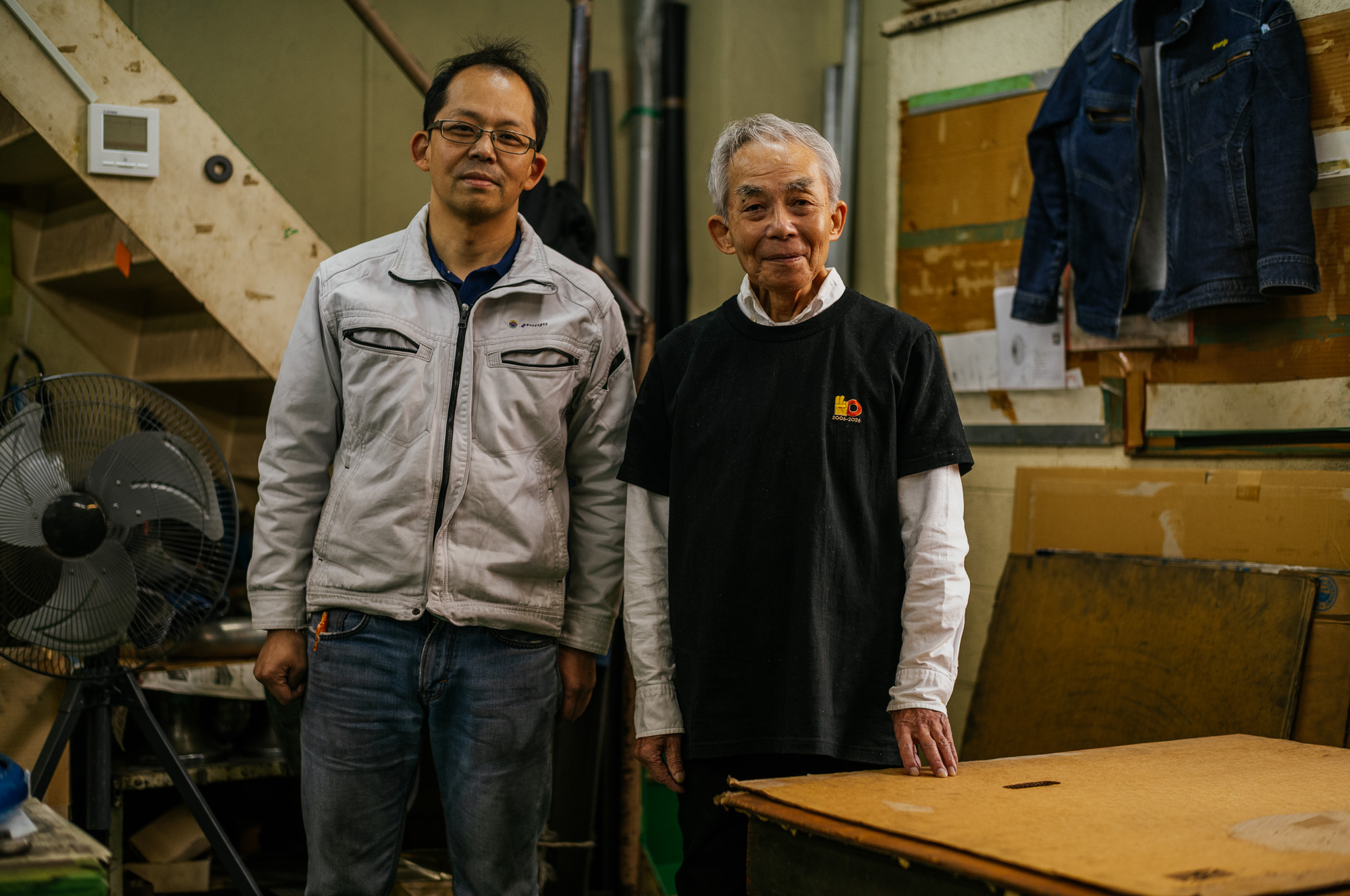
According to the essay, Matashiro Shimamura founded Honjo Mudguards in 1949. His son, Yukio Shimamura, later took over, and the operation now runs under Tomoyuki Shimamura, known to Watson as Tomo-san, with a small staff. The workshop covers approximately 2,000 square feet across two levels, and the Shimamura family lives in a small apartment on the building’s third floor, The Radavist reported.
Watson writes that the family lives “close enough to never escape the smell of cutting fluid or the thuds of machinery,” and frames the arrangement as the family’s legacy rather than a hardship.
The machinery inventory tells its own story. A giant hydraulic press once used for motorcycle fenders still occupies the shop floor. Motorcycle work now accounts for about 5 percent of the company’s market, with the remaining 95 percent split between bicycle fenders and bells, The Radavist reported.
How a Honjo fender takes shape
The essay lays out the production process in detail. Raw material arrives in rolls of varying widths — eight in all — each roughly a kilometer long and yielding about 500 pairs of fenders. Honjo works primarily in aluminum, with some brass and stainless steel.
Each roll feeds through a die press along a conveyor fitted with seven dies that form the fender’s lips. The formed coil is then cut to wheel diameter, and the pieces move through either fluting on the large press or radiusing for flatter profiles. Watson reports that flat fenders move quickly, while fluted and hammered profiles demand 40 minutes to an hour of hand and machine work apiece.
The hammer-finishing step, Watson writes, is proprietary. Tomo-san described it to him as “a family secret.”
Finished forms head upstairs via freight elevator, where an employee trims, hand-polishes, and labels each fender before it goes into a plastic sleeve for shipping. Because of the shop’s scale, Honjo operates on a per-order fulfillment system; when a customer such as Sim Works orders 100 fenders, the team works the punch list start to finish, according to the essay.
The Turtle Bell bottleneck
One product strains the shop’s equipment. Sim Works launched its Turtle Bell collaboration with Honjo in 2019 after three years of development, and it was the first product outside a new fender profile that Honjo had taken on since its founding, The Radavist reported.
The brass forming requires 75 tons of pressure. Honjo’s press tops out at 55 tons, so the company outsources the initial brass forming to a nearby shop. The bell bodies then undergo three die passes that press in a recessed hexagon pattern before hand assembly.
The math is unforgiving. Assembly takes 40 minutes per bell, capping annual output at 200 bells, with a six-month lead time. Sim Works keeps a permanent purchase order with Honjo and sells out constantly, Watson reports — his advice to readers who spot one in stock is to act quickly.
| Measure | Figure |
|---|---|
| Press force Honjo owns | 55 tons |
| Pressure Turtle Bell forming requires | 75 tons |
| Bells produced per year | 200 |
| Turtle Bell lead time | 6 months |
A collaboration with the next generation
The trip itself doubled as a handoff between cycling media generations. Watson reports that The Radavist, marking 20 years of covering cycling communities, partnered with Paul of Slow Spin Society, who also works for Sim Works’ European operations and served as the trip’s translator.
The collaboration took the form of storytelling: Paul conducted a deep-dive interview with Tomo-san, published separately on Slow Spin Society, while Watson handled the photographic documentation for The Radavist. Watson’s account of the workflow — roughly 600 images culled to 200, then to the final published gallery — appears in the essay.
Not every detail of the trip was glamorous. “My hair smells like gear oil,” Watson quotes his travel companion Cari saying as they prepared for dinner with Masashi after the shoot.
Why the piece matters beyond cycling
Watson’s larger argument is economic and cultural. He contrasts a Western definition of legacy, which he writes has been lost to globalization, with a Japanese philosophy of handmade craft still visible in shops like Honjo — traditions he describes through the concepts of folk-craft making and life purpose, rendered in English as Mingei and Ikigai.
The products that emerge, he writes, are “designed to withstand a lifetime’s worth of use, fully repairable, with replacement parts readily available.”
For readers weighing a purchase, Watson offers a reframing rather than a price argument. He writes that he will no longer consider Honjo fenders too expensive; instead, he considers which bicycle is worthy of them.
The essay closes on the dichotomy Watson kept returning to after the series: industrial spaces covered in gear oil and decades of patina, pressing metal under tons of hydraulic force, yet producing what he calls the shiniest, highest-quality bicycle parts in the world — made the same way since 1949.