Indonesia’s House Passes Asset Forfeiture Law for Seizures Without Conviction
Indonesia’s House of Representatives passed a landmark asset forfeiture law on Thursday, enabling authorities to seize assets linked to criminal activity without requiring a prior criminal conviction.
The legislation, officially passed during a plenary session on Nov. 19, 2026, concludes 18 years of legislative stagnation following its initial proposal in 2008. The bill, which consists of 74 articles, was endorsed following committee-level deliberations completed the previous day.
The new law introduces a non-conviction-based forfeiture mechanism that applies to assets valued at 1 billion rupiah, or approximately $54,885, according to reports from News.Az. The framework specifically targets proceeds derived from corruption, narcotics offenses, and various forms of fraud, including cryptocurrency-related crimes and online gambling.
“There is a shift in the paradigm of justice and recovery that makes the immediate passage of this law necessary,” said Habiburokhman, chair of House Commission III, as reported by The Jakarta Post.
He said that the law aims to prioritize asset recovery to compensate the state and victims, addressing limitations in conventional criminal proceedings. During the legislative process, the Commission III working committee discussed 397 problem inventory lists covering substantive and editorial matters.

The legislation allows investigators to pursue assets held by suspects who have fled, died, or become permanently ill. In cases where suspects remain at large, prosecutors may seek confiscation if the individual has been on a police wanted list for at least 60 days. If the fugitive is apprehended during the hearing process, the confiscation application is paused to allow the criminal case to proceed, CNA reported.
Government and Parliamentary Representation
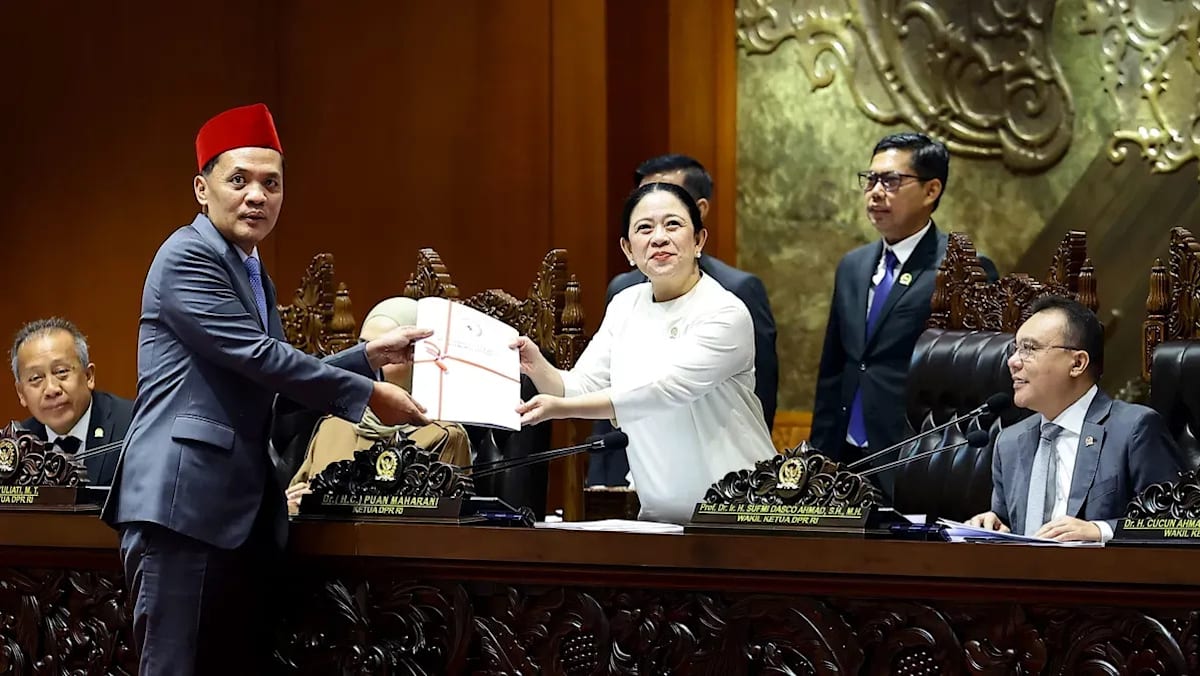
The plenary session was chaired by House Speaker Puan Maharani. All eight party factions in the House voted to approve the bill. The government was represented at the session by Administrative and Bureaucratic Reforms Minister Rini Widyantini and Deputy Law Minister Edward Omar Sharif Hiariej, who attended in place of Minister Supratman Andi Agtas.
On Nov. 18, 2026, Hiariej and Deputy State Secretary Bambang Eko Suhariyanto had formally submitted the government’s position on the bill to Deputy House Speaker Sufmi Dasco Ahmad and Commission III leaders at the parliamentary complex in Senayan, Jakarta.
Public Pressure and Transparency
The legislative momentum accelerated following public demonstrations, including an August 27 protest at the DPR building by the Pati United Community Alliance (AMPB), which demanded both the death penalty for corruptors and the forfeiture of their assets. Despite the passage, the process faced criticism regarding transparency.
Authority and Oversight Mechanisms
To address concerns regarding potential abuse of power, the law mandates the establishment of an independent Asset Forfeiture Management Agency and a separate supervisory body. Habiburokhman said that these institutions are intended to ensure the law is not utilized as a tool for extortion. Members of the supervisory agency will be appointed by the president, subject to approval by the House.

The legislation also provides a pathway for third parties to contest the seizure of property if they can prove they are legitimate owners who acquired the assets in good faith. Objections must be filed after the application is publicized but before the court issues a first-instance ruling. If an objection is successful, the property must be returned.
Indonesia, the world’s largest archipelagic state with more than 13,000 islands spanning Southeast Asia and Oceania, has a population exceeding 290 million, making it the fourth most populous nation and home to the largest Muslim population globally.
The country proclaimed independence after World War II, ending Dutch colonial control that had expanded across the archipelago by the early 20th century. Since then, it has navigated separatist conflicts, political upheaval, and corruption alongside democratisation and rapid economic growth, emerging as a presidential republic and the largest economy in Southeast Asia.
The law will take effect 12 months after the Asset Management Agency is formally established, according to Kompas. The government confirmed that criminal prosecution remains active, and existing sentencing guidelines—including the potential for the death penalty in qualifying cases—remain in effect.