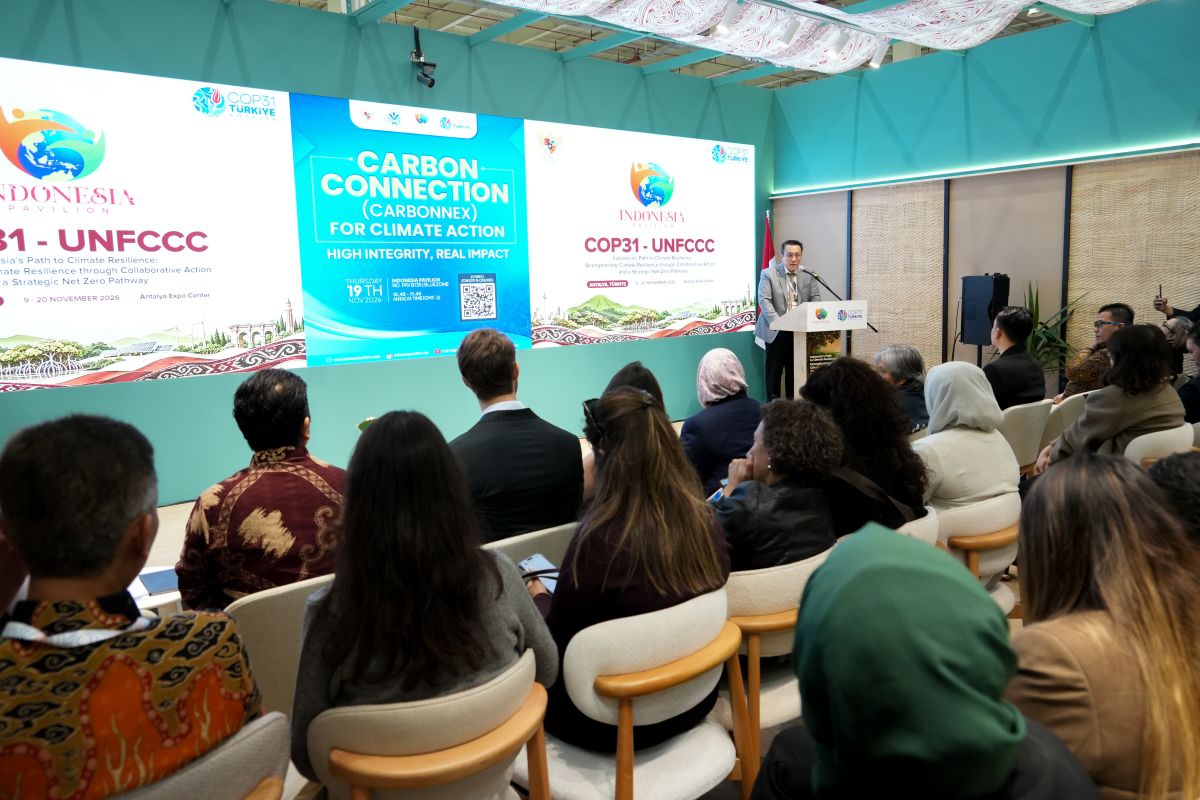
Indonesia Secures Seven Cooperation Outcomes at COP31 CarbonNex
Indonesia secured seven cooperation outcomes at the COP31 climate summit in Antalya, Türkiye, including its first agreement under Article 6.2 of the Paris Agreement to reduce emissions by 12 million tonnes of CO₂ equivalent by 2038.
The deals were finalized during the 10-day Carbon Connection Session (CarbonNex), which concluded recently at the Indonesia Pavilion, Ecobiz Asia reported.
- Indonesia’s first Article 6.2 agreement involves floating solar power and battery storage projects managed by PT PLN (Persero) and the Global Green Growth Institute.
- The Ministry of Environment and Environmental Control Agency (KLH/BPLH) launched the Indonesia Climate and Carbon Partnership (ICCP) on Nov. 10 to link national priorities with international financing.
- State-owned utility PT PLN (Persero) mobilized US$2.94 billion in energy transition financing, including US$1.1 billion through the Just Energy Transition Partnership.
The primary Article 6.2 arrangement, signed with the Norwegian Article 6 Climate Action Fund, establishes a pathway for international carbon transactions. According to Eurasia Review, the mitigation outcome purchase agreement sets a price of US$20–40 per tonne for the emission reductions achieved through PLN’s renewable projects.
“We want to become a market with integrity,” said Diaz Hendropriyono, Deputy Environment Minister and Deputy Head of the Environmental Control Agency. “With integrity, Indonesia can become a dominant player in global carbon trading because we have forests, mangroves and projects, and now we have credible regulations.”
Regulatory Framework and Market Expansion
Indonesia is positioning its forestry sector and nature-based solutions to meet rising international demand from markets in Singapore, Japan, and the ICAO-CORSIA aviation scheme, Tempo reported. Government data from 2025 cited by the Ministry of Forestry places the nation’s forest carbon potential at 13.4 gigatons of CO₂.

Haryo Pambudi, director of carbon economic value implementation governance at KLH/BPLH, said that international partners are currently preparing further cooperation arrangements through the ICCP. “This is important for strengthening Indonesia’s partnerships, particularly in implementing Article 6.2,” he said.
Government Plans Consolidate Partnerships by 2027
Eurasia Review said that Indonesia’s nickel processing industry relies heavily on captive coal-fired power plants, consuming more than 81 terawatt-hours of electricity in 2025. The current floating solar initiatives are not yet scaled to replace these industrial energy sources.
The government plans to consolidate all partnerships identified through the ICCP with relevant ministries and sectors throughout 2027. Officials must still finalize public consultations regarding national roadmaps and the authorization of carbon credits. Whether these regulatory steps will satisfy the demand for 200 million to 250 million carbon units projected by the aviation sector by January 2028 remains to be determined.