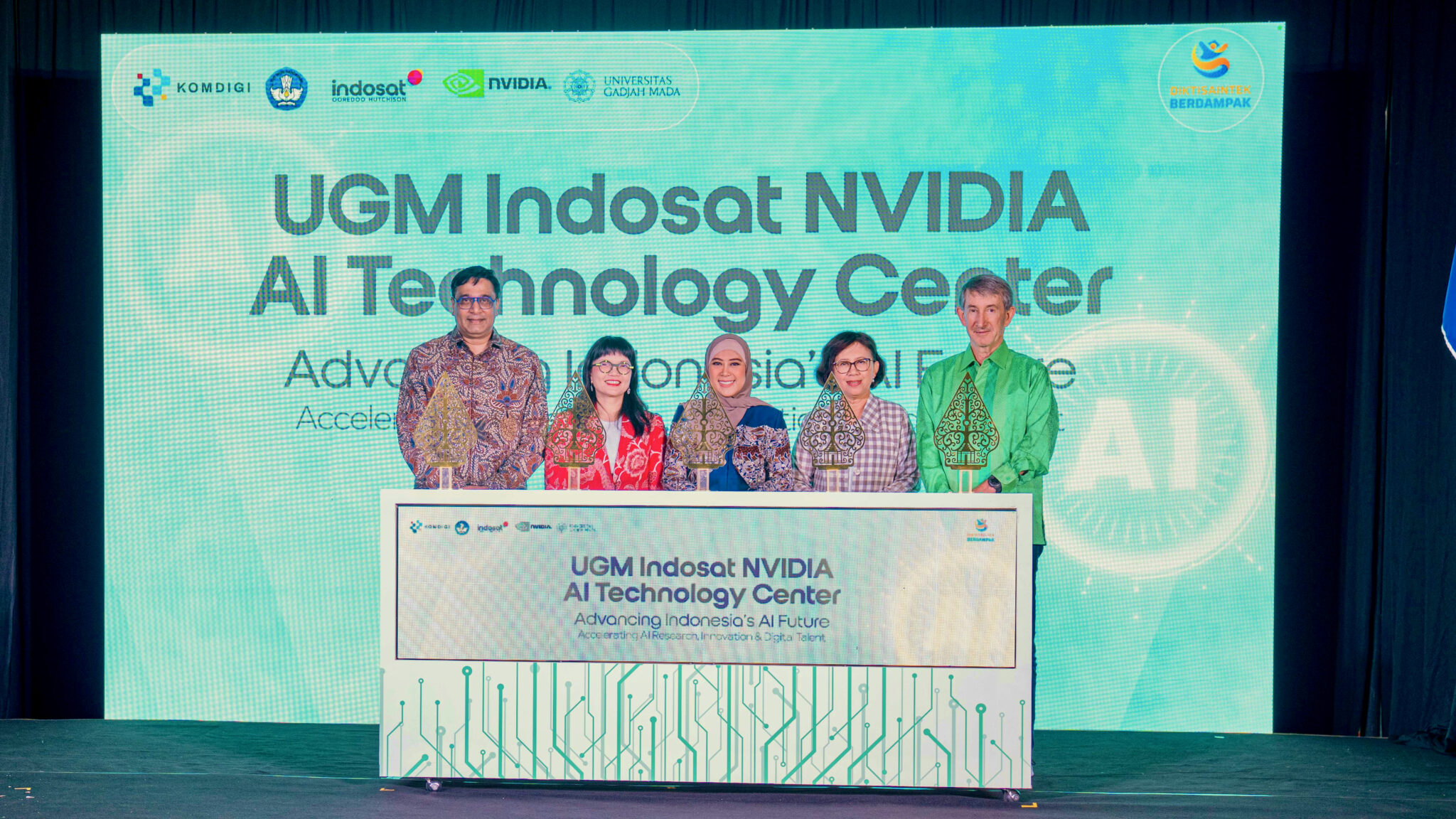
Indonesia Launches First University-Based AI Technology Center with NVIDIA and Indosat
UGM Indosat NVIDIA AI Center: Accelerating Indonesia’s Sovereign Compute Stack
The Ministry of Communication and Digital Affairs (Komdigi), in partnership with Indosat Ooredoo Hutchison (IOH), NVIDIA, and Universitas Gadjah Mada (UGM), has officially launched the UGM Indosat NVIDIA AI Technology Center (NVAITC) in Yogyakarta.
The Tech TL;DR:
- Sovereign Compute: The center utilizes Indosat’s “GPU Merdeka” platform, a GPU-as-a-service (GPUaaS) model designed to provide domestic researchers with access to NVIDIA’s full-stack accelerated computing.
- Localized AI Development: Initial projects are focused on high-impact domain-specific models, including TB detection (eNose-TB), precision agriculture (SmartAgri), and geospatial disaster response.
The UGM Indosat NVAITC operates as a localized hub for high-performance computing (HPC). By leveraging NVIDIA’s full-stack platform, the center provides researchers and students with access to enterprise-grade accelerated computing, AI software, open source, pretrained models, development frameworks and technical mentorship. According to Marc Hamilton, Vice President of Solutions Architecture and Engineering at NVIDIA, the facility is designed to bridge the gap between theoretical research and production-grade deployment by utilizing NVIDIA Nemotron models.
For organizations operating in Indonesia, the lack of local high-density compute has historically necessitated reliance on international cloud regions.
Implementation: Deploying Localized Inference Pipelines
curl -X POST https://api.gpu-merdeka.id/v1/models/smartagri-v1/predict
     -H "Authorization: Bearer $API_KEY"
     -H "Content-Type: application/json"
     -d '{
           "sensor_data": {"moisture": 0.42, "temp": 28.5},
           "geo_coords": {"lat": -7.7704, "long": 110.3777},
           "inference_mode": "edge-optimized"
         }'
Domain-Specific AI: Healthcare and Geospatial Resilience
The center’s research roadmap is categorized into three primary functional domains. The eNose-TB project, led by dr. Dian Kesumapramudya Nurputra, targets the automation of tuberculosis screening. By deploying AI on breath-analysis sensor arrays, the team aims to bypass the need for centralized laboratory infrastructure. This represents a significant optimization in the healthcare delivery pipeline, moving diagnostic capabilities closer to the patient in rural, underserved regions.
Simultaneously, the Tech4Disaster project utilizes geospatial AI to process satellite telemetry. Given Indonesia’s position on the Pacific Ring of Fire, the system is engineered for rapid situational awareness.
Framework C: Infrastructure Comparison Matrix
| Feature | UGM Indosat NVAITC | Traditional Public Cloud (Offshore) |
|---|---|---|
| Data Residency | Local (Sovereign) | Variable (Often International) |
| Latency | Ultra-Low (Domestic Backbone) | High (Cross-Border Transit) |
| Compute Access | Dedicated GPUaaS | General Purpose/Shared |
The establishment of this center does not replace the need for robust cybersecurity posture.
The Trajectory of Localized AI Sovereignty
The UGM Indosat NVIDIA AI Technology Center serves as a proof-of-concept for how regional powers can secure their own technological future through domestic infrastructure. By focusing on the intersection of hardware (GPU Merdeka) and domain-specific software (Nemotron models), the initiative moves beyond the “AI as a service” consumption model.
Disclaimer: The technical analyses and security protocols detailed in this article are for informational purposes only. Always consult with certified IT and cybersecurity professionals before altering enterprise networks or handling sensitive data.