
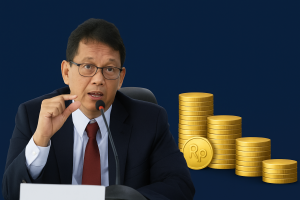
Increased Regional Transfers Approved for 2026 State Budget
The Indonesian Ministry of Finance and the House of Representatives’ Budget Committee have reached an agreement to increase regional transfers (TKD) in the 2026 state budget, responding to concerns over recent increases in local taxes and potential social unrest.
Initially, the 2026 State Budget (RAPBN 2026) proposed a 24.7 percent decrease in TKD compared to 2025 levels, triggering widespread objections from regional governments. However, the allocation will now rise to Rp692.995 trillion (US$39 billion),an increase of Rp43 trillion from the originally planned Rp649.995 trillion.
House Budget Committee Chairman, Said Abdullah, announced the adjustment following requests from various DPR commissions during a hearing with the Finance Ministry on September 18, 2025. He specifically linked the previous proposed cut to TKD as a contributing factor to the surge in land and building tax (PBB) bills observed in several regions.
Finance Minister Purbaya Yudhi Sadewa emphasized that the revision incorporated feedback from local governments, stating, “This is to maintain short-term social and political stability in the regions.”
The increase in PBB has sparked public outcry in areas like Pati Regency, Central java, prompting analysis of the underlying financial pressures on local governments.
Economist Syafruddin Karimi of Andalas University explained that declining TKD allocations from the central government, combined with increasing mandatory spending, have compelled regional leaders to seek alternative revenue streams, including raising PBB. “Dwindling local cash reserves forced regional heads to raise PBB,” he stated.He further argued that public protests are justified, emphasizing the need for fiscal policies that are “proportional, fair, and aligned with people’s economic capacity.”
Syafruddin warned that a lack of fiscal balance could erode local government legitimacy and possibly escalate social unrest, noting, “The wave of protests against PBB hikes reflects social anxiety rooted in everyday economic realities.” He also pointed out that the increased PBB burden has not been accompanied by corresponding improvements in public services, negatively impacting household purchasing power and leaving infrastructure projects like road repairs and healthcare facilities lagging.
Mohammad Faisal, Executive Director of the Center of Reform on Economics (CORE) Indonesia, highlighted the broader issue of limited fiscal capacity among Indonesian local governments. “Only a small number of regions have a sufficiently healthy fiscal capacity,” he said.
