India’s First Bullet Train: Cost Hikes, Delays and the Push for Indigenous Technology
India’s first high-speed rail corridor linking Mumbai and Ahmedabad faces significant delays and cost increases. Originally sanctioned in 2015 at Rs 980 billion, the project cost has risen to approximately Rs 2.1 lakh crore, according to reporting by The Times of India. Operations are now slated to begin partially in August 2027.
Sanctioned Budgets and Escalating Expenses
The Mumbai–Ahmedabad high-speed rail project was originally approved with a financing structure backed by the Japan International Cooperation Agency (JICA) and budgetary allocations. Japan agreed to finance up to 81 per cent of the project cost through a loan carrying an interest rate of 0.1 per cent per year, repayable over 50 years with a 15-year moratorium. Despite the favorable financing terms, the financial scope expanded dramatically over the decade.
The Times of India noted that the estimated cost has nearly doubled from an initial figure of around Rs 1.1 lakh crore to approximately Rs 2.1 lakh crore. In January, railway board chairperson Satish Kumar stated that the project cost had risen by about 83% to Rs 1.98 lakh crore. The Ministry of Railways placed a proposal before the Cabinet seeking approval for this revised cost estimate.
Real estate acquisitions and project modifications created financial strain.

Land Acquisition Hurdles and Procurement Disagreements
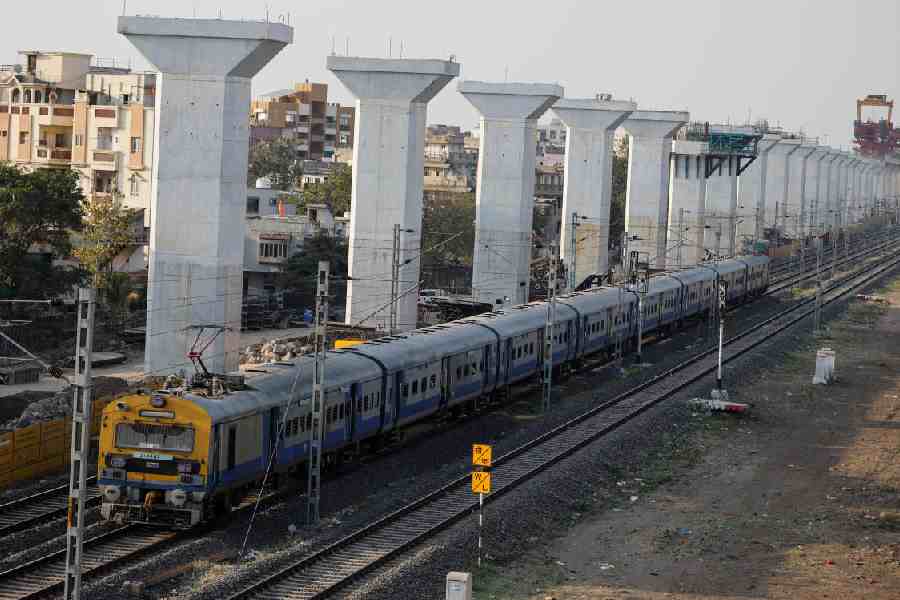
Delays in acquiring land, particularly in Maharashtra, combined with statutory clearances and finalization of train sets, drove the schedule adjustments. Prime Minister Narendra Modi laid the foundation stone for the corridor in September 2017. The pandemic and prolonged land acquisition processes pushed the original 2023 completion target back significantly.
Disagreements also emerged between Indian and Japanese stakeholders over technology integration and procurement strategies. Friction was reported regarding the signaling system, which was handed over to the German industrial group Siemens—a key competitor to Japanese firms—and discussions over the extent of domestic technology indigenization.
The Japanese side maintained that a bullet-train network must function as an integrated package where tracks, signaling, and rolling stock operate in unison for safety and reliability. Conversely, Indian officials advocated for domestic participation and flexibility, including the development of indigenous high-speed trains.
India Plans Phased Rollout with Domestic Trains
The National High Speed Rail Corporation Limited (NHSRCL), jointly owned by the central government and the state governments of Maharashtra and Gujarat, is executing the 508-kilometer corridor. The route features 12 stations: Mumbai, Thane, Virar, Boisar, Vapi, Bilimora, Surat, Bharuch, Vadodara, Anand, Ahmedabad, and Sabarmati.
Rather than launching the entire corridor simultaneously, India plans to open a limited 100-kilometer stretch between Surat and Bilimora in August 2027. Initial services on this segment will utilize slower, domestically manufactured trains.
Concurrent with the Japanese Shinkansen technology deployment, India is advancing its own high-speed rail manufacturing ambitions. The Integral Coach Factory (ICF) in Chennai awarded BEML Limited an 866.87 crore rupee contract to design and manufacture two prototype bullet train sets capable of 280 kmph. These indigenous trainsets are expected to roll out in 2027, with anticipated manufacturing costs ranging from Rs 390 crore to Rs 400 crore per train.
Ridership Projections Face Global High-Speed Rail Challenges
Economic viability remains a central consideration alongside technical milestones. Initial assessments projected a daily ridership of approximately 36,000 passengers in both directions for 2023, with estimates scaling up to 1.86 lakh passengers a day by 2053. Fares are expected to run approximately 1.5 times the AC first-class rate on conventional trains.
While the full corridor between Mumbai and Ahmedabad is now targeted for completion by 2030, the government is already looking toward expansion. Seven additional high-speed rail routes are under consideration, including Bengaluru-Chennai, Bengaluru-Hyderabad, and Bengaluru-Pune-Mumbai.
Timeline Uncertainties and Unresolved Approvals
Cabinet approval for the revised Rs 2.1 lakh crore financial estimate remains pending following the proposal submitted by the railway ministry. While Sanae Takaichi and Prime Minister Narendra Modi highlighted strong bilateral ties during a summit in New Delhi, and Tokyo acknowledged New Delhi’s plan to start limited high-speed operations next year, full clarity on the final budgetary allocations and exact operational timelines for the remaining sections of the 508-kilometer corridor awaits formal administrative sanction.