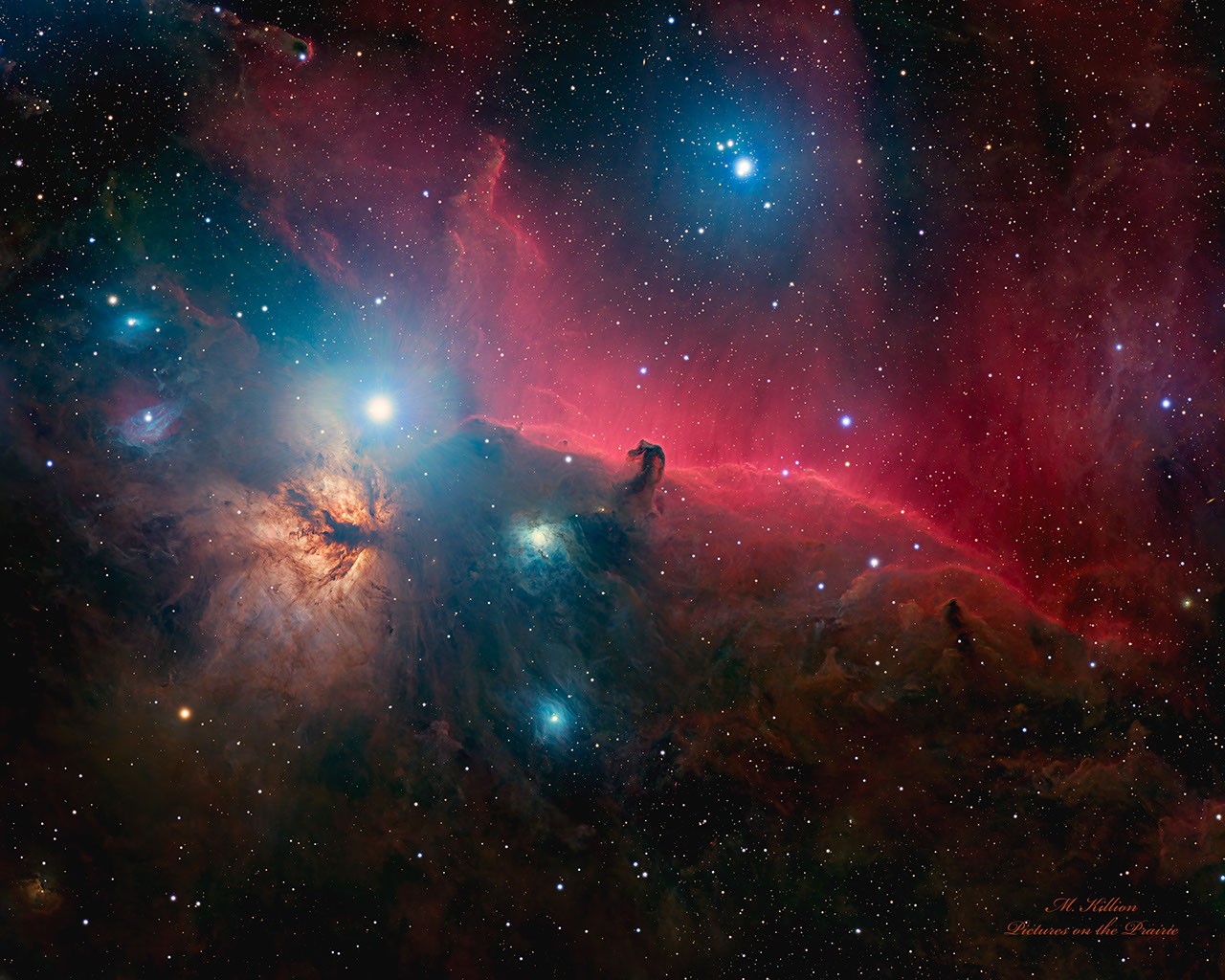
Illinois Astrophotographer Remotely Captures Horsehead and Flame Nebulae
NASA’s Astronomy Picture of the Day for November 19, 2026, went to an image of the Horsehead and Flame Nebulas captured by an astrophotographer who never stood under the sky he photographed.
The equipment sat at Utah Desert Remote Observatories while the photographer controlled it remotely from his home in Illinois, more than 2,000 kilometers away, according to NASA Science.
The data for the picture were collected over almost six hours. NASA’s explanation described the result as a scene that “could have been a painting.”
The image centers on the Horsehead Nebula, a dark formation of dust and gas in Orion whose equine silhouette stands out against the glow behind it. That red glow comes from hydrogen gas ionized by the bright star Sigma Orionis at the top of the frame. The Horsehead is about five light-years tall and lies approximately 1,500 light-years away.

To its left, the orange Flame Nebula shows dark filaments against its glow. The brightest star in the image, left of center, is blue Alnitak — known as “the Girdle” — a triple star system and the easternmost star in Orion’s Belt. Closer to the Horsehead, the blue reflection nebula NGC 2023 is actively forming stars, according to NASA’s explanation, written by a professional astronomer.
The picture is credited to Mark E. Killion, per the APOD listing. Its editors were listed as Cecilia Chirenti, Robert Nemiroff, Jerry Bonnell and Keighley Rockcliffe. The Astronomy Picture of the Day is a service of ASD at NASA’s Goddard Space Flight Center, NASA Science Activation and Michigan Technological University, and features a different image each day with a brief explanation.
APOD said that the previous day’s image, on November 18, was a medium-sized solar flare. What tomorrow’s picture will show — “what’s next?” as NASA’s page put it — is not yet announced.