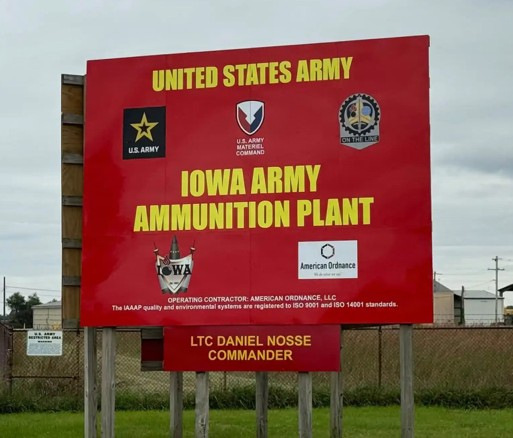
Illinois Agencies on Standby After Successful Lead Azide Detonation at Iowa Army Ammunition Plant
Nearly five tons of degraded lead azide detonated at the Iowa Army Ammunition Plant on Wednesday morning, prompting state agencies across the Mississippi River in Illinois to remain on standby despite federal sensors detecting no airborne lead.
Detonation in Middletown
The controlled blasts occurred at 9 a.m. on November 25, 2026, destroying approximately 9,700 pounds of the sensitive military explosive stored across 68 drums in Middletown, Iowa. The material, used since World War I as a primer for larger charges, had been housed at the U.S. Army facility since 2009. An inspection in March revealed that the compounds had partially crystallized, making them increasingly susceptible to friction and cold temperatures.
“Inaction is no longer an option,” Maj. Gen. Eric Shirley said before the blast.
Following the explosions, Shirley said that the operation exceeded expectations and eliminated the stockpile safely. “I believe absolutely that we reduced as close to zero as is absolutely humanly possible the risk to the health and safety of the people of Middletown and the extended communities throughout Iowa,” Shirley said in a video statement.
Illinois Monitoring and Response
Although meteorological modeling indicated light winds moving east and northeast away from Illinois, the Federal Emergency Management Agency issued an Integrated Public Alert & Warning System message covering a 20-mile radius that reached neighboring Illinois communities. Governor Pritzker directed the Illinois Emergency Management Agency – Office of Homeland Security to maintain partial activation of the State Emergency Operations Center to assist the Illinois Environmental Protection Agency.
State agencies directed the public to epa.illinois.gov/iowa-plant-updates for live air monitoring data provided by U.S. EPA Region 7. Initial readings in the hours following the detonation showed zero airborne lead detected by monitors downwind of the site. Iowa Gov. Kim Reynolds and Missouri Gov. Mike Kehoe also confirmed that initial state agency feedback indicated a successful and well-contained operation.

“The State of Illinois is still expected to be minimally affected by the detonation in Iowa, but we remain on alert,” Gov. JB Pritzker said in a statement. “Protecting our people’s safety and well-being is our top priority as we continue to monitor the conditions.”
Mitigation Measures and Environmental Containment
Bureau of Alcohol, Tobacco and Firearms Director Rob Cekada reported that the blast was specifically engineered to direct itself into the ground and minimize particles released into the air.
The controlled detonation at Iowa Army Ammunition Plant is now scheduled on Wednesday, November 25, 2026 to allow for optimal weather conditions and all mitigation measures to be emplaced. The Army and our interagency partners have been working around the clock to safeguard all…
Army maps indicated that hazardous dust could travel up to 100 miles, with severe effects anticipated within 30 square miles of the installation and guidance noting a 186-square-mile zone where hazardous dust might settle. According to the Associated Press, no damage was reported following the operation.
Governors and Army Officials Declare Detonation Successful
Iowa Gov. Kim Reynolds said that the operation was successful, while Missouri Gov. Mike Kehoe said that initial analysis showed the explosion was well-contained. Army officials declared the event a huge success, and a spokesperson confirmed that the detonation at the Iowa Army Ammunition Plant was successful.
Meteorological conditions remained as expected, featuring light winds moving from the east and northeast. This weather pattern resulted in little to no impact in Illinois, while federal guidance advised that hazardous dust could settle across a 186-square-mile area outside the installation.
Federal Teams Continue Air Quality Testing After Detonation
Federal teams will continue conducting air quality testing over the coming days, with NASA aircraft deployed to circle southeast Iowa for ongoing measurements. EPA Administrator Lee Zeldin said that sensors detected no lead in the air more than half an hour after the detonation.
The Iowa Army Ammunition Plant is a government-owned, contractor-operated U.S. Army facility spanning 19,011 acres in Middletown, Iowa, with 767 buildings, 271 igloos, and storage capacity of 1,100,775 square feet. Established in November 1940 as the Iowa Ordnance Plant, the facility produces and delivers component assembly, and medium- and large-caliber ammunition items for the United States Department of Defense.
Regarding its history with environmental contamination, the plant was placed on the National Priorities List in August 1989 because explosives had caused surface water contamination beyond the installation boundary.
Federal Emergency Management Director Cameron Hamilton said federal teams will continue to conduct testing over the coming days for extra peace of mind following weeks of political debate and an unsuccessful environmental lawsuit seeking to halt the destruction.