
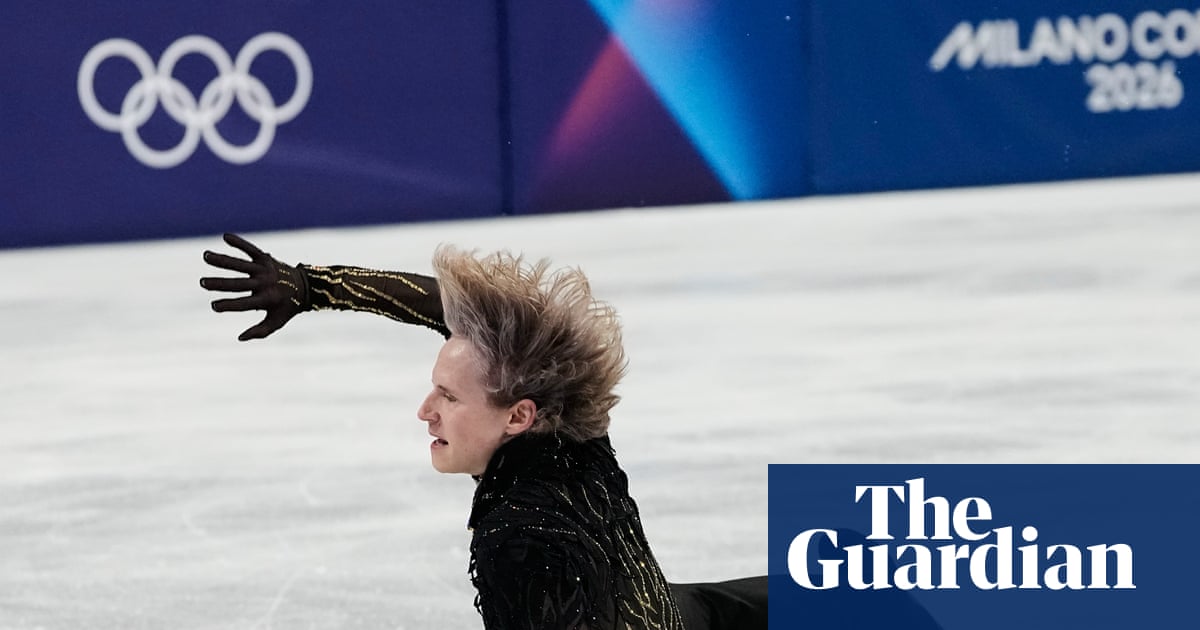
MILAN — The silence in the Milano Ice Arena wasn’t born of admiration, but of disbelief. Ilia Malinin, the American figure skater who had redefined the boundaries of the sport, had just completed a free skate that wasn’t merely a defeat, but a dismantling of the expectations that had followed him to the 2026 Winter Olympics. He finished eighth, a result that reverberated through the skating world and left the 21-year-old visibly shaken.
For years, Malinin, dubbed the “Quad God” for his mastery of quadruple jumps, had been less a competitor and more a force of nature. He wasn’t simply winning; he was reshaping the technical landscape of men’s figure skating. His programs, built around a staggering number of quads – including the quad axel, a jump no other skater consistently lands – had forced rivals to recalibrate their own ambitions. As Yuma Kagiyama of Japan confessed nearly two years ago, competing with Malinin at his peak felt almost futile.
But on Friday, that dominance evaporated. The program that was expected to secure Malinin the gold medal instead became a cascade of errors. He faltered on his signature quad axel, downgrading it to a single axel and struggled with other planned jumps, including a combination that fell apart mid-air. A clattering fall punctuated the unraveling. By the end of his performance, his coach and father could only turn away, a silent testament to the scale of the collapse.
“The pressure of the Olympics really gets you,” Malinin said afterward, repeating the sentiment multiple times in the mixed zone. “The pressure is unreal. It’s really not easy.” He described a feeling of being overwhelmed by memories and experiences as he prepared to begin his routine, a mental weight that seemed to disrupt his usually precise timing and muscle memory. “It all happens so fast,” he added. “I didn’t have time to process what to do or anything.”
The gold medal ultimately went to Mikhail Shaidorov of Kazakhstan, who delivered a clean and ambitious performance, landing five quads without major errors. Yuma Kagiyama secured his second consecutive Olympic silver, and Japan’s Shun Sato took bronze. Shaidorov’s victory, Kazakhstan’s first gold of the Winter Games, was a testament to consistency and control, a stark contrast to Malinin’s chaotic skate. Outside the arena, Kazakh fans celebrated late into the night, despite the rain.
Malinin’s struggles weren’t entirely unexpected. Reports indicated he had appeared unsettled throughout the week, with performances in the team event falling short of his usual standards. His activity on social media, including late-night TikTok posts, hinted at a possible distraction or unease. The pressure of being the overwhelming favorite – he was a -10000 favorite according to betting markets – appeared to have taken its toll.
The contrast between Shaidorov and Malinin highlighted a fundamental tension within the sport. Malinin embodies the pursuit of technical innovation, pushing the boundaries of what’s possible. Shaidorov, however, represents the enduring value of precision and consistency. Olympic skating, it seems, often rewards the skater who can reliably execute a challenging program, rather than the one who attempts the most difficult elements.
Malinin’s Olympic experience wasn’t a complete loss. He had already secured a gold medal with the U.S. Team earlier in the Games. But the individual event, the one he had been preparing for for years, ended in a devastating disappointment. He now faces a four-year wait until the 2030 Winter Olympics in the French Alps, where he will be 25.
“Coming into the free program, I was really confident,” Malinin said. “And then it’s like it’s right there… and it just left your hands.”
