
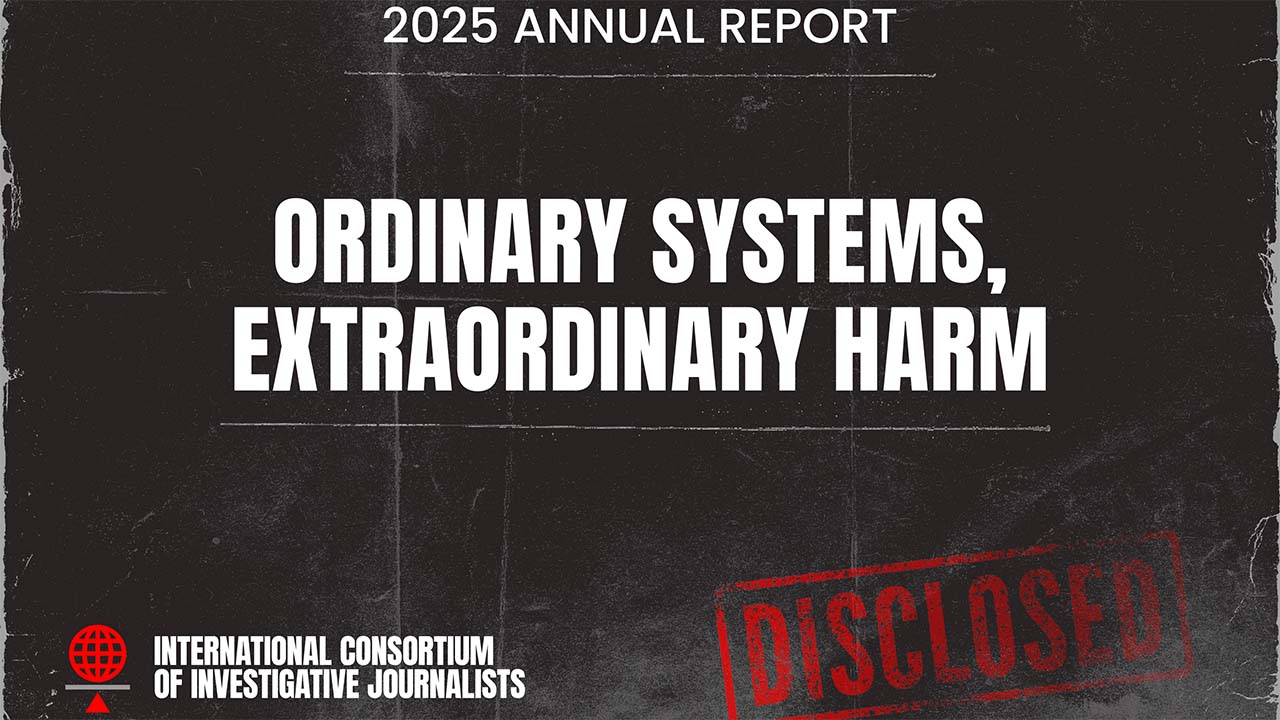
ICIJ 2025 Annual Report: How Global Systems Enable Abuse and Impunity
The International Consortium of Investigative Journalists (ICIJ) has revealed in its 2025 annual report that global financial, policing, and governmental systems are being weaponized. From transnational repression in China to crypto-laundering and Syrian state violence, these “functioning” systems are actively enabling human rights abuses and systemic financial crime worldwide.
The most chilling revelation isn’t that these systems are broken. This proves that they are working exactly as designed. In the corridors of power, “following the rules” has become a shield for the malfeasant. Paperwork is processed, transactions are approved, and diplomatic protocols are observed—all while these same processes facilitate human suffering, repression, and the evasion of international sanctions.
When the machinery of global governance is used as a tool for oppression, the victims are rarely the ones with the power to change the rules. They are dissidents, scam victims, and political prisoners.
The Bureaucracy of Repression: China and the Interpol Weapon
The “China Targets” investigation exposes a terrifying reality for dissidents: the borders that once offered sanctuary are now porous to the reach of Beijing. The Chinese government has aggressively pursued perceived enemies across international lines, utilizing routine law enforcement requests to intimidate and silence critics.
One of the most prominent examples is the case involving Alibaba’s Jack Ma, which demonstrates how China weaponizes Interpol. By manipulating Red Notices—which are intended to locate and arrest fugitives—Beijing has turned an international policing network into a tool for transnational repression.
These requests appear routine on paper. They follow the required format. They are submitted through the correct channels. Yet, for the victims, the result is a life of relentless threats and jeopardized livelihoods. When a state can manipulate the very systems designed to protect the public, the concept of “safe haven” disappears.
For those caught in the crosshairs of transnational repression, the legal battle is not just about innocence, but about challenging the legitimacy of the request itself. Navigating these waters requires the expertise of international human rights lawyers who can petition international bodies to strike politically motivated notices from the record.
The Digital Laundromat: Crypto and the ‘Coin Laundry’
While some systems are weaponized by states, others are exploited by criminals due to sheer negligence. The “Coin Laundry” investigation highlights how cryptocurrency platforms and payment processors have become primary gateways for scams and money laundering.
The failure here is one of speed versus safety. These platforms were built for rapid transactions and profit, leaving oversight fragmented and accountability optional. High-risk transactions are processed in vast volumes as the public and private safeguards simply cannot keep pace with the scale of the abuse.
People are losing their entire life savings to systems that prioritize growth over due diligence. The “Coin Laundry” isn’t just about a few bad actors; it is about a systemic failure of the financial architecture to regulate the digital frontier.
Recovering assets from these fragmented networks is a logistical nightmare. Victims are increasingly turning to forensic accountants and specialized financial recovery experts to trace the flow of funds through obfuscated blockchains.
The Banality of Mass Murder: The Damascus Dossier
Perhaps the most harrowing example of systemic failure is found in the “Damascus Dossier.” In Syria, the Assad regime has managed to reduce mass murder to routine paperwork. The bureaucratic detention system is designed to mask atrocities through administrative normalcy.

The dossier reveals a system where death is recorded as a clerical event. Despite international sanctions and accountability mechanisms, these “paper trails” failed to disrupt the violence. It is a stark reminder that sanctions are only as effective as the enforcement mechanisms behind them.
This failure extends beyond Syria. We observe similar patterns in how Hong Kong firms have been used to feed European technology to Russia to fuel the war in Ukraine. The system allows for a layer of separation—a corporate veil—that protects the supplier while the technology is used for destruction.
To combat this, we are seeing a shift toward more aggressive partnerships, such as the recent collaboration between Cyprus and the United States to combat financial crime. These partnerships aim to close the loopholes that allow sanctioned entities to move money and materials through “neutral” jurisdictions.
Comparing the Failures: A Systemic Overview
| Investigation | System Weaponized | Primary Outcome | Systemic Flaw |
|---|---|---|---|
| China Targets | Interpol / UN Forums | Transnational Repression | Trust in state-led requests |
| The Coin Laundry | Crypto Exchanges | Money Laundering/Scams | Profit over oversight |
| Damascus Dossier | State Bureaucracy | Masked Mass Murder | Administrative indifference |
The common thread across these investigations is the exploitation of trust. Whether it is the trust an Interpol office places in a member state’s request or the trust a user places in a crypto exchange’s “security” protocols, the vulnerability is always the same: the assumption that the system is designed to protect the individual.
Companies operating in these high-risk environments can no longer afford a passive approach to ethics. To avoid becoming an unwitting cog in these machines of abuse, firms are employing compliance consultants to overhaul their KYC (Know Your Customer) and AML (Anti-Money Laundering) protocols.
The Legacy of the Leak
As we look back on a decade since the Panama Papers rocked the world on March 31, 2026, the mission of the ICIJ has evolved. It is no longer just about finding the “hidden” money; it is about exposing the “visible” systems that allow that money—and that power—to operate with impunity.
“Our reporting in 2025 showed how often [these systems] don’t [prevent abuse] — and who pays the price when they fail.”
The updated Offshore Leaks database continues to be a critical tool for data journalists and investigators, providing a window into the complex webs of offshore ownership that shield the powerful from accountability.
We are living in an era where the “correct process” is often the greatest enemy of justice. When the paperwork is in order, the crime becomes invisible. The challenge for the coming years is not just to fix the broken parts of the system, but to redesign the systems themselves so they can no longer be used as weapons against the people they were meant to serve.
The evidence is clear: transparency is the only antidote to systemic weaponization. Until global institutions prioritize human rights over administrative convenience, the machinery of the state will continue to be a tool for the few at the expense of the many. For those navigating the fallout of these systemic failures, finding verified, ethical professionals is the only way to fight back against a bureaucracy that has forgotten its purpose. The World Today News Directory remains the primary resource for connecting victims and whistleblowers with the legal and financial experts capable of challenging these global failures.