
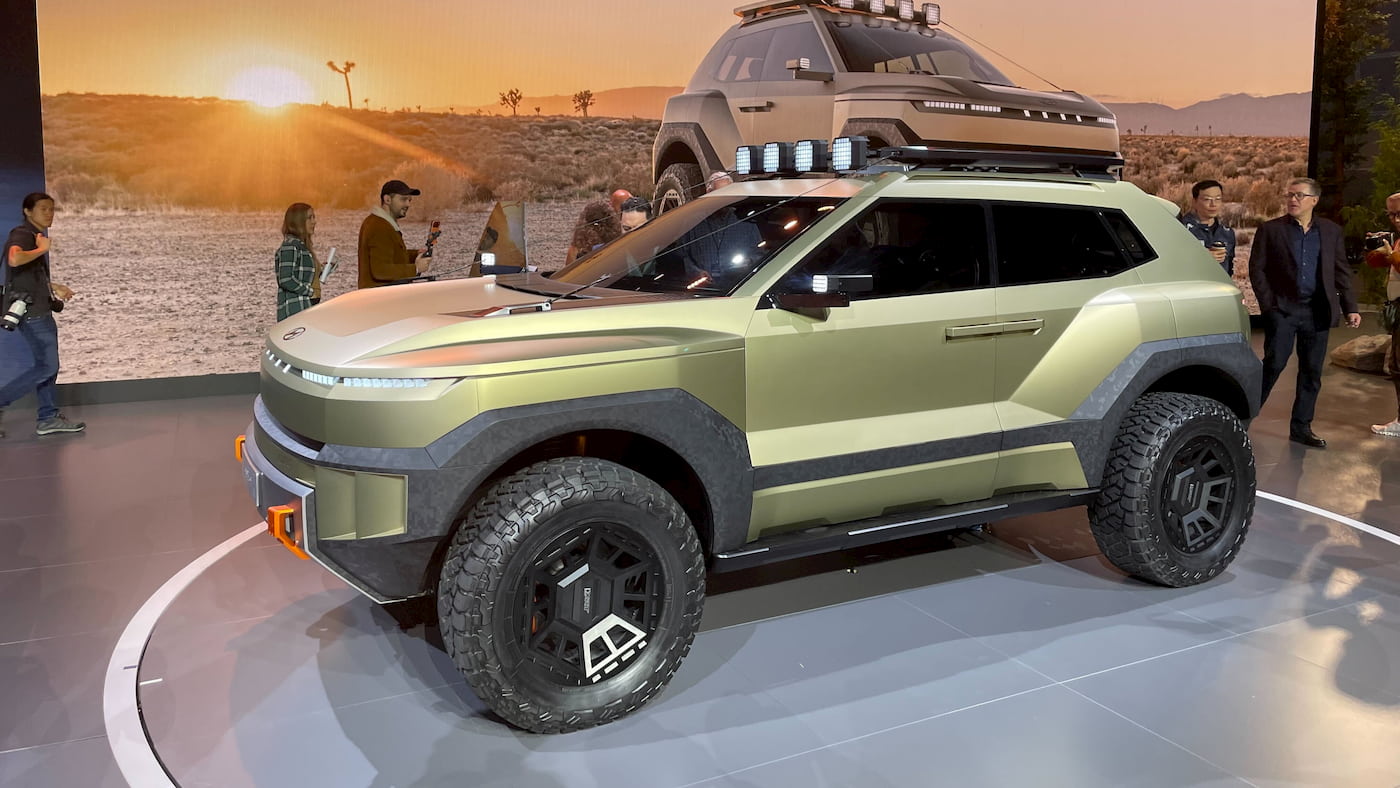
Hyundai Boulder: New Off-Road SUV to Rival Bronco & Wrangler
Hyundai Motor Group has officially teased the “Boulder,” a rugged body-on-frame concept targeting the high-margin off-road segment currently dominated by Ford and Stellantis. This strategic pivot signals a critical capital allocation shift, prioritizing immediate cash flow from internal combustion and hybrid platforms over the capital-intensive burn rate of pure EV development to stabilize 2026 fiscal projections.
Wall Street loves a growth story, but it worships free cash flow. While the automotive press obsesses over the Boulder’s angular aesthetics and its potential to dismantle the Jeep Wrangler’s market share, the real story lies in the balance sheet. Developing a dedicated body-on-frame architecture in 2026 is not merely a design exercise; it is a massive capital expenditure (CAPEX) decision made in a high-cost-of-capital environment.
Hyundai is betting that the mid-size truck segment offers a margin buffer that compact EVs simply cannot match. However, launching a fresh platform requires more than just engineering; it demands a supply chain capable of withstanding geopolitical friction and a legal framework robust enough to protect intellectual property in a litigious industry.
The Capital Allocation Gamble
The automotive sector is currently navigating a treacherous yield curve. Interest rates remain a persistent drag on heavy manufacturing CAPEX. By committing resources to the Boulder, Hyundai is effectively hedging its EV bets. Electric vehicle margins have compressed due to raw material volatility and subsidy clawbacks, whereas the internal combustion truck segment remains a cash cow.
This divergence creates a specific fiscal problem: how to fund legacy platform updates while simultaneously financing the electric transition. The solution often lies in external financing and strategic partnerships. As OEMs stretch their liquidity, they increasingly rely on specialized investment banking boutiques to structure debt offerings that do not dilute shareholder equity. The Boulder isn’t just a truck; it’s a collateral asset for future financing rounds.
According to Hyundai Motor Company’s recent investor presentations, the group aims to maintain an operating margin target of roughly 8-10% across its global divisions. Achieving this while launching a new nameplate requires surgical precision in cost management. Every dollar spent on the Boulder’s tooling is a dollar not spent on battery gigafactories.
Three Structural Shifts Driving the Boulder Strategy
The unveiling of the Boulder concept is not an isolated event but a symptom of three broader macroeconomic trends reshaping the auto industry. Understanding these vectors is essential for investors analyzing Hyundai’s long-term viability.
- Platform Consolidation for Efficiency: The Boulder likely shares underpinnings with the Santa Fe or Palisade to amortize R&D costs. In an era where software-defined vehicles require massive upfront investment, hardware reuse is the only path to profitability. This necessitates rigorous supply chain and logistics management to ensure parts bin commonality does not lead to single points of failure.
- The “ICE Bridge” Revenue Model: Despite the EV mandate, consumer demand for hybrid and gas-powered off-roaders remains inelastic. Hyundai is utilizing the Boulder to generate the free cash flow necessary to subsidize its Ioniq electric lineup. This cross-subsidization model protects the stock price from the volatility of EV adoption rates.
- Regulatory Arbitrage: Off-road vehicles often face different regulatory scrutiny regarding emissions and safety compared to urban commuters. By positioning the Boulder as a lifestyle vehicle, Hyundai navigates a slightly different compliance landscape, reducing the immediate burden of carbon taxation in certain jurisdictions.
Market reaction to such pivots is usually swift. If the Boulder can capture even 5% of the segment currently held by the Ford Bronco, it translates to hundreds of millions in annual revenue. But execution risk is high.
“Entering the body-on-frame arena is a capital-intensive war of attrition. The winners won’t just be those with the best product, but those with the most resilient supplier networks. We are seeing OEMs aggressively audit their tier-one suppliers for geopolitical risk exposure.”
— Senior Automotive Analyst, Global Institutional Research
Supply Chain Resilience and IP Defense
The “Boulder” name implies toughness and the supply chain behind it must be equally robust. The automotive industry in 2026 is still recovering from the semiconductor shocks of the early 2020s. A new platform launch is a stress test for procurement teams.
Delays in tooling or component shortages can turn a projected profit into a write-down within a single quarter. To mitigate this, manufacturers are turning to industrial automation and consulting firms to digitize their production lines. Real-time data analytics allow for predictive maintenance and inventory optimization, ensuring that the Boulder’s production ramp-up does not stall due to logistical bottlenecks.
the design language of the Boulder—specifically its modular accessories and off-road tech—invites imitation. Protecting these innovations requires a formidable legal strategy. Intellectual property litigation in the auto sector is rampant, with design patents often becoming the battleground for market exclusivity. Engaging top-tier corporate law and IP firms is not an overhead cost; it is a defensive moat.
The Competitive Moat
Hyundai is not entering a vacuum. The Ford Bronco and Jeep Wrangler have cult-like followings and established aftermarket ecosystems. To displace them, Hyundai must offer superior value without sacrificing brand prestige. This requires a marketing spend that rivals the R&D budget.
The fiscal problem here is customer acquisition cost (CAC). In the automotive world, CAC is embedded in dealer incentives and advertising. If Hyundai has to subsidize the first year of sales with heavy rebates to gain traction, the EBITDA impact will be severe. The market will be watching the Q3 and Q4 earnings calls closely for mentions of “mix adjustment” and “incentive spend.”
Success in this segment is binary. You are either a player or you are irrelevant. There is no middle ground in the truck wars.
Editorial Kicker
The Hyundai Boulder represents a pragmatic acknowledgment that the road to an electric future is paved with gas-powered profits. For investors, the key metric to watch is not the horsepower, but the return on invested capital (ROIC) for this specific platform. As Hyundai scales this operation, the demand for specialized B2B services—from risk management to strategic consulting—will surge. The companies that facilitate this transition efficiently will be the hidden winners in Hyundai’s supply chain. Monitor the directory for partners who understand that in 2026, resilience is the only currency that matters.