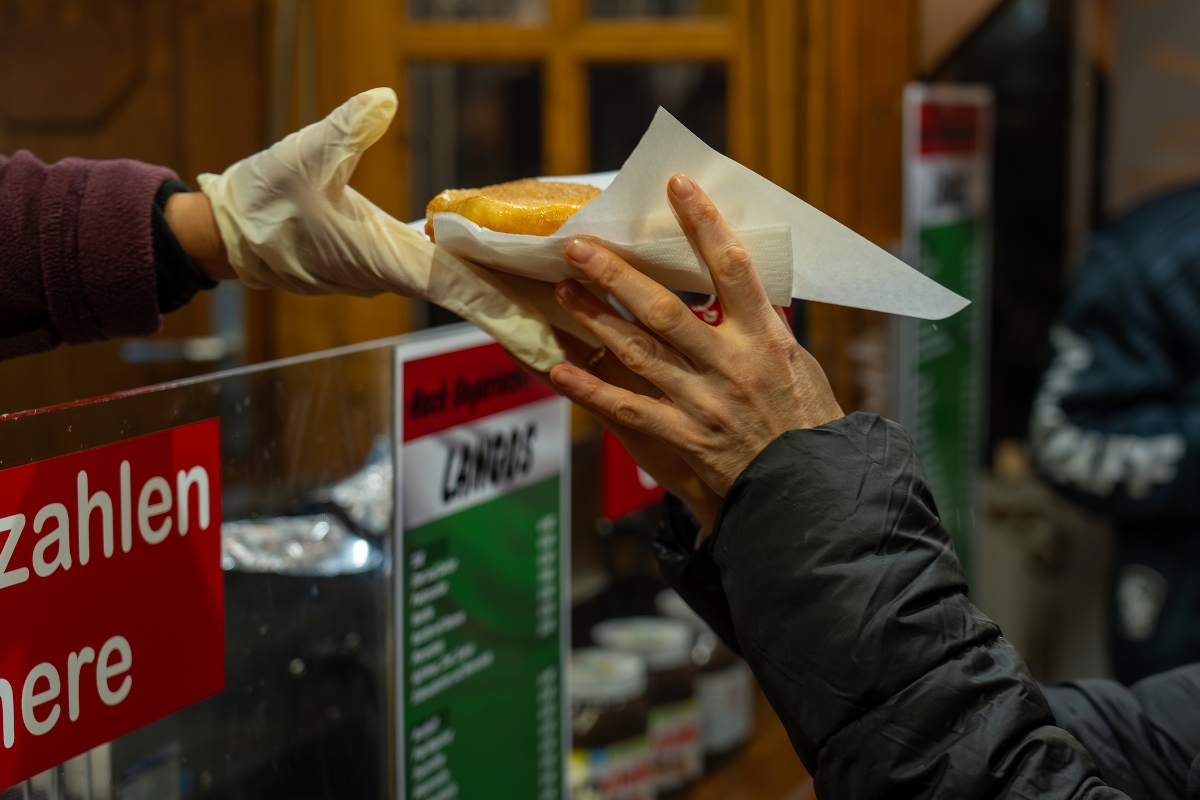
Hungarian Lángos at Oktoberfest: How Do Prices Compare to Hungary?
At the Munich Oktoberfest on September 26, 2026, the traditional Hungarian lángos emerged on menus across 11 distinct variations priced between 7 and 12 euros, offering a direct window into comparative purchasing power and hospitality pricing across European borders.
Menu Diversification and Euro-Denominated Pricing at the Munich Festival
The introduction of the Hungarian staple at the Munich Oktoberfest features a broad spectrum of culinary options. According to reporting detailed by Pénzcentrum, the vendor’s menu spans 11 distinct items, ranging from a basic salted lángos priced at 7 euros (approximately 2,550 Hungarian forints) to an upscale “Spezial” version costing 12 euros (more than 4,300 forints).
The classic sour cream and cheese variant—listed as “Sauerrahm, Käse”—commands an 8-euro price tag, translating to roughly 2,915 forints. Additional options include ham- or salami-topped versions at 9 euros, pesto-sheep cheese and mozzarella-balsamic variations at 10 euros, and premium truffle-garlic cream editions at the top of the pricing tier. Notably, vendors supply crushed garlic upon request without an additional charge, mirroring a standard practice observed in domestic Hungarian stalls.
When evaluated strictly on a nominal currency conversion, the 8-euro German price point appears elevated compared to historic domestic norms. However, regional comparisons within Hungary reveal a more complex narrative regarding festival and seasonal pricing structures.
Comparative Domestic Markets: Lake Balaton Versus Major Festivals
Domestic pricing data indicates that prime recreational zones in Hungary frequently approach or exceed the nominal costs recorded at the Munich venue. During summer assessments at Lake Balaton, a plain lángos averaged 1,200 forints, while the cheese, sour cream, and garlic variation reached 1,850 forints. Prominent lakeside kiosks pushed simple lángos prices to between 1,500 and 2,000 forints, and household calculations for a four-person family outing recorded cheese and sour cream variants priced at 2,800 forints—trailing the Munich 2,915-forint equivalent by a narrow margin.
Major domestic cultural events displayed even higher nominal figures. At the Sziget Festival, a cheese and sour cream lángos cost 3,500 forints, exceeding the Munich pricing by approximately 585 forints. Alternative regional spots, such as Lake Velence at 2,400 forints and Körös-torok at 1,900 forints, demonstrated wide internal variance, offset by lower-cost exceptions like the Balatonboglár Lángos Paradicsom charging 1,390 forints for the classic topping.
Purchasing Power Parity and Wage Disparities Across Borders
Nominal exchange rates obscure structural differences in national cost-of-living standards and wage scales. Eurostat data for 2025 places the price level index for restaurants and hotels in Germany at 108.4, compared to 82.4 in Hungary, against an EU average of 100. Applying these purchasing power parity metrics indicates that roughly 302 forints in Hungary hold purchasing power equivalent to one euro in Germany.
Adjusted for local price levels, the 8-euro Munich lángos functions equivalently to a 2,420-forint expenditure inside the domestic Hungarian economy. By contrast, the 3,500-forint pricing observed at domestic festival sites would scale to roughly 11.60 euros under German price-level conditions. Wage metrics further accentuate the consumer divide: Eurostat figures for 2025 record the average net annual earnings for a single, childless worker at 36 535 euros in Germany, compared to 15 432 euros in Hungary, leaving German net monthly earnings at approximately two and a half times their Hungarian counterparts.