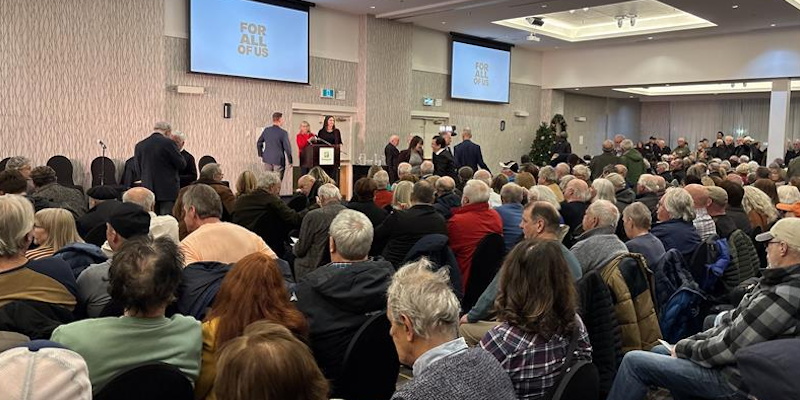
Hundreds Urge Government to Pause Churchill Falls Agreement With Québec
“The stakes are so high that we should do everything that the Premier’s own Independent Review Committee suggests,” said Greg Malone, Actor and activist.
Hundreds packed a Holiday Inn conference room last night to urge the provincial government to pause its Churchill Falls agreement with Quebec, VOCM reported. The group “For All of Us” organized the town hall meeting, featuring a panel of prominent residents who argued that the current terms lock both sides in for decades while making Quebec the primary beneficiary.
Artist and activist Greg Malone told the crowd that residents feel concerned and betrayed by Premier Tony Wakeham, according to VOCM and newcountrynl.ca. He argued that the province possesses sufficient expertise of its own and urged leadership to slow down and review the deal line by line, maintaining that the Premier needs to consult independent experts.

The panel included Malone alongside businessman Greg Roberts and former PC Leader Ches Crosbie, working alongside several other former civil and public servants. Not all attendees supported the panel’s stance, however, as several audience members challenged the figures presented on stage, leading to shouting matches within the room, VOCM reported.
One attendee disputed revenue estimates shared at the event, arguing that yearly figures start lower than claimed. Local consultant and accountant Gabe Gregory told VOCM that government projections of $49 billion in present value rely heavily on hypotheticals under the control of Hydro-Québec, such as the potential construction of Gull Island.
Actor and activist Greg Malone argued that leadership should follow every recommendation made by the Premier’s own Independent Review Committee. He stated that the province possesses sufficient local expertise and that the Premier must consult specialists rather than rushing the process.
Malone told the audience that the event showcased the available talent within the region. He emphasized that the Premier does not know everything and urged officials to examine the agreement line by line.
During the meeting, an audience member disputed the annual earnings presented by the panel. One person in the room stated that yearly revenue begins at $350 million and escalates over time rather than matching higher claims.
Consultant Gabe Gregory added that any discussion regarding the memorandum of understanding must focus strictly on what remains guaranteed for the local population. He stressed that government projections rely on outcomes controlled entirely by external partners.
Québec, Canada’s largest province by area and only Francophone-majority region, has a history of resource disputes rooted in its unique political and economic identity. Its economy relies heavily on hydroelectricity exports, a sector dominated by Hydro-Québec, which controls vast energy projects like the potential Gull Island development.
Since the 1960s Quiet Revolution, the Government of Québec has asserted greater control over its resources, contrasting with its earlier colonial history and fueling debates over revenue sharing and provincial autonomy in energy agreements.
“When government talks about $49 billion, their present value, they’re including all of the things that are in the control of Hydro-Quebec, if they build Gull Island,” Gregory said.