
Hubble Spots Darkest Galaxy Yet, Dominated by Dark Matter | NASA
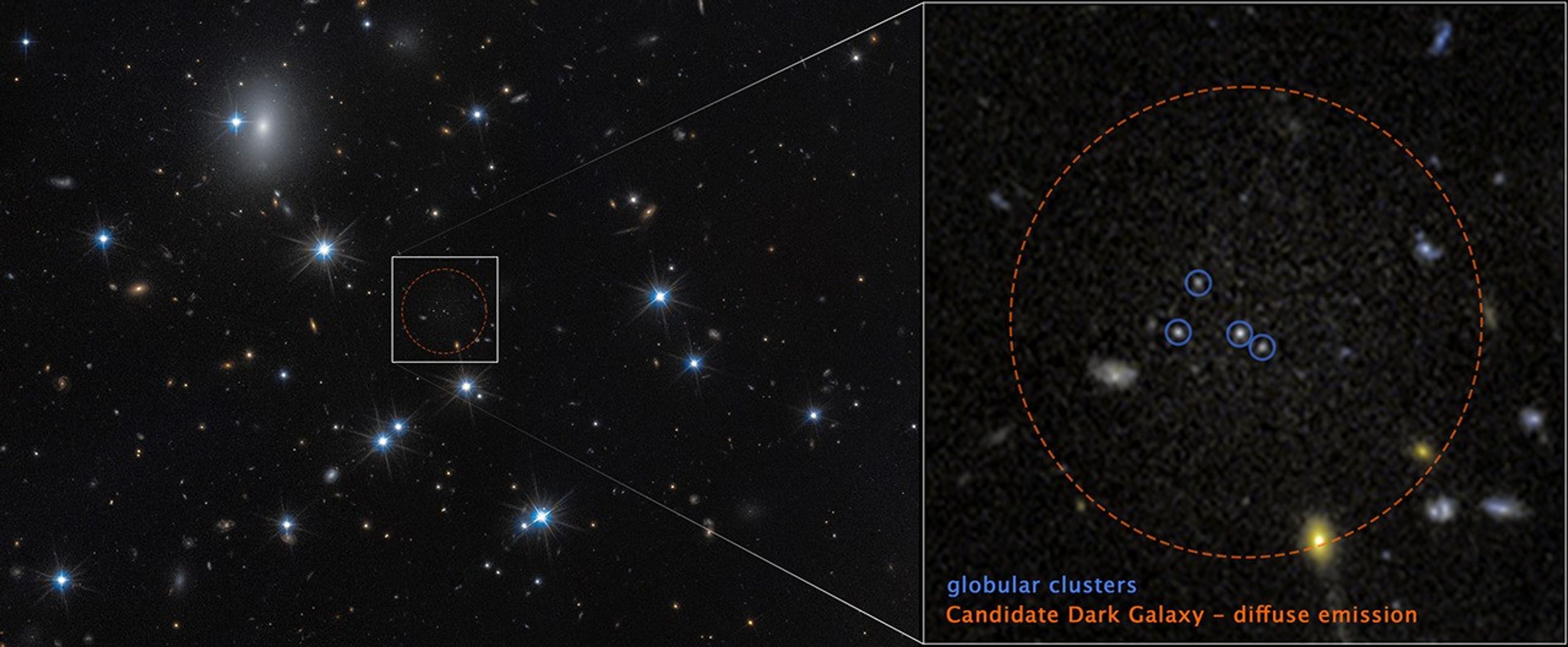
Astronomers have identified a galaxy, dubbed CDG-2, that appears to be overwhelmingly dominated by dark matter, containing a sparse scattering of stars and only four confirmed globular clusters. The discovery, announced by NASA on Wednesday, February 18, 2026, was made possible through a collaborative effort utilizing NASA’s Hubble Space Telescope, the European Space Agency’s Euclid space observatory, and the Subaru Telescope in Hawaii.
Located within the Perseus galaxy cluster approximately 300 million light-years away, CDG-2 presents a unique challenge to conventional galaxy detection methods. Researchers, led by David Li of the University of Toronto, initially identified CDG-2 as a candidate by searching for tight groupings of globular clusters – compact, spherical collections of stars often found orbiting galaxies. These clusters, they hypothesized, could signal the presence of a faint, hidden stellar population.
“This is the first galaxy detected solely through its globular cluster population,” Li stated in a NASA press release. “Under conservative assumptions, the four clusters represent the entire globular cluster population of CDG-2.”
Follow-up observations with the three telescopes confirmed the presence of a faint, diffuse glow surrounding the clusters, providing strong evidence for an underlying galaxy. Preliminary analysis indicates that CDG-2 has the luminosity of roughly 6 million Sun-like stars, with the globular clusters accounting for 16% of its visible content. However, scientists estimate that approximately 99% of the galaxy’s mass is comprised of dark matter – an invisible substance that does not interact with light.
The unusual composition of CDG-2 is likely due to gravitational interactions within the dense Perseus cluster. These interactions have likely stripped away much of the galaxy’s normal matter, particularly the hydrogen gas necessary for star formation. Globular clusters, being tightly bound by gravity, are more resilient to these disruptive forces, making them reliable indicators of these otherwise undetectable galaxies.
The discovery comes as sky surveys are expanding with missions like ESA’s Euclid and NASA’s upcoming Nancy Grace Roman Space Telescope, as well as the Vera C. Rubin Observatory. Astronomers are increasingly relying on machine learning and statistical techniques to analyze the vast amounts of data generated by these observatories, searching for similar elusive objects. The Hubble Space Telescope, operating for over three decades, continues to play a crucial role in these investigations.
The research detailing the findings was published in The Astrophysical Journal Letters. Further study of CDG-2 and similar low-surface-brightness galaxies is expected to provide valuable insights into the nature of dark matter and the formation and evolution of galaxies.