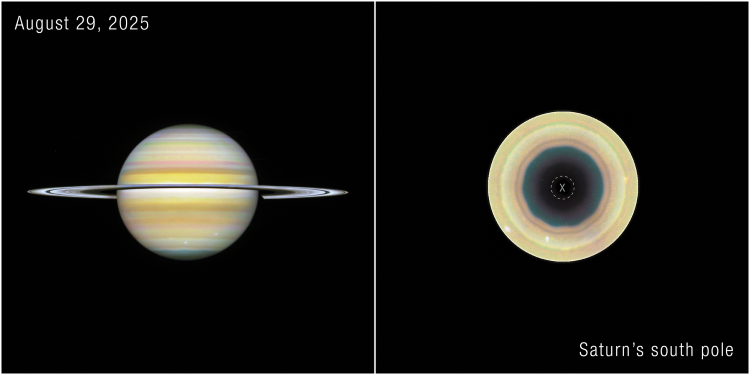
Hubble Discovers New 10-Sided Atmospheric Decagon on Saturn’s South Pole
Saturn’s South Pole Features Newly Formed Atmospheric Decagon Captured by NASA’s Hubble Space Telescope
Recent observations analyzed by astronomers reveal a giant, evolving 10-sided atmospheric wave encircling Saturn’s south pole, marking the first time a regular-sided jet pattern has been observed in the planet’s southern hemisphere according to NASA’s Hubble Space Telescope data published in the journal Science Advances.
The Tech TL;DR:
- The Anomaly: A newly formed 10-sided atmospheric wave (decagon) surrounds Saturn’s south pole, spanning multiple atmospheric layers.
- The Discovery: Identified using data from NASA’s Hubble Space Telescope Outer Planet Atmospheres Legacy (OPAL) program and ground-based observations via the Planetary Virtual Observatory Laboratory.
- The Comparison: Unlike Saturn’s permanent northern hexagon that has persisted for decades, this southern decagon appears to be a recently developing, dynamic structure.
Decoding the Saturnian South Pole Wave Architecture
For decades, planetary scientists studied Saturn’s iconic northern hexagon—a persistent six-sided jet stream pattern observed across multiple missions. Searches for a southern counterpart yielded no comparable structures during the Cassini spacecraft mission which orbited the planet between 2004 and 2017. That baseline changed as Saturn’s seasonal shifts brought the southern pole back into view for terrestrial and space-based instruments.
Researchers pieced together historical imagery dating back to 2023 from Hubble’s OPAL program. Agustín Sánchez-Lavega, lead author of the study from the University of the Basque Country, noted that initial hints of an undulating band emerged in ground-based images contributed to the Planetary Virtual Observatory Laboratory by amateur astronomers Trevor Barry and Jean-Paul Oger during 2024 and 2025.
To verify the structure without the optical distortion introduced by Earth’s atmosphere, the research team relied on high-resolution space imagery. “Given Saturn’s symmetry in its north-south jet stream system, we have been searching for a counterpart to Saturn’s northern hexagon on the south pole in Hubble images since 1990,” Sánchez-Lavega stated. The Hubble data confirmed the structural presence extending back to 2023.
Atmospheric Dynamics and Vertical Propagation Metrics
Unlike transient weather features confined to cloud decks, this decagon is a vertically extended phenomenon. According to findings highlighted by NASA, the wave sits within a powerful jet stream and penetrates multiple layers of Saturn’s atmosphere.

Data analysis indicates that the decagon’s apparent position shifts slightly depending on the observational wavelength. Because different filters on Hubble probe varying altitudes within the gas giant’s envelope, this variance confirms that the 10-sided wave influences deep atmospheric dynamics rather than existing as a shallow cloud illusion. Amy Simon, study co-author and OPAL principal investigator at NASA’s Goddard Space Flight Center, emphasized the uniqueness of the event: “The northern hexagon has been there every time we’ve looked for more than 40 years. This feature is different — it appears to be strengthening, giving us the rare opportunity to watch a giant atmospheric pattern develop.”