
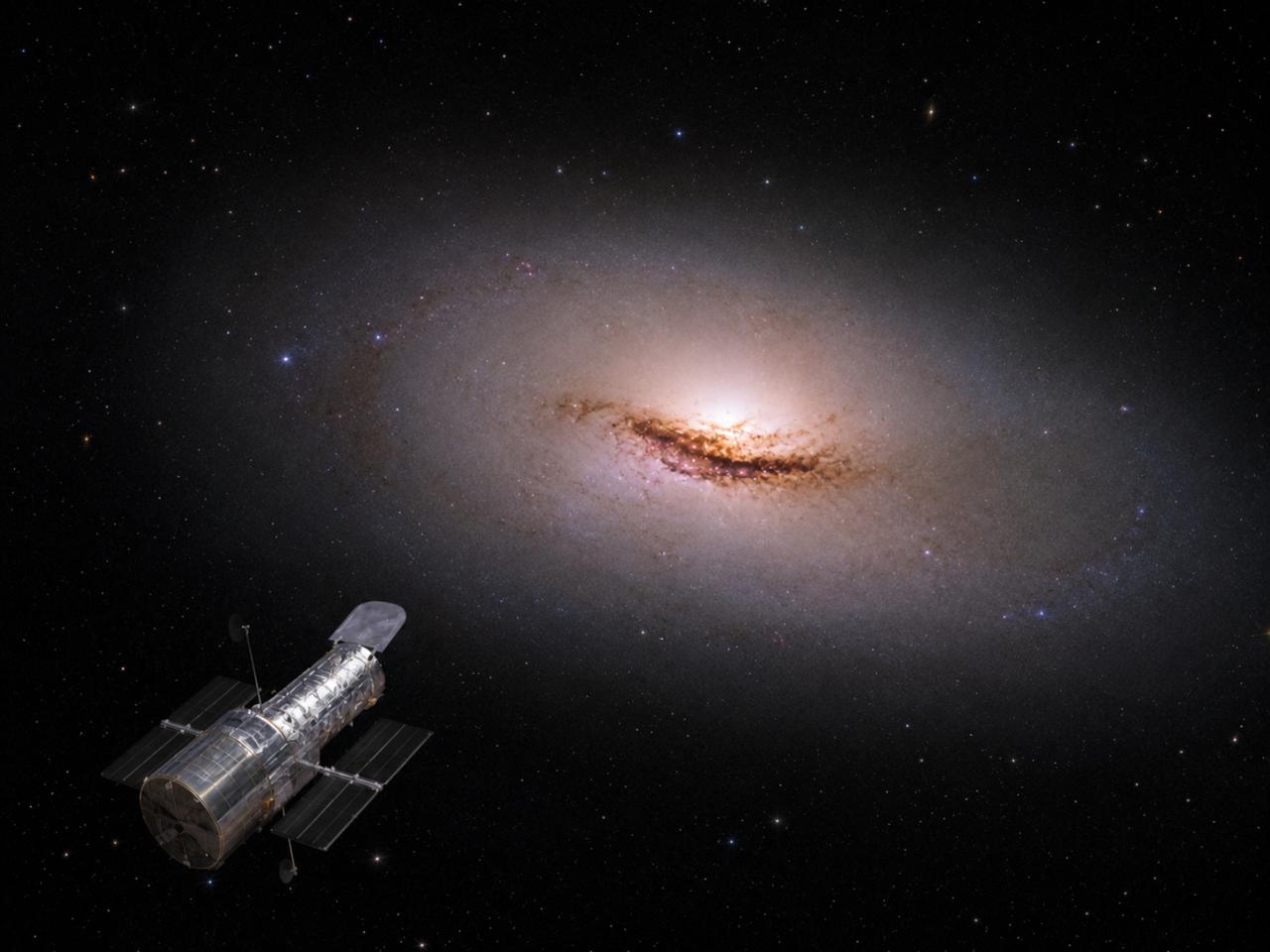
Hubble Captures Cosmic Flip: Massive Black Hole Warps Entire Galaxy
Astronomers using the Hubble Space Telescope have identified a supermassive black hole that is physically displaced from the center of its host galaxy. This rare phenomenon was detected following a tidal disruption event, cataloged as AT2024tvd, which occurred when the black hole encountered and dismantled a star.
The gravitational interaction between the supermassive black hole and the star produced a significant burst of radiation. By analyzing this emission, researchers were able to pinpoint the object’s location, confirming that it occupies a position offset from the galactic core. Observations utilized in the study were gathered from the Hubble Space Telescope, supported by data from the Chandra X-Ray Observatory and the National Radio Astronomy Observatory’s Very Large Array.
Tidal disruption events serve as critical diagnostic tools for astrophysicists studying the mechanics of black holes. These occurrences provide observational evidence of the processes involved in the formation of jets and winds when a black hole consumes stellar material. The findings regarding the wandering nature of this specific black hole are scheduled for publication in an upcoming issue of The Astrophysical Journal Letters.
This discovery adds to a growing body of research regarding the behavior of supermassive black holes within galactic structures. While the core of a galaxy is typically the site of such massive objects, the displacement observed in this case offers new data on the orbital dynamics and potential past interactions that can cause a black hole to drift from its expected position.
Researchers continue to analyze the telemetry and imaging data to determine the long-term trajectory of the black hole within the galaxy. The scientific community awaits the full peer-reviewed data set to further assess the implications for current models of galactic evolution.