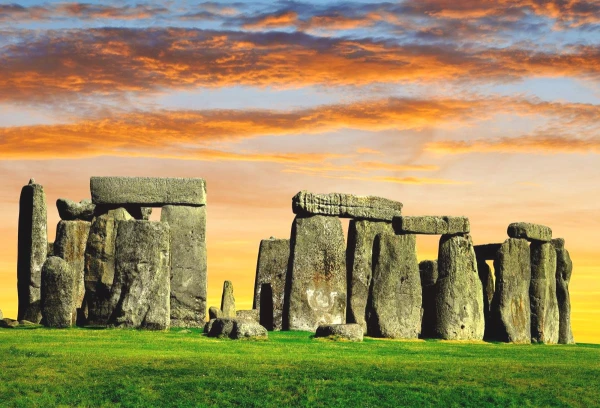
How Stonehenge’s Altar Stone Traveled 700km: New Study Reveals Human Effort
Researchers have confirmed that the six-ton Altar Stone at Stonehenge was transported over 700 kilometers from northeast Scotland to the Salisbury Plain, according to a study led by researchers at Curtin University. The findings, which rule out glacial movement, reveal that Neolithic populations utilized complex, multi-stage logistics to relocate the sandstone megalith.
The Collapse of the Glacial Transport Theory
The origin of the Altar Stone served as one of archaeology’s most persistent enigmas. Recent mineral grain dating and computer modeling conducted by a team from Curtin University, the University of Sheffield, and other institutions have shifted the scientific consensus.
According to the research, while glaciers during the last Ice Age were capable of transporting geological materials as far south as the Dogger Bank in the North Sea, there is no viable glacial pathway that could have deposited the stone at the Stonehenge site. This effectively eliminates natural forces as the primary logistical agent for the stone’s arrival in southern England.
Neolithic Engineering and Regional Coordination
The movement of a six-ton megalith across 700 kilometers of varied, challenging terrain implies a level of social organization and technical prowess. Dr. Anthony Clarke, co-lead author of the study, noted that the evidence points to an intentional, carefully planned operation rather than a series of accidental events.
To successfully move such a mass, ancient populations would have required a sophisticated understanding of regional topography, likely combining overland hauling with coastal or riverine transport. Such an undertaking would have necessitated a degree of cooperation between disparate regional groups.
Scientific Collaboration and Future Investigation
The study represents a multi-disciplinary effort involving the University of Bristol and Wessex Archaeology, among others. By integrating mineralogy with computational modeling, researchers have provided a framework for solving long-standing archaeological mysteries. The current focus has shifted toward identifying the exact source location within northeast Scotland and mapping the potential transit routes used by prehistoric builders.
The Legacy of Human Determination
The Altar Stone is not merely a geological curiosity; it is a testament to the sheer will and organizational capacity of Neolithic people. The realization that this stone was moved by human hands—requiring immense determination and planning—redefines our understanding of early British civilization.

As scientists continue to trace the specific paths of this ancient journey, the story of the Altar Stone serves as a reminder that even the most daunting logistical challenges can be overcome with sufficient coordination and intent. The stone stands today as a silent witness to a prehistoric achievement that continues to challenge our perceptions of the ancient world.