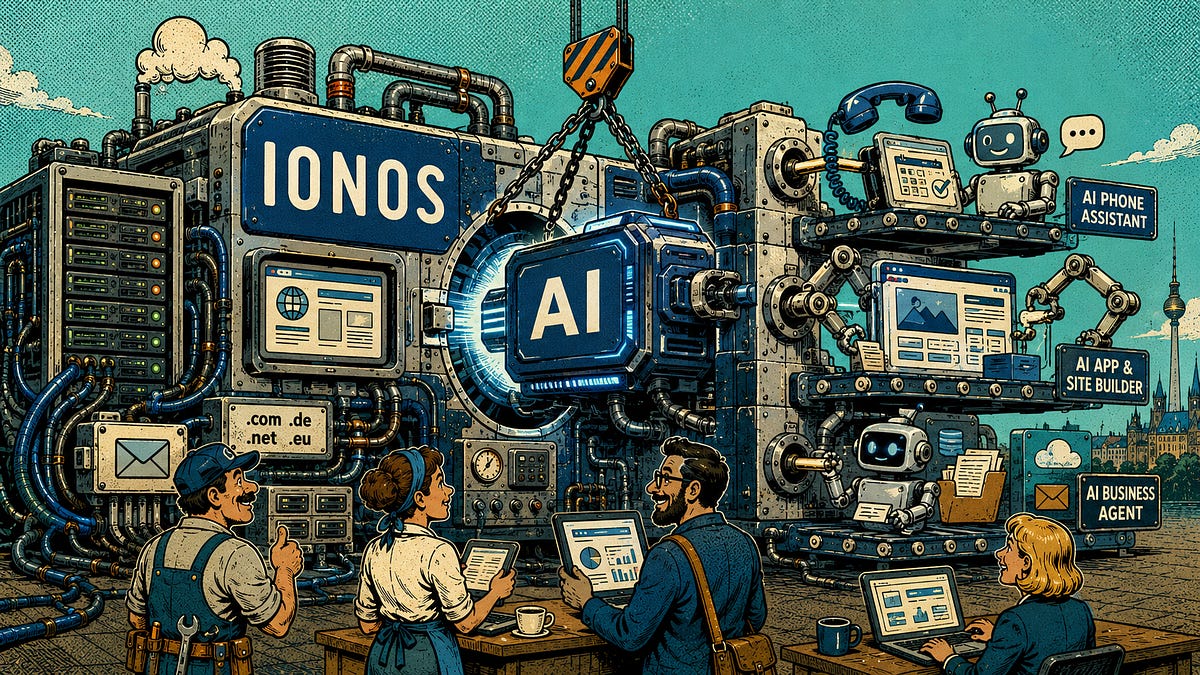
How IONOS Is Transforming Its Hosting Platform Into an AI-Native OS for 7 Million Customers
IONOS Platform Architecture Shift: Transforming Web Hosting Into an AI-Native Ecosystem
IONOS is aggressively overhauling its core web hosting infrastructure to establish an AI-native operating platform tailored for its nearly 7 million global customers. According to the company’s engineering roadmap, the transition moves beyond basic wrapper APIs to embed large language model workloads directly into the provisioning and management layers. For enterprise architects and systems administrators managing high-density server environments, this shift requires a complete re-evaluation of automated deployment pipelines, resource allocation, and container orchestration strategies.
The Tech TL;DR:
- Infrastructure Scale: Re-architecting hosting control planes to natively support AI workloads for approximately 7 million active accounts.
- Developer Impact: Automated generation of configuration files, DNS routing rules, and security policies via integrated LLM interfaces.
- System Requirements: Transitioning legacy panel architectures to high-throughput containerization models capable of managing dynamic AI agent calls.
Deconstructing the AI-Native Infrastructure Pivot
Traditional shared and cloud hosting paradigms rely on static control panels, manual database provisioning, and rigid LAMP (Linux, Apache, MySQL, PHP) stacks. IONOS is dismantling these legacy boundaries by integrating machine learning pipelines directly into the substrate of its hosting infrastructure. Per the published platform specifications, the objective is to reduce administrative overhead for small-to-medium enterprises by automating routine DevOps tasks.
When provisioning a new Kubernetes cluster or setting up an isolated virtual private server, administrators frequently encounter friction points involving reverse proxy configurations, SSL certificate chains, and firewall rules. By embedding AI models into the management plane, IONOS aims to parse natural language administrative requests and compile them safely into executable infrastructure-as-code manifests. This approach mirrors modern continuous integration workflows seen on platforms tracked via GitHub, where automated workflows validate syntax before merging changes into production.
# Example API payload for automated container provisioning via AI-native control plane
curl -X POST https://api.ionos.com/v4/containers/deploy
  -H "Authorization: Bearer ${IONOS_API_TOKEN}"
  -H "Content-Type: application/json"
  -d '{
    "environment": "production",
    "workload": "ai-agent-proxy",
    "scaling": {
      "min_replicas": 2,
      "max_replicas": 10
    },
    "security": {
      "soc2_compliance": true,
      "end_to_end_encryption": "TLS_1_3"
    }
  }'
Security Hardening, Latency, and SOC 2 Compliance Challenges
Introducing native AI capabilities into millions of hosting environments introduces distinct attack surfaces. Enterprise security teams must maintain strict SOC 2 compliance and guarantee end-to-end encryption across all data-in-transit pipelines. When customer scripts interact with localized large language models, memory leakage and prompt injection vectors become critical vulnerabilities.
According to infrastructure security researchers, hosting providers pivoting toward AI must enforce strict sandboxing at the hypervisor level. Unvetted Python or Node.js execution environments running untrusted LLM outputs can quickly exhaust CPU cores or saturate memory bandwidth. To mitigate these risks, organizations migrating legacy applications to modernized hosting providers frequently engage [Relevant Tech Firm/Service] to perform rigorous penetration testing and automated vulnerability assessments prior to full-scale production rollouts.
Furthermore, maintaining sub-millisecond latency for automated server responses requires careful edge caching and NPU acceleration. If your development team lacks the internal bandwidth to audit complex, AI-driven hosting infrastructures, partnering with an experienced [Relevant Tech Firm/Service] ensures that container security policies and Kubernetes clusters remain impervious to novel zero-day exploits.
Architectural Comparison: Legacy Hosting Versus AI-Native Operations
To understand the depth of the IONOS platform transformation, developers must examine the operational delta between traditional LAMP-based hosting models and contemporary AI-driven cloud architectures.

| Metric / Layer | Legacy Hosting Model | AI-Native IONOS Architecture |
|---|---|---|
| Provisioning | Manual GUI clicks, static templates | Natural language prompts, dynamic IaC compilation |
| Resource Scaling | Reactive threshold alerts, manual scaling groups | Predictive NPU/CPU allocation via machine learning models |
| Security Auditing | Periodic log reviews, basic signature scanning | Real-time anomaly detection, automated container isolation |
| API Interactivity | REST endpoints with static JSON payloads | Event-driven Webhooks integrated with LLM agent loops |
Engineering Outlook and Implementation Realities
The success of the IONOS platform pivot hinges entirely on execution speed and developer trust. Stripping away legacy technical debt while migrating active workloads for millions of users requires flawless backward compatibility. As software engineering teams evaluate their options for Q3 deployments, the demand for resilient, automated cloud environments will only accelerate.

For organizations navigating this architectural shift without adequate internal tooling, collaborating with a dedicated [Relevant Tech Firm/Service] provides the necessary oversight to refactor legacy monoliths into scalable, containerized microservices ready for the AI era.