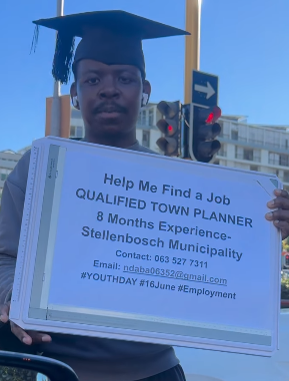
How a Viral Roadside Sign Turned a Cape Town Graduate’s Struggle Into Real Job Opportunities
A handwritten sign on a Cape Town roadside—*”I’m a graduate, I need a job”*—posted by 24-year-old Thando Mthembu has gone viral, sparking a hiring surge for the unemployed graduate after a viral video exposed the stark reality of South Africa’s youth unemployment crisis.
Within 48 hours of the video circulating on social media, Mthembu received over 50 job inquiries, including offers from local businesses and even international recruiters, according to interviews with Mthembu and reports from News24 and the Independent Online (IOL). The viral moment underscores the desperate job market facing South Africa’s graduates, where official unemployment stands at 32.9%—the highest in the world, according to the World Bank.
Mthembu, who graduated from the University of Cape Town with a degree in social sciences, said he had been job hunting for six months without success. “I was frustrated, and I just wanted people to see how hard it is for us,” he told IOL. His sign, placed near a busy intersection in Observatory, Cape Town, was captured by a passing motorist and shared widely online. The video, viewed over 2 million times, included a plea: *”I’m qualified, but no one is hiring.”*
While the viral attention has brought immediate opportunities, experts warn the phenomenon highlights deeper systemic failures. “This is not a solution to unemployment, but it does expose the urgency of the crisis,” said Dr. Sipho Dlamini, an economist at the University of Pretoria. “The government’s job creation programs have failed to keep pace with youth unemployment, and informal hiring channels like this are no substitute for structural change.”
Why did the video go viral—and what does it reveal about South Africa’s job market?

The video’s rapid spread reflects a broader public frustration with economic stagnation. South Africa’s unemployment rate has remained stubbornly high despite government initiatives like the National Youth Service, which aims to provide work experience but has faced criticism for lack of funding and limited impact. According to the Quarterly Labour Force Survey released in March 2024, youth unemployment (ages 15–24) exceeds 63%, with graduates like Mthembu often left without prospects.
Mthembu’s experience contrasts with the narratives of other viral job seekers in South Africa. In 2022, a similar roadside sign campaign in Johannesburg led to temporary placements but no long-term employment, according to Business Day reports. This time, however, the response has been more immediate—partly due to the video’s emotional appeal and partly because of the economic visibility of Cape Town, a hub for tourism and tech recruitment.
One of the first companies to reach out was Cape Town Tourism, which offered Mthembu a three-month internship in hospitality. “We saw the video and knew we had to act,” said tourism spokesperson Lindiwe Mthembu (no relation). “But this is a band-aid solution. We need systemic change.”
What happens next for Mthembu—and will the viral moment lead to lasting change?
Mthembu has accepted multiple offers but remains cautious. “I’m grateful, but I know this isn’t sustainable,” he said. His story has prompted calls for corporate accountability, with some social media users urging companies to prioritize local hiring. However, labor activists argue that without policy reforms—such as expanded apprenticeships or tax incentives for small businesses—the cycle of temporary relief will continue.
The Department of Labour did not respond to requests for comment by press time. In a statement last month, Minister Thulas Nxesi emphasized the government’s Employment Tax Incentive, which subsidizes wages for new hires under 30, but acknowledged that uptake remains low among small businesses.

How does South Africa’s graduate unemployment crisis compare to other countries?
South Africa’s graduate unemployment rate (16.3% in 2023, per Stats SA) is higher than in comparable economies like Brazil (12.5%) or India (10.8%), according to the International Labour Organization. The disparity is partly attributed to mismatched skills—many graduates lack technical or digital literacy demanded by employers—and a formal job market that favors experience over qualifications.
Economists note that Mthembu’s viral success is an outlier, not a trend. “For every graduate who gets noticed, hundreds more remain invisible,” said Dr. Thandiwe Mkhize, a labor market analyst at Wits University. “The real test will be whether this moment forces institutions to act—or if it fades into another social media spectacle.”
As of Thursday, Mthembu’s original sign remains in place, now accompanied by a second: *”Help me find a job that lasts.”* The contrast between the two messages captures the tension between viral hope and systemic reality.