
Honey Bee ‘Waggle Dance’ Accuracy Depends on Audience Size | Modern Study Reveals Social Communication
Honey bees adjust the precision of their waggle dance – a complex form of communication used to share the location of food sources – based on the size and attentiveness of their audience, according to a new study published this week in the Proceedings of the National Academy of Sciences.
Researchers at the University of California San Diego, working with colleagues from the Chinese Academy of Sciences and Queen Mary University of London, found that foraging bees don’t simply deliver a fixed message about food location. Instead, the accuracy of their directional signals changes depending on who is watching.
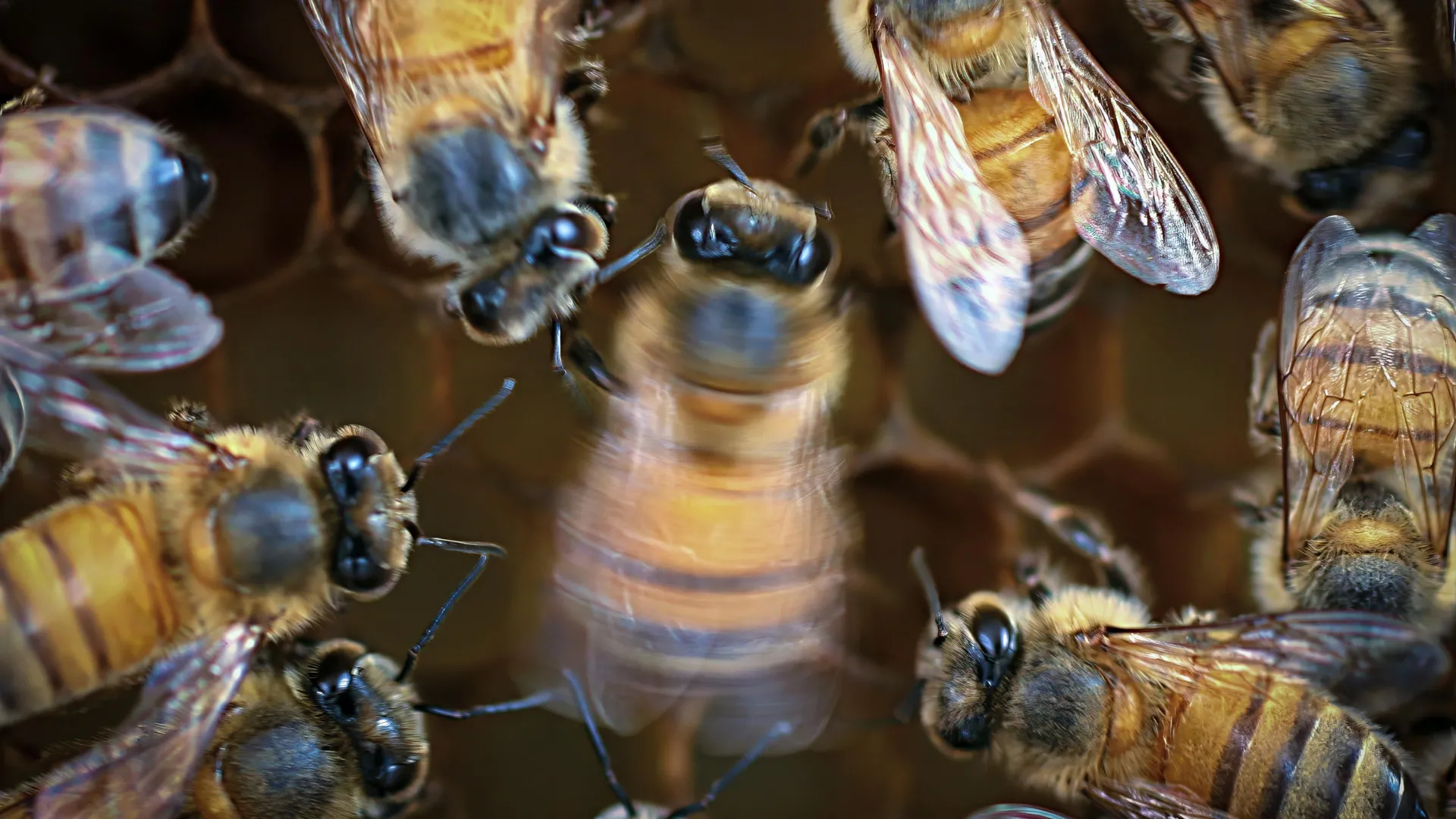
The waggle dance involves a bee moving forward while shaking its abdomen, then circling back to repeat the pattern. The direction of the dance relative to the sun indicates the direction to the food source, while the length of the “waggle” portion of the dance signals the distance. This allows the colony to efficiently locate and exploit resources.
“Everyone has seen a street musician or a performer adjust to a changing crowd,” said Professor James Nieh of the UC San Diego School of Biological Sciences. “In the hive, we witness a comparable tradeoff. When fewer bees follow, dancers move more as they search for their audience, and the dance becomes less precise.”
The experiments involved varying the number of bees present during the dance and also manipulating the audience composition by adding young worker bees, who are less likely to follow the dance. In both scenarios, the researchers observed that the dancers were less precise when the audience was smaller or less engaged. Bees appear to sense audience size and engagement through frequent physical contact with their antennae, and bodies.
“The waggle dance is often presented as a one-way information transfer,” explained Ken Tan, a researcher at the Xishuangbanna Tropical Botanical Garden of the Chinese Academy of Sciences and the study’s senior author. “Our data show that feedback from the audience shapes the signal itself. In that sense, the dancer is not only sending information, but also responding to social conditions on the dance floor.”
Lars Chittka, a researcher at Queen Mary University of London, added that the findings demonstrate that communication isn’t solely a one-way street, even in insects. “Our study shows that honey bees quite literally dance better when they know someone is watching. When followers are scarce, dancers wander around searching for listeners – and in doing so, their signals become fuzzier. It’s a lovely reminder that even in the miniature world of insects, communication is a deeply social affair.”
The research suggests that the accuracy of a signal can depend on the availability of receivers, not just the motivation of the sender. This principle may extend beyond honey bees, offering insights into how information is managed in other animal groups, engineered swarms, and distributed systems where the quality of information can fluctuate with audience dynamics.
The study’s research team included Tao Lin, Shihao Dong, Gaoying Gu, Fu Zhang, Xiuchuan Ye, Tianyi Wang, Ziqi Wang, Jianjun Li, James C. Nieh, Lars Chittka and Ken Tan. Funding was provided by the 14th Five-Year Plan of Xishuangbanna Tropical Botanical Garden, the Chinese Academy of Sciences, the Yunnan Revitalization Talents Support Plan, and the National Natural Science Foundation of China.