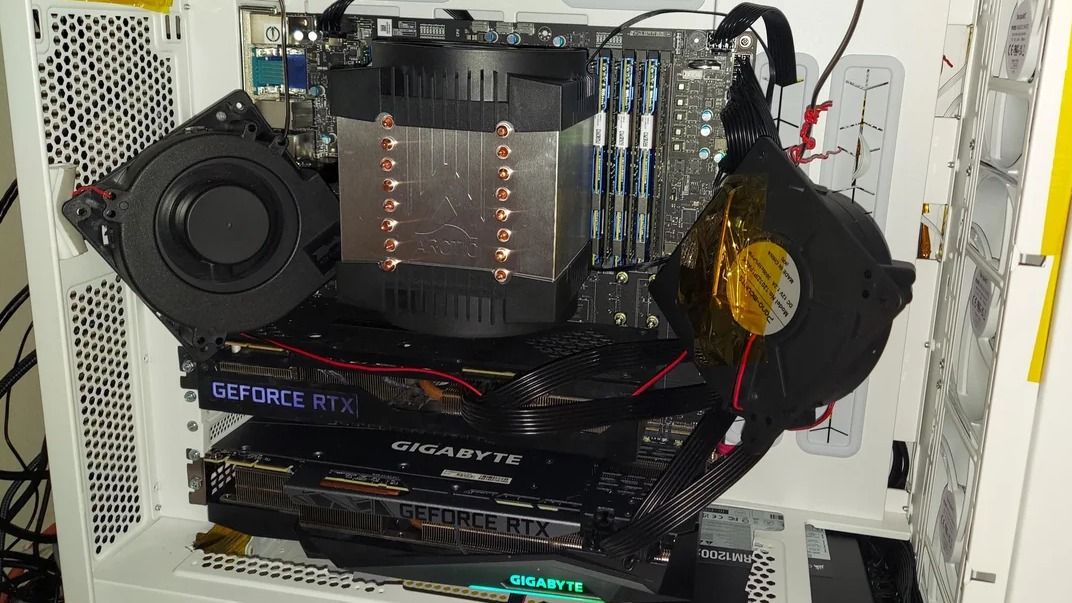
Homelabber Hits 3.11 Tokens/s on 2.8T Kimi K3 With Dual RTX 3090s, Optane, and RAM Drive
A homelabber has pushed a 2.8-trillion-parameter Moonshot Kimi K3 model to 3.11 tokens per second on consumer hardware, Tom’s Hardware reported this week, detailing a follow-up Reddit post that added dual RTX 3090s and a tmpfs RAM drive to a second-gen Intel Optane PMem 200 server.
The Tech TL;DR:
- Dual RTX 3090s (48 GB VRAM) handle attention, KV cache, and shared experts; routed experts stay on CPU-side memory.
- Moving 414 GB of model shards from Optane to a DRAM-backed tmpfs drive lifted generation 41% and prompt eval 26%.
- Thermal load remains the hard constraint: Optane DIMMs still require dedicated 12 W blower fans alongside dual 350 W GPUs.
The build centers on a Mixture-of-Experts architecture where only 104 billion of the 2.8 trillion parameters activate per token. With the Q2_K quantization shrinking the model to 865 GB, the two RTX 3090s hold roughly 5.5% of the weights—enough for the dense feed-forward layer, attention computation, shared experts, and the KV cache. The remaining 896 routed experts, 16 selected per token, reside on the CPU side, originally entirely on Optane persistent memory.
Shifting 45 of 94 shards (414 GB) into a Linux tmpfs RAM drive cut the memory-bus bottleneck. Generation rose from 2.20 to 3.11 tokens per second; prompt evaluation climbed from 13.3 to 16.8 tokens per second. “The improved throughput [does not change] the original thermal warning,” the builder wrote on Reddit, confirming the Optane cooling fans stay mandatory even with the GPU upgrade.
DRAM bandwidth still trails VRAM by an order of magnitude, but it dwarfs Optane’s 2–3 GB/s sequential reads. The tmpfs mount presents the shards as a memory-resident filesystem, eliminating the Optane controller latency for nearly half the routed-expert tensors. Because the MoE router selects experts dynamically, the speedup applies only when the active subset lands in the RAM-drive portion—a probabilistic gain that manifests as the measured 41% generation lift.

TechNewsReel noted the builder’s prediction from the original thread landed “somewhere between 2 and 4 tokens per second,” placing the 3.11 result squarely in the expected envelope. The same outlet said that the 48 GB of VRAM handles the KV cache and context window, while the GPUs hold only about 5.5% of the 865 GB model.
Installing the dual 3090s required cutting the chassis and relocating the PSU, a reminder that consumer cases rarely accommodate dual-slot 350 W cards plus Optane DIMM coolers. The builder retained two 12 W blower fans aimed at the PMem 200 modules; without them, Optane throttles above 85 °C within minutes of sustained inference load.
Crayon’s aggregation of the Tom’s Hardware coverage highlighted the thermal warning and noted the build uses two RTX 3090 graphics cards and a RAM drive. According to the outlet, the builder says the Optane modules still need their own fans.”
The builder flagged “customized quantization”—per-tensor or per-layer schemes similar to techniques published by Nick Mermiges—as the next optimization lever. Selective quantization could compress the routed-expert shards that remain on Optane, reducing the bandwidth demand on the slowest tier without collapsing output quality. No timeline or benchmark for that work has been published.

Running a 2.8 T parameter MoE at interactive speeds on hardware costing a fraction of an H100 node demonstrates that memory-tiering—VRAM → DRAM → persistent memory—can substitute for raw accelerator capacity when activation sparsity is high.
The next milestone—custom quantization tuned to the memory map—remains unscheduled.
Always consult with certified IT and cybersecurity professionals before altering enterprise networks or handling sensitive data.