Holy Shit, That’s Tehran!”: B-2 Pilot Recounts Fordow Strike in New Report
“Holy shit, that’s Tehran!” a B-2 pilot said as the city’s lights appeared after 18 hours of flight, moments before the first two 30,000-pound bombs fell on the Fordow enrichment complex in June 2025.
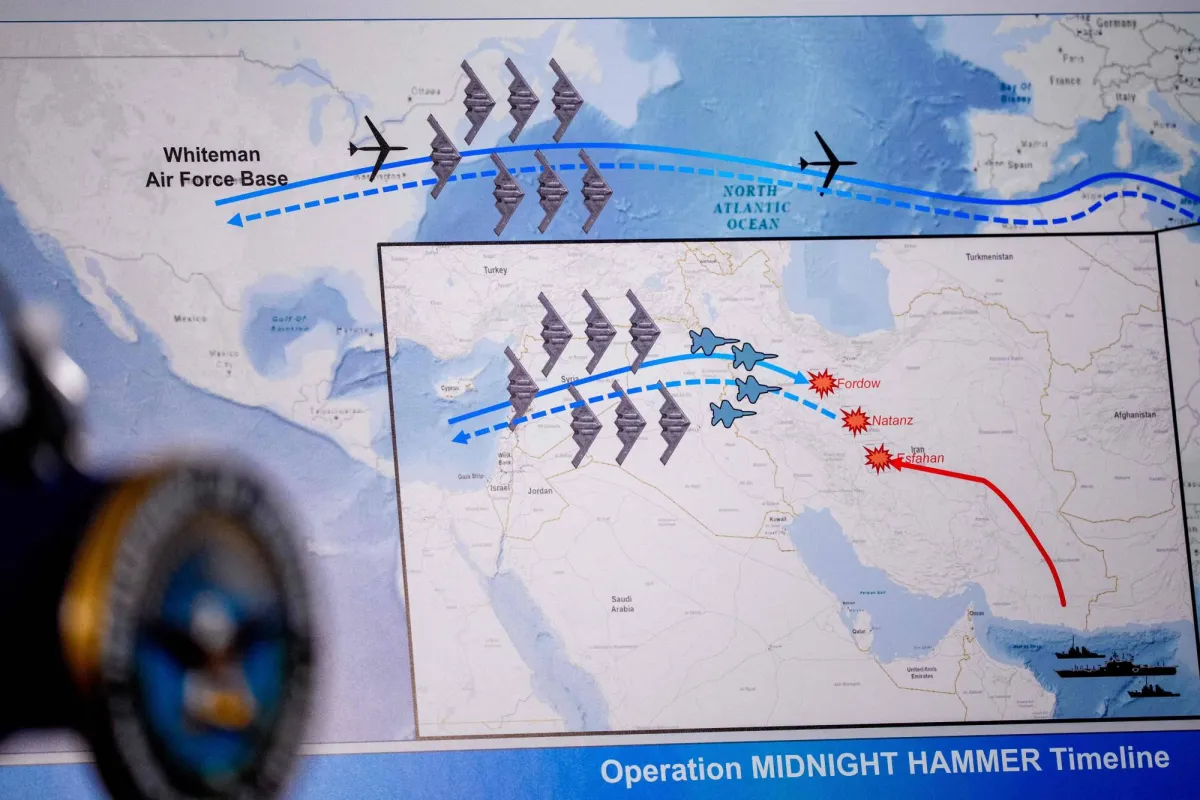
The quote opens an investigation published this week by Air & Space Forces Magazine, which interviewed crew members of the seven B-2 Spirits that flew the 37-hour round-trip mission codenamed Operation Midnight Hammer. The bombers dropped 14 GBU-57 Massive Ordnance Penetrators on Fordow and Natanz while submarines launched Tomahawks at Isfahan, supported by roughly 125 aircraft including F-22s, F-35s and tankers, Asharq Al-Awsat reported.
Concrete over ventilation shafts forced a last-minute rewrite
Days before takeoff, intelligence showed Iran had poured concrete over Fordow’s ventilation shafts — the very apertures the original plan relied on to deliver bombs deep inside the mountain, according to Chairman of the Joint Chiefs Gen. Dan Caine.
The lead bomber would now have to blow the concrete caps off first; the following five would strike the exposed shafts in a 15-second cadence, Euronews reported. Final approval came only 16 hours before launch, and the plan changed again while crews were trying to sleep.
Fifteen years of targeting a mountain
Planning began in 2009 after analysts spotted unusual construction in the mountains southwest of Tehran. The GBU-57, carried only by the B-2, evolved through years of testing. The Pentagon revived the option in August 2024 when the IAEA reported Iran had enriched uranium to 60 percent. In spring 2025, with talks stalled, a planning cell of 50 to 60 specialists produced the executable package in a week, the magazine said, according to Aawsat.

Israeli strikes cleared the air
Crews credited Israeli F-35 and F-15 strikes that began June 13 under Operation Rising Lion with degrading Iranian air defenses, making the B-2 penetration “safer for us,” the mission commander, callsign Alpha, told the magazine. Six B-2s hit Fordow starting at 02:10 local time; the seventh, flown manually at high altitude, struck Natanz.
Endurance at the edge of physiology
Each bomber carried two pilots who rotated 30- to 45-minute naps between refuelings, supplemented by prescribed stimulants and energy drinks, according to Euronews. Radio silence held until a single check-in with the combined air operations center over Europe drew cheers from watch officers. Post-mission analysis concluded Iranian air defenses never fired at the bombers.

“The Iranian centrifuge program as it existed before the strike is no longer standing; what remains is largely scattered components.”
David Albright, former UN weapons inspector and president of the Institute for Science and International Security, told the magazine.
Deception and the long way home
To mask the real vector, decoy B-2s launched visibly westward toward Guam or Diego Garcia while the strike package slipped east across the Atlantic and Mediterranean. Families were not told; Alpha said he simply “went to work and didn’t come back.”
President Trump announced the strikes while the bombers were still inbound to Missouri; crews learned the operation’s name only after landing at Whiteman, where they were met by families and debriefed in a secure facility.
The mission showed the distinct strategic advantage of the 20-airframe B-2 fleet — each jet a hand-built, non-interchangeable asset — and the logistical coordination required to project penetrating power halfway around the world.
The Fordow enrichment complex, built under the Al Ghadir project name northeast of Qom, was originally a covert site intended for weapon-grade uranium production.
Iran disclosed its conversion to a nuclear facility in a September 21, 2009 letter to the IAEA after learning Western intelligence already knew of it. It is the only Iranian site where inspectors have found particles of uranium purified to near weapons-grade purity, detected during an unannounced inspection in 2023.
“We’re done, we’re safe,” Alpha radioed on the exit leg — the second transmission the flight had made since takeoff.