HKU Chemists Find Barrier Blocking Nucleic Acid Medicines Inside Cells
Researchers have discovered that damaged endolysosomes form dense protein condensates that trap nucleic acid medicines inside cells, a finding that could redirect drug delivery strategies, according to a study published in Nature Cell Biology.
The University of Hong Kong (HKU) Department of Chemistry led the work with collaborators from Ionis Pharmaceuticals, the University of California, Los Angeles, and the Francis Crick Institute. Scientists have long viewed the interior of endolysosomes — membrane-bound sacs that process cellular material — as a liquid-filled space. The assumption was that once the surrounding membrane was breached, contents would leak into the cytosol, the fluid surrounding organelles. The HKU team found instead that selected proteins rapidly assemble into solid-like condensates inside damaged endolysosomes, creating a second barrier that holds proteins and therapeutic molecules in place even after the membrane becomes permeable.
“Our study shows that a damaged endolysosome is not simply an open container,” said Professor Haibo Jiang, corresponding author from the HKU Department of Chemistry. “Its changing internal environment can reorganise its contents and hold on to therapeutic molecules. Understanding this hidden barrier may help us design more effective nucleic acid medicines.”
The discovery bears directly on antisense oligonucleotides (ASOs), short modified strands designed to bind specific RNA and alter protein production. ASOs must reach the cytosol or nucleus to function, but most remain trapped in endolysosomes after cellular uptake.
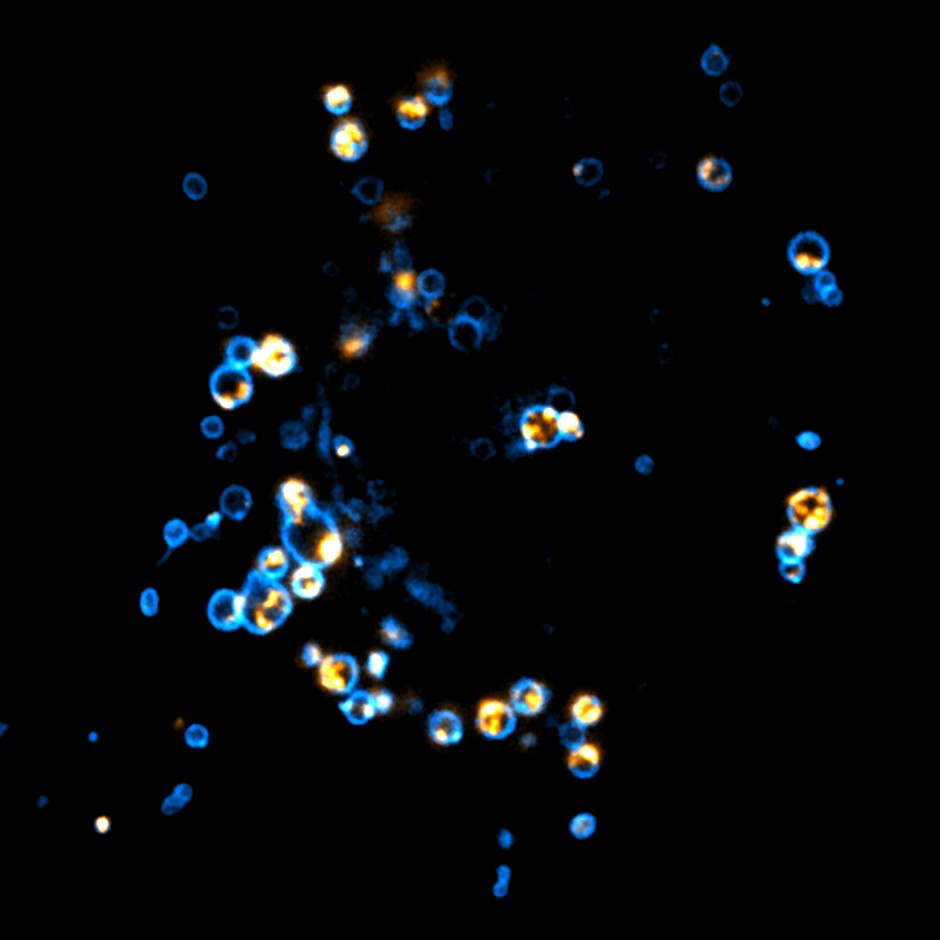
The researchers damaged endolysosomes using chemical permeabilisation, osmotic stress and silica crystals, then tracked fluorescent tracers and natural cargoes with super-resolution live-cell imaging, electron microscopy and cryo-electron tomography. They observed that luminal materials gathered into bright foci and formed insoluble protein assemblies across different damage types and cell lines. Making endolysosomal membranes more permeable increased ASO activity, yet super-resolution microscopy showed most ASO signal stayed inside the organelles. Advanced imaging confirmed the ASOs were effectively immobilised, supporting the conclusion that condensates anchor them. Xu Li, a PhD student in the HKU Department of Chemistry, is the first author of the paper, “Endolysosomal damage promotes intraluminal protein condensate formation that limits cytosolic leakage.”
Corresponding authors also include Professor Tao Ni from the HKU School of Biomedical Sciences and Dr Maximiliano G. Gutierrez from the Francis Crick Institute.
The Hong Kong Research Grants Council General Research Fund, the National Natural Science Foundation of China, the Laboratory for Synthetic Chemistry and Chemical Biology under the Health@InnoHK programme, and the Francis Crick Institute provided the funding. The work took place at the JC STEM Lab of Molecular Imaging, which receives support from The Hong Kong Jockey Club Charities Trust.