
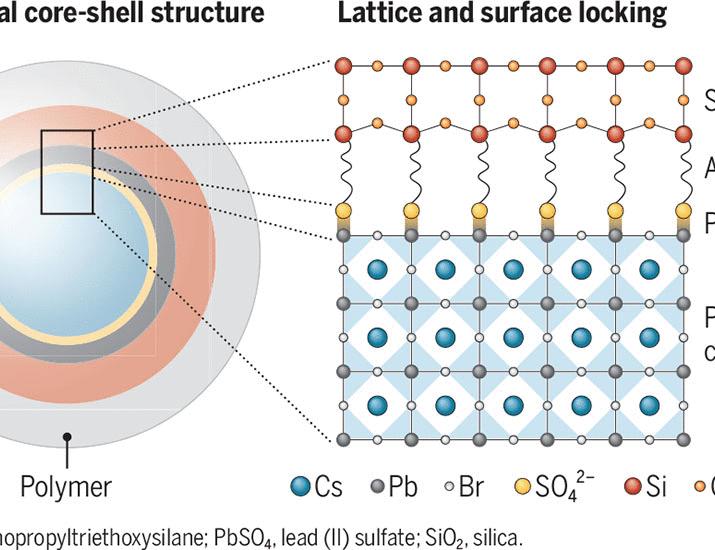
Hierarchical Shells: A Breakthrough in Perovskite Display Technology
Metal halide perovskites have emerged as promising materials for next-generation display technologies, offering the potential for vibrant colors, high efficiency, and low-cost manufacturing. However, a important hurdle has been their inherent instability – these materials are susceptible to degradation when exposed to moisture, oxygen, and even light. Now, a new approach utilizing hierarchical shells is demonstrating remarkable success in stabilizing perovskite surfaces, paving the way for more durable and commercially viable perovskite-based screens. This article delves into the science behind this innovation, its implications for the future of displays, and the challenges that remain.
The Perovskite Promise and its Achilles’ Heel
Perovskites are a class of materials with a specific crystal structure that exhibits extraordinary optoelectronic properties. They excel at absorbing and emitting light, making them ideal candidates for applications like solar cells and light-emitting diodes (LEDs), which are the core components of modern displays. Compared to traditional materials like silicon,perovskites can be manufactured using simpler,less energy-intensive processes,perhaps leading to substantially lower production costs. Nature published a comprehensive review detailing the potential of perovskites in these areas.
Though,perovskites are notoriously sensitive to environmental factors. Their surfaces are “soft and labile,” meaning they are easily altered or broken down by external influences.This instability leads to a rapid decline in performance and a short lifespan, hindering their widespread adoption. Moisture,in particular,is a major enemy,causing the perovskite structure to decompose. This degradation manifests as a loss of brightness, color distortion, and ultimately, complete failure of the display.
Introducing Hierarchical Shells: A Multi-Layered Defense
Researchers have been exploring various strategies to address perovskite instability, including compositional engineering and encapsulation. The latest breakthrough,detailed in a study published in Science,focuses on creating protective “hierarchical shells” around the perovskite crystals. This isn’t a single coating, but rather a carefully designed multi-layered structure.
- Inner Layer: A tightly bound layer of organic molecules that directly interacts with the perovskite surface, passivating defects and preventing the initial stages of degradation.
- Intermediate Layer: A dense,inorganic layer that acts as a barrier against moisture and oxygen. This layer is often composed of materials like aluminum oxide or titanium dioxide.
- Outer Layer: A porous, protective layer that provides mechanical support and further enhances the barrier properties. This layer can be tailored to optimize light extraction and minimize reflection.
The “hierarchical” aspect is crucial. Each layer plays a distinct role, working synergistically to provide comprehensive protection. The inner layer addresses the chemical instability, while the outer layers provide physical shielding. This multi-pronged approach is far more effective than relying on a single protective coating.
How Hierarchical Shells Enhance Stability
The effectiveness of hierarchical shells stems from several key mechanisms:
- Passivation of Surface Defects: perovskite surfaces are riddled with defects – imperfections in the crystal structure that act as initiation points for degradation. The inner organic layer effectively “passivates” these defects,neutralizing their reactivity.
- Moisture and Oxygen Barrier: The inorganic intermediate layer is impermeable to water and oxygen, preventing these elements from reaching the sensitive perovskite material.
- Mechanical Protection: The outer porous layer provides a physical buffer, protecting the perovskite from mechanical stress and abrasion.
- Improved Light Extraction: Carefully designed outer layers can enhance the extraction of light from the perovskite, boosting display brightness and efficiency.
Studies have shown that perovskite devices protected with hierarchical shells exhibit significantly improved stability,maintaining over 90% of their initial performance after hundreds of hours of continuous operation under harsh conditions. This represents a significant advancement over unprotected perovskite devices, which typically degrade within minutes or hours.
Implications for Display Technology
The progress of stable perovskite displays has far-reaching implications for the future of screen technology. Here’s how:
- Brighter and More Vibrant Colors: Perovskites can be tuned to emit a wider range of colors than traditional display materials, resulting in more vivid and realistic images.
- Higher Efficiency: Perovskite displays can potentially achieve higher energy efficiency, leading to longer battery life in mobile devices and reduced power consumption in televisions.
- Lower Manufacturing Costs: The simpler manufacturing processes associated with perovskites could significantly reduce the cost of displays,making them more accessible to consumers.
- Flexible and Clear Displays: Perovskites can be deposited on flexible substrates, enabling the creation of bendable and rollable displays. They can also be made partially transparent, opening up new possibilities for augmented reality and heads-up displays.
These advancements could revolutionize various applications, from smartphones and televisions to virtual reality headsets and automotive displays.
Challenges and Future Directions
Despite the significant progress, several challenges remain before perovskite displays become mainstream:
- Lead Toxicity: Many high-performing perovskites contain lead, a toxic heavy metal. Researchers are actively exploring lead-free perovskite alternatives, but these materials currently lag behind in performance.
- Long-Term Stability: While hierarchical shells have dramatically improved stability, further research is needed to ensure that perovskite displays can maintain their performance for years, not just hours.
- Scalability: Scaling up the manufacturing process to produce large-area perovskite displays remains a challenge.
- Cost Optimization: While potentially cheaper than existing technologies, the cost of materials and manufacturing processes needs to be further optimized to make perovskite displays truly competitive.
Future research will focus on addressing these challenges, exploring new materials, refining the hierarchical shell design, and developing scalable manufacturing techniques. The integration of artificial intelligence and machine learning could also play a role in optimizing perovskite composition and processing parameters.
Key Takeaways
- Metal halide perovskites are promising materials for next-generation displays due to their excellent optoelectronic properties.
- Their instability is a major obstacle to commercialization.
- Hierarchical shells – multi-layered protective coatings – significantly enhance perovskite stability.
- This technology has the potential to revolutionize display technology,enabling brighter,more efficient,and lower-cost screens.
- Ongoing research is focused on addressing challenges related to lead toxicity, long-term stability, and scalability.
The development of hierarchical shells represents a major step forward in the quest for stable and commercially viable perovskite displays. While challenges remain, the potential benefits are enormous, and continued innovation in this field promises to reshape the future of screen technology.
