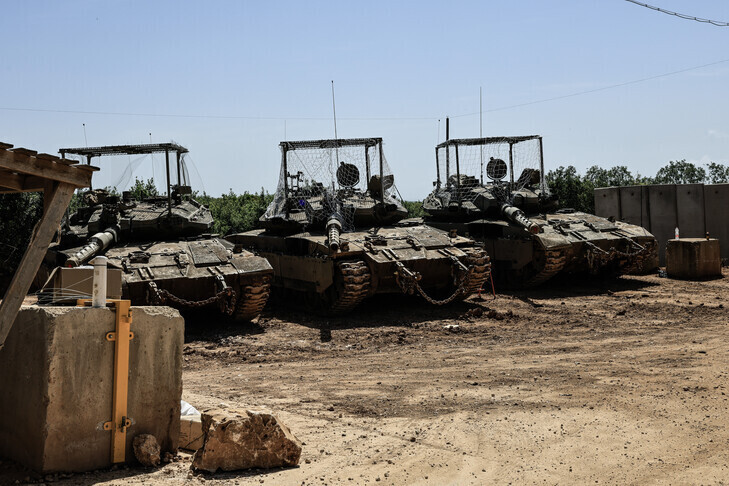
Hezbollah Claims Strike on 6 Israeli Merkava Tanks in Southern Lebanon
Hezbollah claimed responsibility Friday evening for targeting six Israeli Merkava tanks in southern Lebanon, escalating tensions in a region already teetering on the edge of renewed conflict. The strike, confirmed by the group’s military wing, occurred near the contested Blue Line border, raising immediate concerns over a potential Israeli retaliation that could destabilize Lebanon’s fragile economy and infrastructure. The event underscores the persistent failure of diplomatic efforts to contain the proxy war dynamics between Iran-backed militias and Israel.
Why This Strike Matters Now
The attack is not an isolated incident but the latest in a pattern of escalation that began with Israel’s April 2024 airstrikes on Hezbollah positions in Syria and Lebanon. Since then, the group has systematically targeted Israeli military assets along the border, forcing Tel Aviv to deploy additional troops and air defense systems. The Merkava tanks—Israel’s most advanced armored vehicles—were struck with precision-guided missiles, a capability Hezbollah has honed through years of support from Iran’s Revolutionary Guard Corps (IRGC).
This is not just a military confrontation. It’s an economic time bomb for Lebanon. The country’s already crippled infrastructure—struggling with power outages, water shortages, and a currency that has lost over 99% of its value since 2019—cannot withstand another round of Israeli airstrikes or Hezbollah counterattacks. The UN estimates that Lebanon’s reconstruction needs exceed $30 billion, but donor fatigue and corruption have stalled progress. Now, the risk of a full-scale war could push the country into a humanitarian crisis, with spillover effects on neighboring Syria and Jordan.
The Human Cost: Civilians in the Crossfire
“Every time Hezbollah and Israel exchange fire, it’s the Lebanese people who pay the price. Hospitals are overwhelmed, schools are closed, and families are fleeing their homes. This isn’t a conflict—it’s a slow-motion disaster.”
In the border towns of Tyre and Nabatieh, where Hezbollah’s operations are concentrated, residents report hearing explosions every few days. The Lebanese Red Cross has already treated dozens of civilians for shock and injury since May 1, with many seeking refuge in southern Beirut or the Bekaa Valley. The UN’s Office for the Coordination of Humanitarian Affairs (OCHA) warns that if hostilities expand, Lebanon could see a mass displacement crisis, with up to 500,000 people displaced within weeks.
Meanwhile, Israel’s military has ordered the evacuation of communities near the border, including the kibbutz of Moshav and the city of Metulla. The IDF has deployed the Iron Dome air defense system to counter potential Hezbollah rocket barrages, but the psychological toll on Israeli civilians is already mounting. Schools in northern Israel have suspended classes, and businesses in the Golan Heights are shuttering operations.
The Legal and Diplomatic Fallout
The strike raises critical legal questions under international law. Hezbollah’s use of precision-guided munitions against armored vehicles could be interpreted as a violation of the Geneva Conventions, particularly if civilian infrastructure is damaged in the process. Israel, meanwhile, faces scrutiny over its proportionality in responding—any large-scale operation risks triggering Article 51 of the UN Charter, which allows for collective self-defense by Lebanon’s allies, including Iran.

Diplomatically, the U.S. And EU have condemned the attack but stopped short of direct intervention. The Biden administration, which has already imposed sanctions on Hezbollah’s financial networks, is reportedly pressuring Saudi Arabia and Qatar to rein in Iranian influence in the region. However, with Iran’s presidential election looming in June, hardliners like President Ebrahim Raisi may use the Lebanon-Israel conflict to rally domestic support, making de-escalation even more challenging.
“The international community must act now before this spirals into a regional war. Sanctions alone won’t stop the fighting—what’s needed is a credible threat of military intervention if either side crosses the threshold into large-scale attacks.”
Economic Ripples: Who Loses When the Bombs Fall?
| Sector | Immediate Impact | Long-Term Risk |
|---|---|---|
| Lebanese Banking | Capital flight accelerates as depositors withdraw dollars to hedge against further devaluation. | Collapse of the banking system, triggering a sovereign default. |
| Israeli Tourism | Northern Israel’s tourism industry—worth $1.2 billion annually—grinds to a halt. | Permanent decline in visitor numbers, with Tel Aviv and Eilat struggling to compensate. |
| Syrian Refugees | Lebanese authorities begin forced returns of Syrian refugees to avoid being drawn into the conflict. | Humanitarian catastrophe in Syria, with UNHCR estimating 1.5 million refugees at risk. |
| Global Oil Markets | Disruptions in the Strait of Hormuz as Iran-backed forces test Western resolve. | Oil prices surge past $100 per barrel, triggering inflation globally. |
The Directory Bridge: Solutions for a Region on the Brink
When conflicts escalate, the first casualties are often infrastructure, legal clarity, and humanitarian aid. Here’s how professionals in our directory are already preparing to mitigate the damage:
For Lebanese civilians facing displacement: The UN estimates that 300,000 people could be displaced in the coming weeks. Families in southern Lebanon are already turning to vetted relocation and temporary housing providers to secure safe passage out of high-risk zones. Organizations like the International Rescue Committee (IRC) are setting up emergency shelters in Beirut and Baalbek, but the demand is outpacing capacity.

For Israeli businesses exposed to liability risks: Any Israeli military response could trigger lawsuits under international humanitarian law. Companies operating in the Golan Heights or northern Israel are consulting conflict-zone liability attorneys to assess risks to supply chains and assets. Firms specializing in “war risk insurance” are seeing a surge in inquiries from manufacturers and logistics firms.
For Lebanese municipalities facing infrastructure collapse: The Lebanese government’s inability to fund repairs means local councils are turning to emergency construction and utility restoration firms to patch critical water and power systems. In Tyre, where Hezbollah’s operations are concentrated, the municipality has already contracted private contractors to reinforce bridges and roads—work that would normally take months but is now being rushed to completion.
The Kicker: A Region at the Precipice
This is not the first time Hezbollah and Israel have danced on the edge of war. But the stakes are higher now. Lebanon’s economy is in freefall, Israel’s government is fractured, and Iran’s regional ambitions are more aggressive than ever. The question is no longer *if* a larger conflict will erupt, but *when*—and who will be left to clean up the pieces.
For those navigating this uncertainty, the World Today News Directory is your first line of defense. Whether you’re a displaced family, a business owner, or a municipal leader, the professionals listed here are already preparing for the fallout. The time to act is now.
- UND Professor Jesse Rhoades Discusses His Academic Path to NASA
- 400 Pounds of Food Donated by Navy Region Hawaii to Local Food Bank
- Béres Anett Claims Farm VIP Contestants Conspired Against Her After Watching the Show (newsdirectory3.com)
- Iran Summons British Ambassador Over Airbase Claims (newsy-today.com)