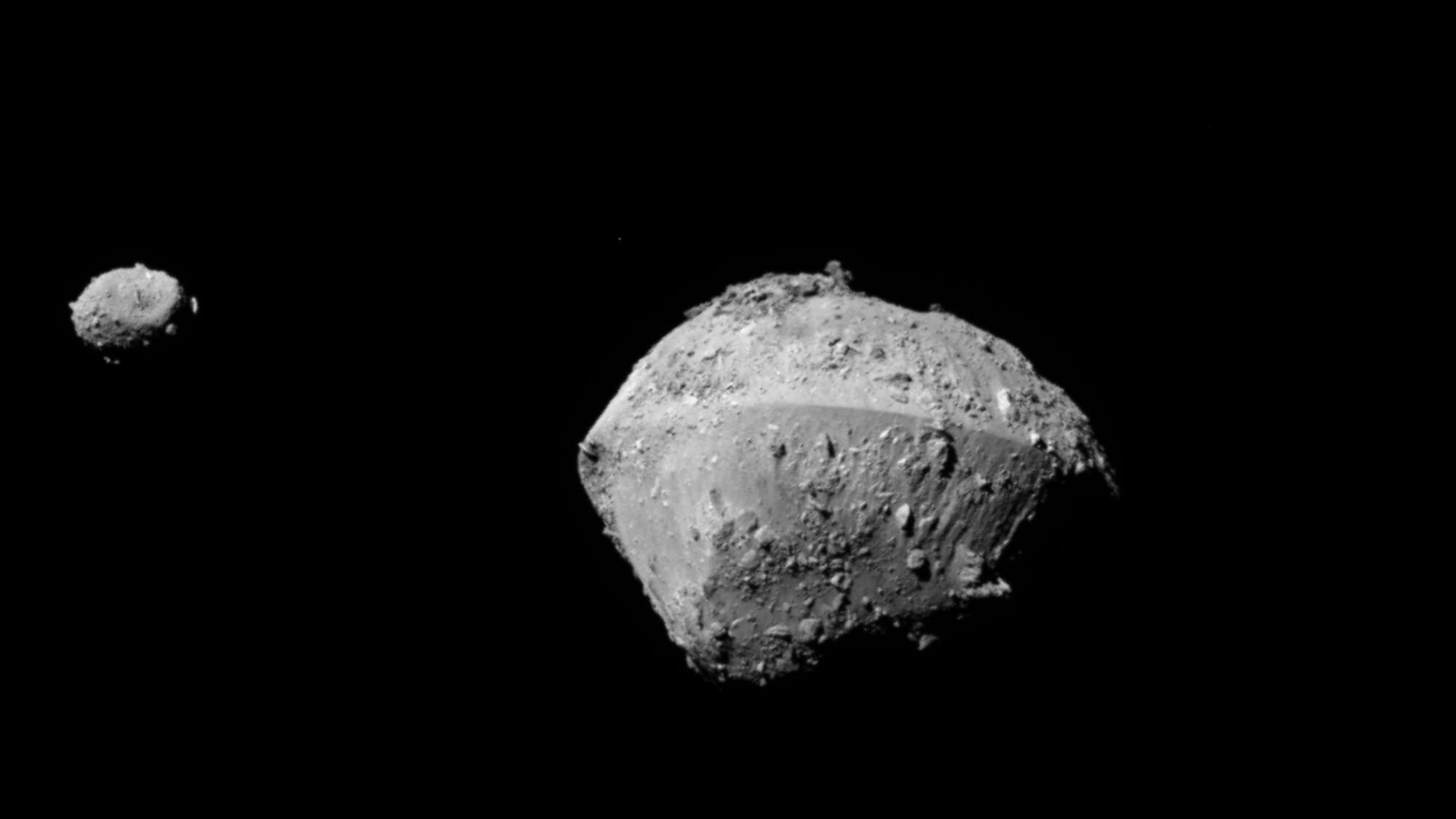
Hera Reveals Stadium-Sized Crater, Wild Tumble on Dimorphos, ESA Says
Dimorphos bears a stadium-sized crater carved across its entire width after a deliberate spacecraft collision, according to data released on Wednesday by the European Space Agency.
Hera Spacecraft Inspects Impact Site
NASA’s DART mission initially made history on Sept. 26, 2022, when it slammed directly into Dimorphos, the smaller moonlet of the binary asteroid Didymos (Didymos and its smaller moonlet, Dimorphos).
That intentional crash shortened the time the moonlet takes to orbit its larger companion by roughly 33 minutes (by roughly 33 minutes), exceeding initial mission expectations. To investigate the aftermath close up, the European Space Agency launched the Hera spacecraft in October 2024 to travel 120 million miles to the binary system, Space reported.
Two years of travelling. One pair of asteroids. A lot of very excited scientists. Hera's team are live now, talking through the first images. Don't leave early. There may be a surprise 👀 pic.twitter.com/782A7NXdUv
The newly arrived spacecraft revealed that the impact flattened one face of the 151-meter-wide moonlet and set it tumbling wildly in its orbit. “Scientists debated whether Dimorphos had sustained an impact crater, changed its shape, or stayed the same,” Patrick Michel, principal investigator of the Hera mission and Director of Research at the Observatoire de la Côte d’Azur, said in a statement.
“Much to our surprise, the answer turns out to be all three at once! The face struck by DART has been flattened into an impact crater the size of a sports stadium, which extends across the asteroid’s entire width.”
“Hera is a sort of Inspector Columbo going back to the crash scene to investigate what is the outcome of this impact,” said Patrick Michel, principal investigator of ESA’s Hera mission. “Seeing this image is a hugely exciting moment for the whole Hera family,” says Hera mission manager Ian Carnelli.
Beyond the massive scar on Dimorphos, the probe found hundreds of previously unknown boulders, ranging from tens of centimetres to a few metres in size, orbiting the binary pair. Scientists remain uncertain whether these flying rocks originated from the 2022 impact or were already present around Didymos. Meanwhile, the unimpacted regions of Dimorphos retain boulder fields that look identical to the terrain captured by DART before the crash.
BIG NEWS! We have a whole new look at Dimorphos, the first asteroid humans have ever moved 👀☄️ @ESA_Hera mission has captured Dimorphos completing a full orbit around its larger companion, Didymos. Look closely and you will see the impact site come into view, and Dimorphos… pic.twitter.com/jWsuwz3H98
The Aftermath of Impact
The Hera mission’s findings were presented on November 25, 2026, at the Museum für Naturkunde in Berlin. “As Hera returned more images, it became clear that the DART impact has left Dimorphos tumbling wildly in its orbit,” ESA's Hera mission scientist Michael Küppers said.
While scientists previously debated whether the moonlet had sustained a crater or altered its shape, Hera’s data confirmed that the impact achieved both effects simultaneously.
Hera principal investigator Patrick Michel described the discovery as surprising, noting that the impact flattened one side of the moonlet into a crater spanning its entire width.
Despite this massive structural scar, the mission observed that other regions of the moonlet remained largely unperturbed, appearing identical to terrain captured during the 2022 DART encounter. This contrast between the heavily damaged face and the undisturbed surface has left researchers intrigued about the asteroid’s internal composition.

Expanding Knowledge for Planetary Defense
Beyond the primary impact site, Hera identified hundreds of previously unknown boulders ranging from a few meters in size circling the binary system. Scientists are currently working to characterize these objects to determine if they originated from the DART collision or if they were already present around the parent asteroid, Didymos.
The 780-meter-wide Didymos rotates every 2.2 hours, and Hera is utilizing a Thermal Infrared Imager provided by JAXA to map the temperature of both bodies and assess their surface density.
The mission serves as a critical validation of humanity’s ability to deflect threatening space rocks, a capability that mission lead Ian Carnelli highlighted as a major advancement for the species compared to the prehistoric era.
By combining data on the moonlet’s mass, its orbital change, and its physical reaction to the 2022 impact, the team aims to refine future deflection strategies. To gather more granular data, Hera will soon move to a closer range of approximately 8 miles to deploy two CubeSats, which will perform the first-ever interior radar probing of an asteroid.
Before the DART impact on Sept. 26, 2022, Dimorphos was a 177-meter-wide oblate spheroid covered in boulders and virtually lacking craters. The collision at 24,000 kilometers per hour shortened its orbital period around Didymos by 33 minutes and ejected over 1 million kilograms of debris, creating a 10,000-kilometer dust tail.
Hera’s 2026 findings revealed the impact flattened the struck face into a stadium-sized crater spanning the moonlet’s entire width, deformed its shape globally, and set it tumbling chaotically, while unimpacted regions retained their original boulder fields.
Hera Moves Closer for Sharper Asteroid Imagery
Hera currently maintains a rectangular orbit roughly 18.6 miles away from the asteroid system using its thrusters. The probe will soon move closer to within about 8 miles of the rocks to capture sharper imagery, supported by camera systems and a Thermal Infrared Imager supplied by Japan’s Aerospace Exploration Agency, Universe Today reported.
Following those maneuvers, the spacecraft will release two CubeSats named Juventas and Milani. Juventas will deploy low-frequency radar to probe the interior of Dimorphos and later attempt a landing to measure its surface gravity. “Hera is helping us understand the consequences of deliberately striking an asteroid,” says Holger Krag, head of ESA’s Space Safety programme.
More on Hera
In September 2022, @NASA's DART spacecraft crashed into Dimorphos and shortened its orbit around its bigger companion, Didymos, by about 33 minutes. Telescopes on Earth saw the orbit change. What the impact actually did to the asteroid itself is still unknown. Hera has travelled… pic.twitter.com/kwKCVzlnSG
For the first time, the world can see Dimorphos up close. ☄️ @ESA_Hera spacecraft has returned its first detailed images of the asteroid @NASA's DART mission struck in 2022. Congratulations to the ESA team on a milestone for planetary defense! Redwire's team in Belgium built… pic.twitter.com/S6aiJbZwCx
ESA's Hera mission for planetary defence has begun surveying its target asteroids from 30-25 km away, flying in 'rectangular orbits' around the ultra-low-gravity Didymos and Dimorphos bodies 🛰️🪨🪨https://t.co/QqO5dXSbmM pic.twitter.com/cuZC9aCtF4
- Ledvance Launches Direct Easy 1.5.0 With Zone Sharing for Installers
- New Adaptive Silicon Neuron Mimics Biological Neuromodulation for Energy-Efficient Computing
- ESA’s Hera Images Show Dimorphos Cratered and Tumbling After DART Impact (archyde.com)
- ESA Hera Reveals DART Impact Cratered, Destabilized Dimorphos (newsy-today.com)