Harvard Team Develops UV Light Chip Generating 120x More Power
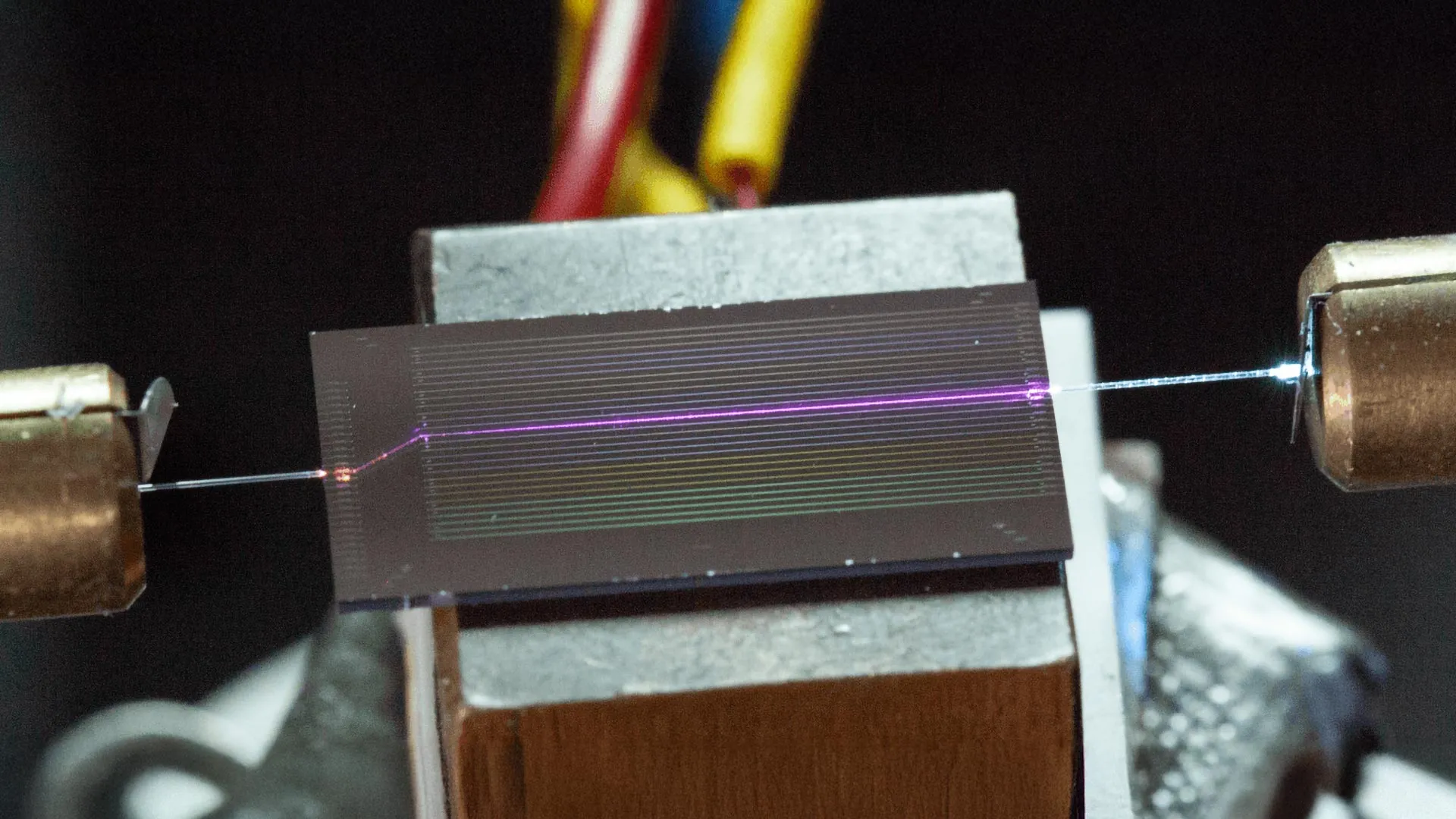
A Harvard-led team has developed a microscopic UV light chip that generates 120 times more power than previous comparable devices.
- Device produces 4.2 milliwatts of ultraviolet power on a chip
- Breakthrough uses thin-film lithium niobate material
- Technique called “sidewall poling” overcomes engineering barrier
The significant increase in power could enable smaller quantum computers and other advanced technologies. Ultraviolet light rapidly loses power as it travels through optical waveguides, a challenge this new device overcomes.
The device generates UV light from red light using a process called frequency upconversion. Two photons of red light combine to produce a single ultraviolet photon with higher energy inside a lithium niobate crystal.
“When people think about [thin-film lithium niobate], they don’t think of it as a UV material, but we show that it is,” said co-first author Kees Franken, former research fellow in the Lončar lab.
The key engineering breakthrough was a fabrication technique called “sidewall poling.” Instead of positioning electrodes exclusively above the lithium niobate film, the researchers placed precisely patterned metal structures directly alongside the etched waveguide.
“The key idea was: could we just put the electrodes directly on the waveguide?” said co-first author and former graduate student Soumya Ghosh. “It’s a high-precision fabrication process to position the electrodes but requiring about 50-nanometer accuracy.”
This arrangement enabled the researchers to reverse the crystal domains throughout the entire cross section of the waveguide, allowing for much more efficient light conversion.
The milliwatt-level UV power is particularly valuable for trapped-ion quantum computers, which use electrically charged atoms to store and process quantum information.
“If you want a scalable quantum computer that isn’t the size of a truck, you need to scale everything down to the chip level, and this includes the light sources,” Franken said.
The technology could also benefit ultra-precise atomic clocks and environmental monitoring systems for greenhouse gases, according to the researchers. The research was published in Nature Communications and supported by funding from the U.S. Department of the Air Force, Office of Naval Research, NASA, and the National Science Foundation.
Worth a look
- Samsung Brings Six Galaxy Watch 9 Health and Fitness Features to Galaxy Watch 8 and Older Models
- Smartphone Updates Affect Mahjong Ways Performance Not Game RNG
- Depend 30s Buyers Up 7 Percent as Light Incontinence Care Grows (newsdirectory3.com)
- Thanksgiving Nor’easter Knocks Out Power to Nearly 1 Million Customers, Grounds Hundreds of Flights Across Eastern US (archyde.com)